Blopai
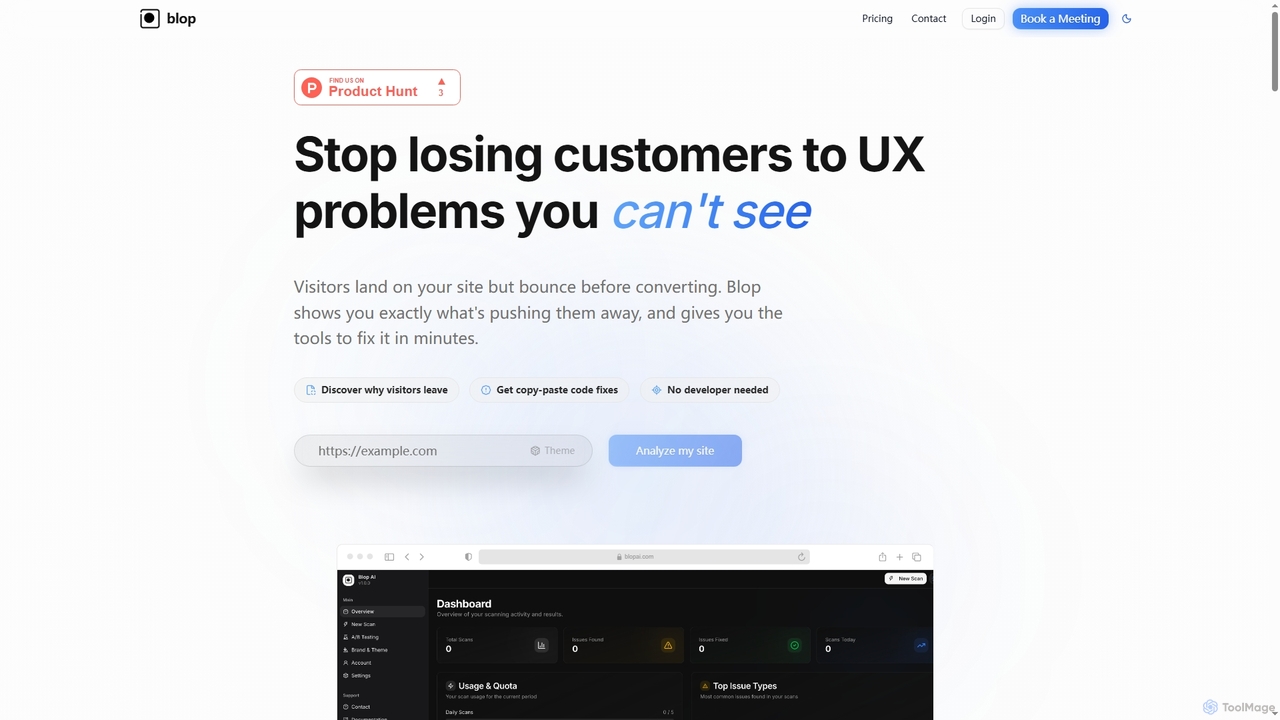
Blopai is an AI-powered UX analysis tool that identifies website usability issues, accessibility problems, and design flaws. It …
Blopai is an AI-powered UX analysis tool that identifies website usability issues, accessibility problems, and design flaws. It provides automated, code-ready fixes and actionable insights to improve conversion rates and user experience in minutes.

Flawless
Flawless is an AI-powered tool that provides instant UX audits for your landing pages. By analyzing a screenshot …
Flawless is an AI-powered tool that provides instant UX audits for your landing pages. By analyzing a screenshot with GPT-4 Vision, it delivers actionable suggestions to improve usability, conversion rates, and messaging. Ideal for marketers, designers, and entrepreneurs, it offers expert-level feedback in under 90 seconds, helping you optimize your site's performance quickly and affordably.
About Website Optimization
AI Website Optimization tools are a specialized category of productivity software that use machine learning to analyze and improve a website's performance. These platforms go beyond simple analytics by automatically identifying user behavior patterns, testing content variations, and providing data-driven recommendations to increase engagement and conversions. They empower marketers and developers to make smarter decisions, enhance user experience (UX), and achieve better business outcomes without extensive manual analysis. This proactive approach helps streamline the entire optimization workflow.
Core Features
- AI-Powered A/B Testing: Automatically tests headlines, images, and layouts to find the highest-converting combinations.
- Behavioral Analysis: Generates heatmaps and analyzes session replays to uncover user friction points and UX issues.
- Content & SEO Recommendations: Provides real-time suggestions to improve on-page SEO, readability, and content relevance.
- Predictive Personalization: Delivers tailored content, offers, and experiences to different user segments in real-time.
Use Cases
These tools are widely used by e-commerce managers, SaaS marketers, UX designers, and SEO specialists. They are essential for optimizing landing pages to increase sign-ups, improving checkout funnels to reduce cart abandonment, and enhancing blog content to rank higher in search results.
How to Choose
When selecting a tool, consider your specific goals (e.g., CRO, SEO, or UX), its integration capabilities with your existing platforms (like CMS or analytics), the level of automation it provides, and whether its pricing model aligns with your website's traffic volume.
Website OptimizationUse Cases
Boosting E-commerce Checkout Conversions
An e-commerce manager for an online fashion retailer notices a high cart abandonment rate. Using an AI website optimization tool, they analyze session replays and heatmaps specifically for the checkout pages. The AI identifies that the shipping information form is confusing and causes users to drop off. The tool then suggests a simplified, multi-step form layout. The manager uses the platform's A/B testing feature to automatically test the new layout against the original, quickly confirming that the new design increases checkout completions by 15%.
Optimizing SaaS Landing Page for Sign-ups
A marketing manager for a SaaS company wants to increase free trial sign-ups from their main landing page. They use an AI optimization tool to run a multivariate test on the headline, call-to-action (CTA) button text, and customer testimonial section. The AI automatically allocates traffic to different variations and learns which combination performs best. After two weeks, the AI identifies a winning combination that focuses on a benefit-driven headline and a more direct CTA, resulting in a 22% uplift in sign-up conversions without manual intervention from the marketing team.
Enhancing Blog Content for Higher SEO Rankings
A content strategist aims to improve the search engine ranking for a key article on their company's blog. They input the article into an AI optimization tool that analyzes top-ranking competitor content for the target keyword. The AI provides a detailed report with actionable suggestions, such as including specific semantic keywords, improving the heading structure for better readability, and adding an FAQ section to address user intent. After implementing these AI-driven changes, the article's ranking on Google improves from page two to the top three positions within a month, doubling its organic traffic.
Personalizing the User Journey for Different Segments
A digital marketer at an online travel agency wants to provide a more relevant experience for visitors. They use an AI personalization engine that identifies user segments based on behavior, such as 'budget travelers' and 'luxury seekers'. The AI then dynamically alters the homepage for each segment. Budget travelers are shown deals on hostels and budget flights, while luxury seekers see promotions for five-star hotels and business class upgrades. This targeted approach leads to a 30% increase in user engagement and a significant rise in bookings for both segments.
Identifying UX Friction Points with AI Analysis
A UX designer is tasked with improving a complex web application's user interface. Instead of relying solely on user interviews, they use an AI tool to analyze thousands of user sessions. The AI automatically flags instances of 'rage clicks' (users repeatedly clicking in frustration) and identifies pages with unusually high exit rates. This data points the designer directly to the most problematic areas of the interface, such as a confusing navigation menu. By redesigning this specific menu based on AI insights, the team reduces user-reported frustration tickets by 40%.
Automating Technical SEO Audits for Agencies
An SEO agency manages dozens of client websites and needs an efficient way to monitor technical health. They integrate an AI website optimization tool that performs automated weekly crawls of all client sites. The tool's AI analyzes the data and generates prioritized to-do lists for each site, flagging critical issues like broken links, slow page load speeds, and mobile usability errors. This automation saves the agency's technical SEO team over 10 hours per week on manual audits, allowing them to focus on high-level strategy and implementation rather than routine checks.