Productivity Best in category 1 results Worldbuilding AI Tool

Popular AI tools in the Worldbuilding field of Productivity include LitRPG Adventures, etc., helping you quickly improve efficiency.

LitRPG Adventures

LitRPG Adventures

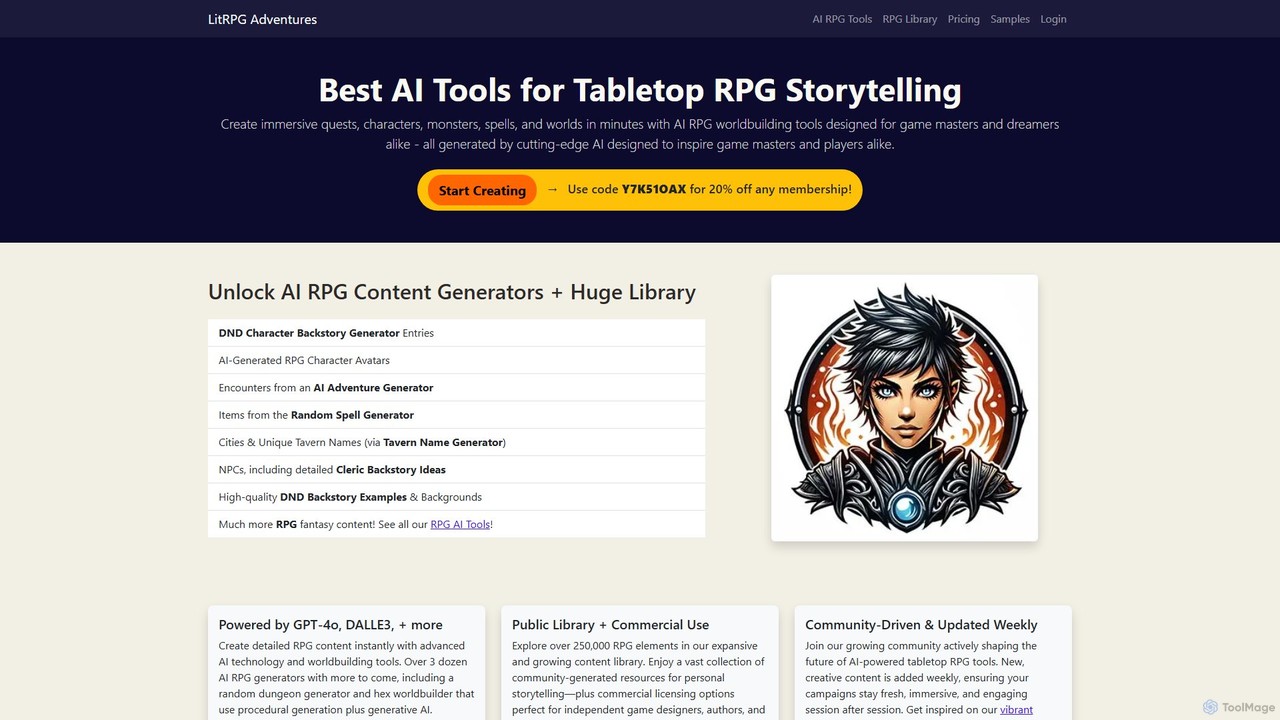
LitRPG Adventures is an advanced AI-powered platform for tabletop RPG worldbuilding. Leveraging models like GPT-4o and DALL-E 3, …

12.9K

About Worldbuilding

AI Worldbuilding tools are specialized platforms designed to help creators construct and manage complex fictional universes. They leverage AI to generate ideas, organize lore, and visualize world elements, acting as a central database for creative projects. This enhances productivity by systematizing the intricate process of world creation, from tracking character lineages to mapping entire continents. These tools are invaluable for maintaining consistency and depth in storytelling.

Core Features

  • Lore & Wiki Management: Create an interconnected database for characters, locations, items, and events, similar to a private wiki.
  • AI-Powered Generation: Generate names, plot hooks, character backstories, and descriptions to overcome creative blocks.
  • Interactive Map Creation: Design and link interactive maps with geographical details and location markers.
  • Timeline Visualization: Build and manage chronological timelines to track historical events and character arcs.
  • Relationship Tracking: Visually map out complex relationships between characters, factions, and families.

Use Cases

These tools are primarily used by authors, screenwriters, tabletop RPG game masters (GMs), and video game narrative designers. For example, a fantasy novelist can use them to ensure the rules of their magic system remain consistent across a series, while a game developer can build a rich, explorable world with detailed faction histories and interconnected quests.

How to Choose

When selecting an AI Worldbuilding tool, consider the depth of its organizational features, such as custom templates and relationship mapping. Evaluate the quality and controllability of its AI generation capabilities. Also, assess its mapping and timeline functionalities, collaboration features for team projects, and available export options (e.g., PDF, Markdown) for integration with other writing software.

WorldbuildingUse Cases

1

Designing a Fantasy Novel Series

An author writing an epic fantasy series uses a worldbuilding tool to manage their complex universe. They create detailed articles for each kingdom, a timeline of historical wars, and family trees for royal dynasties. The AI helps generate names for remote villages and ancient artifacts. This ensures consistency across multiple books, preventing plot holes related to geography, character lineage, or the rules of the magic system. The interactive map allows them to track the protagonist's journey visually.

2

Creating a Tabletop RPG Campaign

A Game Master (GM) prepares a new Dungeons & Dragons campaign. They use a worldbuilding tool to create a continent map, placing major cities, dungeons, and points of interest. For each city, they generate a list of non-player characters (NPCs), shops, and local rumors using AI prompts. They also build a timeline of the kingdom's history to reveal to players over time. This centralized hub allows the GM to quickly access information during sessions and keep track of the players' impact on the world.

3

Developing Lore for a Video Game

A narrative designer for an indie game studio is tasked with building the game's universe. They use a worldbuilding tool to document the history of different factions, the biographies of key characters, and the descriptions of unique flora and fauna. The AI generation feature helps brainstorm creature concepts and cultural traditions for various in-game races. The tool's wiki-like structure allows the entire development team (artists, programmers, quest designers) to access a single source of truth for lore, ensuring a cohesive and immersive game world.

4

Outlining a Sci-Fi Screenplay

A screenwriter is developing a concept for a science fiction film set in a distant galaxy. They use a worldbuilding tool to establish the laws of physics, the technological capabilities of different alien species, and the political structure of the galactic council. The timeline feature is used to map out the history leading up to the film's events. This structured approach helps the writer create a believable and well-thought-out setting, which serves as a strong foundation for the plot and character development, making the script more compelling for producers.

5

Managing a Collaborative Writing Project

A team of writers is co-authoring a webcomic series. They use a cloud-based worldbuilding tool as their shared encyclopedia. Each writer can add or edit entries for characters, locations, and plot points. The relationship mapping feature helps them visualize the complex web of alliances and rivalries. This collaborative environment ensures everyone is working from the same information, reducing inconsistencies and streamlining the creative process. The tool acts as a living document that evolves with the story.

6

Visualizing Historical or Mythological Worlds

An educator or history enthusiast uses a worldbuilding tool to create an interactive resource for Ancient Rome. They map out the empire at its peak, creating entries for major cities, historical figures like Caesar, and key events like the Punic Wars. The timeline feature visually represents the rise and fall of the Republic and Empire. This digital model serves as a powerful educational aid, allowing students or readers to explore the interconnected elements of a historical period in a more engaging way than a traditional textbook.

WorldbuildingFrequently Asked Questions