DebateDevil
DebateDevil is an AI-powered platform designed to strengthen your arguments and refine your ideas. It acts as a …
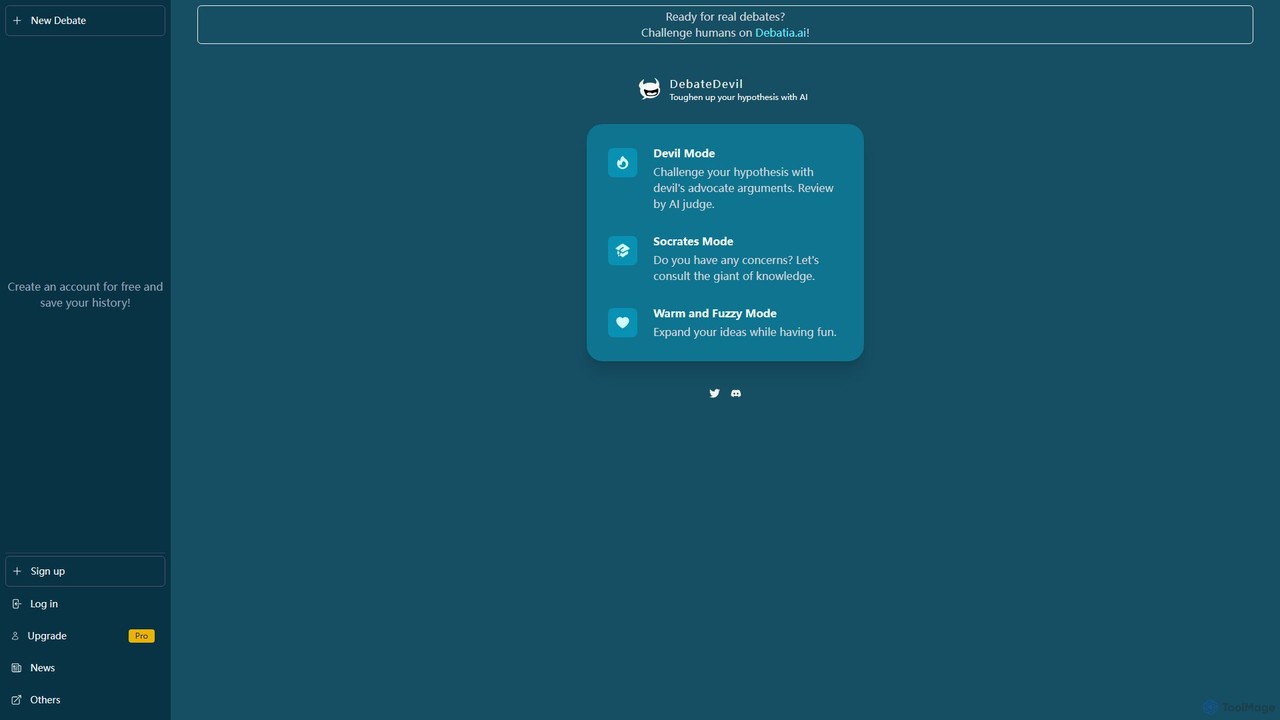
DebateDevil is an AI-powered platform designed to strengthen your arguments and refine your ideas. It acts as a virtual debate partner, using modes like 'Devil's Advocate' and 'Socrates' to challenge your hypotheses, identify logical fallacies, and help you build more robust and persuasive points. Ideal for students, researchers, and critical thinkers.
About Argumentation
AI Argumentation tools are a specialized category of research software designed to help users construct, analyze, and visualize complex arguments. They leverage natural language processing (NLP) and knowledge graphs to deconstruct texts, identify logical relationships between claims and evidence, and map out reasoning structures. This enables users in academia, law, and policy-making to build more robust, evidence-based cases and identify weaknesses in opposing viewpoints. Unlike general research tools that focus on information discovery, argumentation tools concentrate on the synthesis and critical evaluation of that information.
Core Features
- Argument Mapping: Visually diagramming the structure of an argument, showing premises, conclusions, and evidence.
- Claim & Evidence Extraction: Automatically identifying key claims, supporting evidence, and counter-arguments from documents.
- Logical Fallacy Detection: Analyzing text to flag potential weaknesses or errors in reasoning.
- Evidence Synthesis: Aggregating and organizing supporting data from multiple sources to strengthen a specific claim.
Applicable Scenarios
These tools are primarily used in academic research for literature reviews and thesis construction, legal case preparation for structuring arguments and evidence, and policy analysis for evaluating the pros and cons of different proposals. Journalists and debaters also use them to prepare for discussions and fact-check claims.
Selection Criteria
When selecting an AI Argumentation tool, consider the complexity of its mapping capabilities and its accuracy in claim extraction. Evaluate the range of document types it supports (e.g., PDFs, web pages) and its integration with reference managers. The user interface's ease of use for building complex diagrams is also a critical factor.
ArgumentationUse Cases
Structuring an Academic Thesis
A PhD student uses an AI argumentation tool to outline their dissertation. They input dozens of research papers and their own experimental data. The tool helps them extract core claims from the literature, map how these claims support or contradict each other, and visually structure their thesis chapters. Each chapter's central argument is linked directly to supporting evidence, ensuring a coherent and logical flow from introduction to conclusion, significantly reducing the time spent on organization and synthesis.
Preparing for a Legal Case
A legal team prepares for a complex corporate litigation case. They upload thousands of pages of documents, including contracts, emails, and witness depositions, into an AI argumentation platform. The AI extracts key arguments, identifies every piece of evidence supporting their position, and flags potential counter-arguments from the opposing side. The team uses the visual argument map to build a clear trial strategy, ensuring every claim is backed by solid evidence and they are prepared to address any challenges from the opposition.
Analyzing Public Policy Debates
A policy analyst at a think tank evaluates a proposed environmental regulation. They use an argumentation tool to process legislative text, scientific reports, and public comments. The tool maps out the main arguments for and against the policy, identifies the key stakeholders behind each argument, and detects logical fallacies in public discourse. This structured analysis allows the analyst to produce a comprehensive and objective report for policymakers, highlighting the strengths and weaknesses of the proposal based on available evidence.
Enhancing Critical Thinking in Education
A university professor incorporates an AI argumentation tool into their critical thinking curriculum. Students are tasked with analyzing news articles or academic papers. They use the tool to visually break down the author's argument, identify the main thesis, supporting premises, and any underlying assumptions. The tool can also flag potential logical fallacies, prompting students to engage more deeply with the text. This hands-on approach helps students develop tangible skills in deconstructing and evaluating complex arguments, rather than just passively reading.
Developing Corporate Strategy
A business strategy team is deciding on a new market entry plan. They use an argumentation tool to map out the arguments for several options (e.g., acquisition, organic growth, joint venture). For each option, they link supporting arguments to specific market research data, competitive analysis reports, and financial projections. The tool helps visualize the risks (counter-arguments) and rewards (conclusions) of each path, facilitating a more structured and evidence-based discussion among executives and leading to a more defensible final decision.
Fact-Checking for Investigative Journalism
An investigative journalist is analyzing a series of political speeches and press releases for a story. They feed the transcripts into an AI argumentation tool. The software automatically extracts all verifiable claims made by the politician. It then helps the journalist organize these claims and link them to external fact-checking sources and contradictory evidence. The visual map of claims and evidence allows the journalist to quickly identify patterns of misinformation or unsupported assertions, forming the backbone of their investigative report.