LMArena
LMArena is an open, crowdsourced platform from UC Berkeley researchers for evaluating and comparing leading AI models. Users …
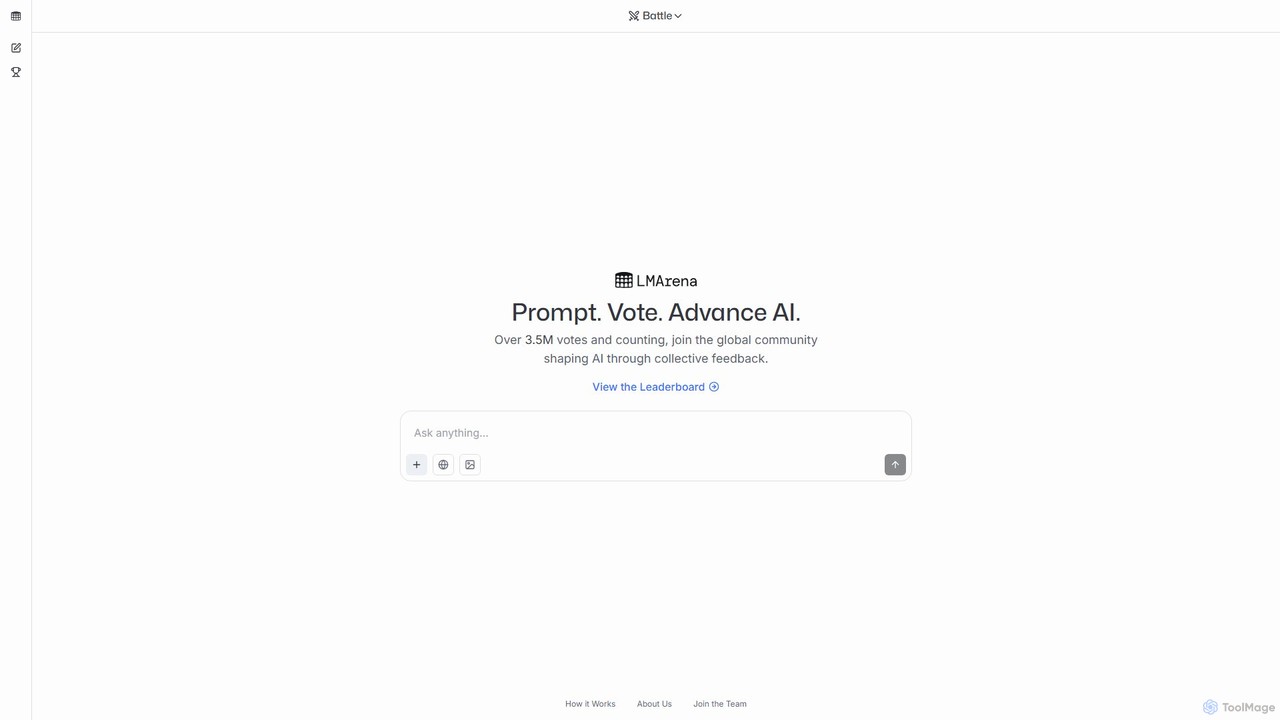
LMArena is an open, crowdsourced platform from UC Berkeley researchers for evaluating and comparing leading AI models. Users anonymously test two models side-by-side, vote for the best response, and contribute to a dynamic, public leaderboard. It aims to make AI progress transparent and grounded in real-world human feedback.
About Benchmarking
AI Benchmarking tools are a class of software designed to systematically measure, compare, and rank the performance of AI models and systems. They operate by running standardized tests on various models using consistent datasets and evaluation metrics, such as accuracy, speed, or resource consumption. This process provides objective, data-driven insights, enabling developers and researchers to identify the most effective models for specific tasks and track progress in the field. As a key part of the AI Research toolkit, these tools are essential for validating model capabilities and ensuring transparency in AI development.
Core Features
- Standardized Test Suites: Provides pre-built collections of datasets and tasks for evaluating models in areas like NLP and computer vision.
- Performance Metrics Tracking: Automates the calculation and visualization of key metrics like accuracy, F1-score, latency, and throughput.
- Comparative Leaderboards: Generates public or private rankings of different models based on their performance on specific benchmarks.
- Resource Usage Analysis: Monitors and reports on computational costs, including CPU/GPU usage and memory consumption during tests.
- Reproducibility Frameworks: Ensures experiments can be reliably repeated by others through environment snapshots or containerization.
Use Cases
AI Benchmarking tools are primarily used by AI research labs, academic institutions, and enterprise R&D teams. They are critical in fields like large language model (LLM) development, computer vision research, and autonomous systems testing to validate new architectures and compare them against state-of-the-art models.
How to Choose
When selecting a tool, consider the supported model types and frameworks (e.g., PyTorch, TensorFlow). Evaluate the breadth and relevance of the available benchmark suites for your domain. Check for integration capabilities with MLOps platforms and cloud infrastructure, and assess the clarity of its reporting and visualization features for easier analysis.

BenchmarkingUse Cases
Compare LLM Performance for Chatbot Development
A development team needs to select the best Large Language Model (LLM) for their new customer service chatbot. They use a benchmarking tool to evaluate three different models on a custom dataset of user inquiries. The tool systematically measures response accuracy, relevance, and latency for each model. It then generates a comparative leaderboard, providing a clear, data-driven basis for selecting the most cost-effective and performant model, ensuring a high-quality user experience.
Validate Computer Vision Models for Quality Control
A manufacturing company is testing several object detection models to identify defects on a production line. Using a benchmarking platform, they upload their proprietary dataset of product images. The platform runs standardized tests to compare each model's precision, recall, and inference speed on specific edge hardware. The resulting report allows them to deploy the most reliable and efficient system, minimizing production errors.
Academic Research and Paper Publication
A university research group develops a novel neural network architecture. To prove its superiority over existing methods, they use a public benchmarking tool. They run their model on established academic datasets like ImageNet or SQuAD and compare its results against state-of-the-art models listed on public leaderboards. This provides verifiable, reproducible evidence of their model's performance, strengthening their research paper and contributing to the scientific community.
Optimize Algorithm Efficiency for Cloud Cost Reduction
An MLOps team aims to reduce the operational costs of their AI services. They use a benchmarking tool to analyze the resource consumption (GPU time, memory) of their deployed models under various load conditions. The tool helps them identify inefficient models and test optimized versions side-by-side. By comparing the performance-to-cost ratio, they can select and deploy model variants that deliver similar accuracy with a quantifiable reduction in their monthly cloud computing bill.
Regression Testing in CI/CD Pipelines for AI
A software company integrates an AI benchmarking tool into their CI/CD pipeline. Every time a developer commits an update to a model, the pipeline automatically triggers a benchmark test against a baseline dataset. This ensures that recent changes haven't negatively impacted performance or accuracy. If a regression is detected (e.g., accuracy drops by 2%), the build fails, preventing a degraded model from reaching production and maintaining service quality.
Select Third-Party AI APIs Based on Performance
A startup needs to choose a third-party API for speech-to-text transcription. Instead of relying on marketing claims, they use a benchmarking tool to send the same set of audio files to multiple vendors. The tool objectively measures and compares the Word Error Rate (WER), processing time, and cost per request for each service. This data-driven approach allows them to select the API that offers the best balance of accuracy and cost for their specific use case.