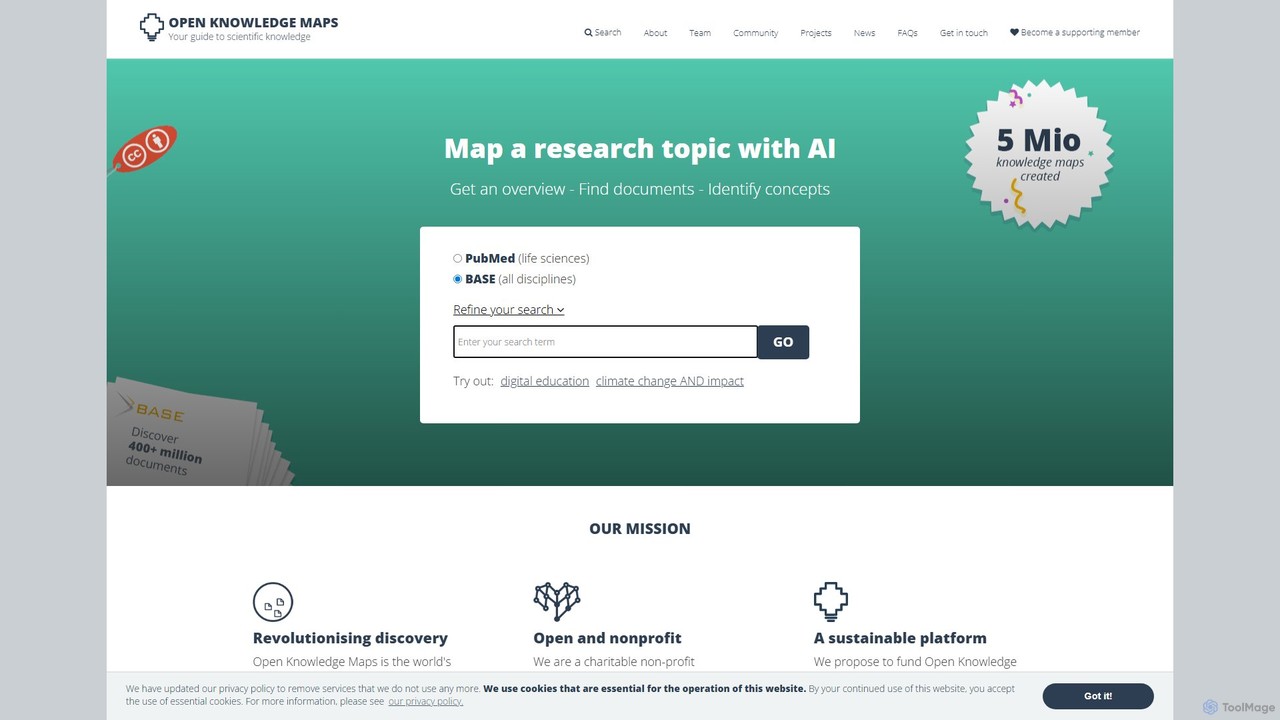
Open Knowledge Maps
Open Knowledge Maps is a non-profit AI-powered discovery platform that transforms research discovery. It creates visual knowledge maps …
Open Knowledge Maps is a non-profit AI-powered discovery platform that transforms research discovery. It creates visual knowledge maps from millions of research articles, providing an instant overview of a topic. Instead of linear search results, it clusters documents by topic, helping users quickly identify relevant concepts and papers, especially in interdisciplinary fields. It emphasizes open access content and offers services for individuals, libraries, and institutions to enhance research visibility and assessment.
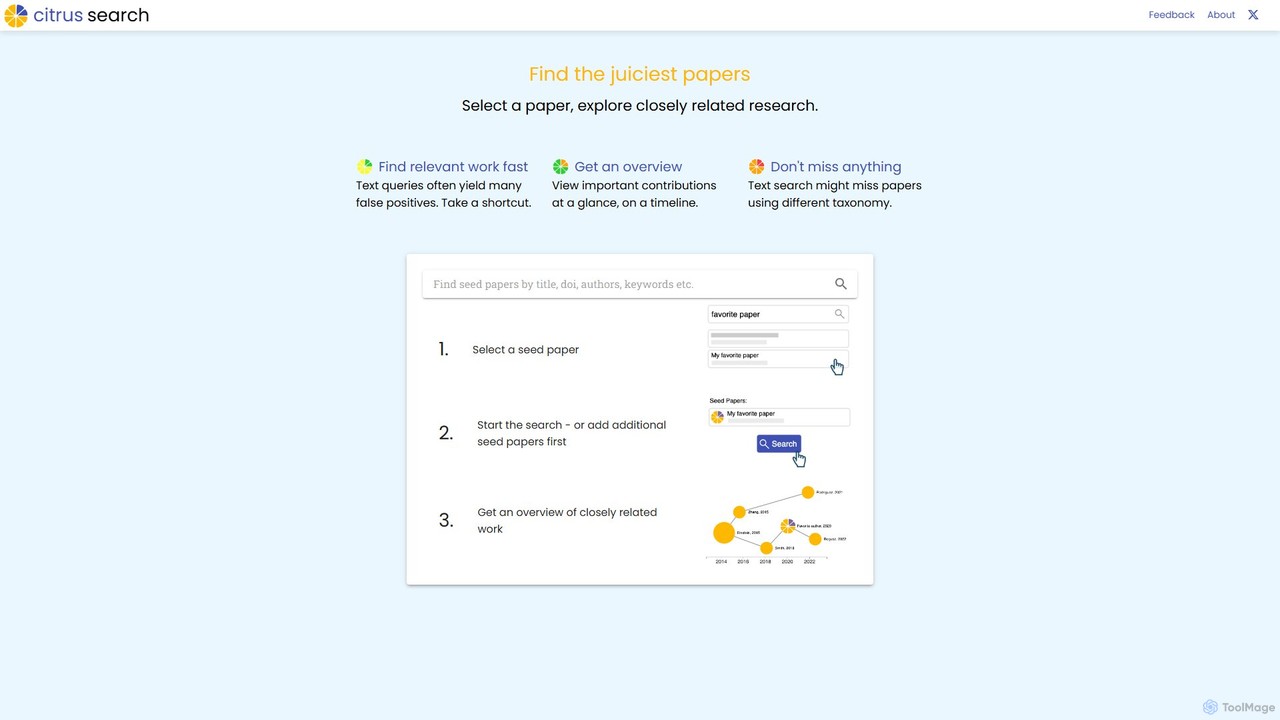
Citrus Search
Citrus Search is an AI-powered academic search engine that revolutionizes literature discovery. Instead of keywords, you provide a …
Citrus Search is an AI-powered academic search engine that revolutionizes literature discovery. Instead of keywords, you provide a "seed paper," and it finds closely related publications using advanced similarity metrics like citation networks and semantic content analysis. It's designed to help researchers quickly find relevant work, get a comprehensive overview of a field, and uncover papers that traditional search methods might miss.
About Literature Search
AI Literature Search tools are specialized platforms designed to automate and accelerate the process of finding, analyzing, and synthesizing scholarly information. They leverage natural language processing (NLP) and machine learning to understand research papers, patents, and academic articles at a deep conceptual level. This enables researchers, students, and professionals to quickly identify relevant studies, uncover hidden connections between papers, and generate comprehensive summaries. These tools significantly reduce the manual effort required for literature reviews, allowing users to focus on interpretation and insight generation.
Core Features
- Semantic Search: Finds conceptually related papers beyond simple keyword matching.
- Automated Summarization: Generates concise summaries of complex research articles, highlighting key findings.
- Citation Network Analysis: Visualizes connections between papers to identify seminal works and research trends.
- Key Information Extraction: Automatically pulls structured data like methodologies, datasets, and conclusions from texts.
- Personalized Recommendations: Suggests new and relevant papers based on your research interests and library.
Use Cases
These tools are essential in academia, corporate R&D, and medical fields. For instance, a PhD candidate can use them to construct a thorough literature review for a dissertation, while a pharmaceutical R&D team can rapidly assess the state-of-the-art for a new drug target. They are also valuable for students writing term papers and patent attorneys conducting prior art searches.
How to Choose
When selecting a tool, consider the breadth of its database (e.g., which journals and archives it covers), the quality of its AI analysis (e.g., summarization accuracy), integration with reference managers like Zotero or Mendeley, and its pricing model. Also, evaluate the user interface for ease of use in complex search and analysis tasks.
Literature SearchUse Cases
Accelerating PhD Dissertation Literature Reviews
A doctoral candidate faces the task of reviewing hundreds of papers for their dissertation. Using an AI Literature Search tool, they input core research questions. The tool performs a semantic search to find conceptually related articles, generates summaries for the most relevant papers, and creates a citation map to visualize key research clusters. This process reduces the initial discovery phase from weeks to a few days, providing a structured foundation for their literature review chapter.
Streamlining Corporate R&D and Patent Analysis
An R&D team at a biotech firm needs a thorough prior art search for a new drug pathway. They use an AI tool to scan millions of scientific papers and patent databases. The platform identifies all existing research on the target molecule, summarizes key experimental outcomes, and flags similar patented technologies. This comprehensive analysis helps the team refine their research direction and make informed investment decisions, saving significant time and resources.
Conducting Efficient Systematic Medical Reviews
A team of medical researchers is conducting a systematic review. This requires screening thousands of articles from databases like PubMed. An AI Literature Search tool automates the initial screening process by applying inclusion/exclusion criteria. It highlights relevant papers and extracts key data points like sample size and outcomes, exporting them into a structured format for meta-analysis. This drastically reduces manual screening time and minimizes human error.
Enhancing University Coursework and Essays
An undergraduate student is writing a term paper. Instead of relying on basic keyword searches, they use an AI tool to ask a direct question like, "What are the main arguments against carbon pricing?" The AI synthesizes information from multiple top-cited papers and provides a summarized answer with direct links to the sources. This helps the student quickly grasp complex debates, find credible sources, and build a stronger, evidence-based argument for their essay.
Staying Updated with Cutting-Edge Research
A machine learning engineer needs to stay current with the latest advancements. Manually tracking new publications is overwhelming. They set up personalized alerts in an AI Literature Search tool based on their specific interests. The tool continuously scans new publications and sends a weekly digest with summaries of the most relevant and impactful papers. This allows the engineer to efficiently absorb key trends and breakthroughs without spending hours searching.
Identifying Research Gaps for Grant Proposals
A university professor is preparing a grant proposal. A crucial part is to clearly define the "research gap." They use an AI Literature Search tool to analyze the existing literature. The tool's visualization features help map out what has been extensively studied and what areas are underexplored. This data-driven approach helps the professor build a compelling case for funding by demonstrating a clear and unmet need in the scientific community.