Apprendo
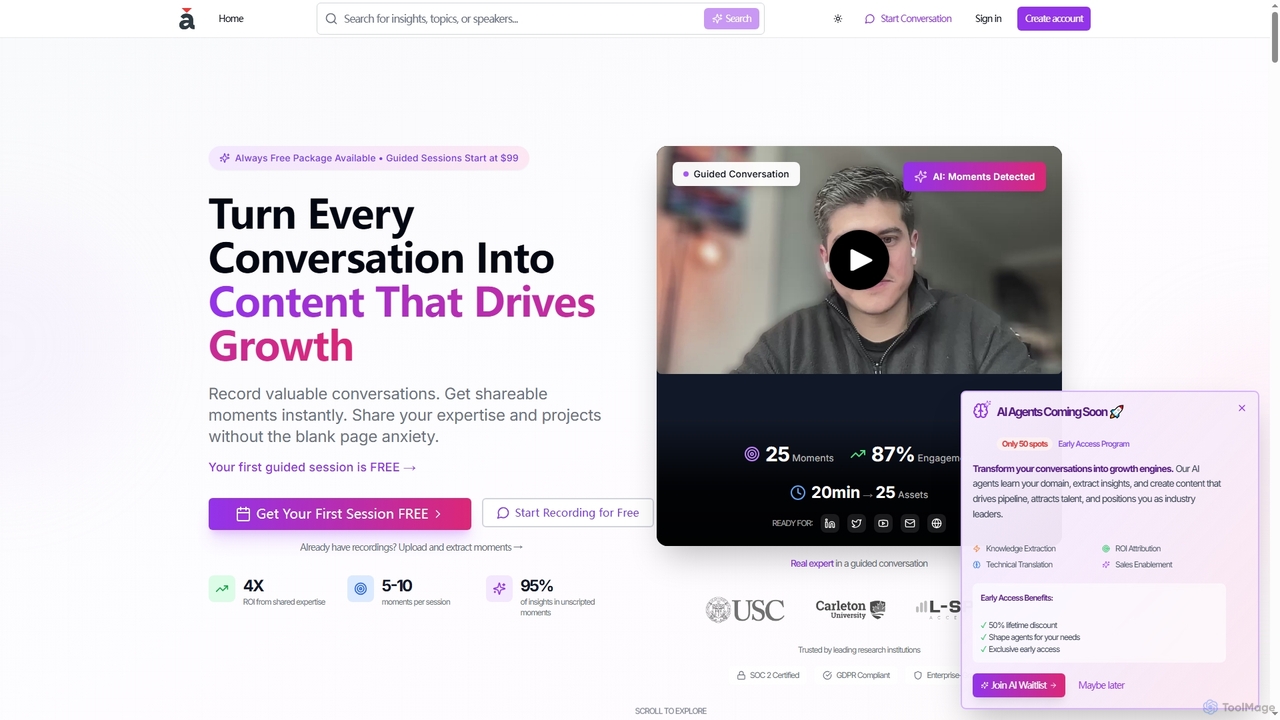
Apprendo is an AI-powered platform that transforms team conversations, meetings, and existing recordings into high-impact content. Designed for …
Apprendo is an AI-powered platform that transforms team conversations, meetings, and existing recordings into high-impact content. Designed for R&D teams and experts, it captures valuable insights, extracts shareable moments, and helps disseminate expertise across various platforms to drive growth, talent acquisition, and thought leadership, all while ensuring enterprise-grade security and compliance.
About Scientific Communication
Scientific Communication tools are a specialized class of AI assistants designed to translate complex research findings into clear, accessible, and engaging content for diverse audiences. These tools utilize advanced natural language processing (NLP) and data visualization algorithms to simplify technical jargon, generate lay summaries, and create informative graphics from raw data. Their primary value is in bridging the communication gap between scientists and the public, policymakers, or peers in other fields, thereby amplifying the impact and reach of scientific discoveries. This focused approach distinguishes them within the broader Research category.
Core Features
- Technical Language Simplification: Automatically rephrases complex scientific terminology and convoluted sentences into plain, understandable language.
- Lay Summary Generation: Creates concise, non-technical summaries from dense research papers, abstracts, or reports.
- AI-Powered Data Visualization: Transforms numerical data and statistical results into intuitive charts, graphs, and infographics.
- Content Adaptation: Reformats a single piece of research into various formats suitable for press releases, social media posts, or blog articles.
- Presentation & Poster Design: Assists in structuring and designing visually compelling academic posters and presentation slides.
Use Cases
These tools are frequently used by academic researchers, university communications offices, science journalists, medical writers, and educational content creators. For instance, a researcher might use a tool to generate a clear summary for a grant application's public impact statement, or a university press officer could quickly draft a press release about a new study.
How to Choose
When selecting a Scientific Communication tool, consider the specific output formats you need (e.g., text, infographic, slides). Evaluate its ability to handle your specific scientific domain and the complexity of your data. Also, assess the level of customization offered for visuals and tone, and check for integrations with research databases or reference managers.

Scientific CommunicationUse Cases
Generate a Lay Summary for a Grant Application
A biomedical researcher needs to explain their complex genetics research to a funding agency's review board, which includes non-specialists. They input their technical proposal and key data points into an AI scientific communication tool. The tool analyzes the content, simplifies jargon like 'crispr-cas9 gene editing' into 'a precise genetic modification technique,' and structures a compelling narrative. The output is a clear, 250-word lay summary that highlights the research's potential impact on treating hereditary diseases, making the application more accessible and persuasive to the entire review panel.
Create an Infographic for Public Outreach
A climate science institute wants to share key findings from a recent report on social media. A communications officer inputs the report's main data points—such as sea-level rise projections and CO2 concentration levels—into an AI tool. The tool suggests several infographic layouts, icons, and color schemes. The officer selects a template and the AI automatically populates it with the data, generating a professional, shareable infographic that visually communicates the urgency of the findings to the public in minutes, a task that would typically require a graphic designer and several hours of work.
Draft a Press Release for a University Discovery
A university's public relations department needs to announce a major breakthrough in materials science. They upload the original research paper to an AI communication tool. The AI identifies the core innovation, its real-world applications (e.g., creating more efficient batteries), and quotes from the lead researchers. It then generates a draft press release in a standard journalistic format, including a catchy headline, a summary lead paragraph, and a boilerplate about the university. This accelerates the process from hours to minutes, allowing the PR team to focus on media outreach and strategy.
Design an Academic Conference Poster
A PhD student with limited design skills needs to create a poster for an international conference. They use an AI tool specifically for academic posters. They input their abstract, key figures, data tables, and conclusions. The AI suggests several professional layouts that adhere to academic standards, ensuring a logical flow from introduction to conclusion. It automatically aligns text boxes, standardizes font sizes, and suggests color palettes that enhance readability. The student can then make minor adjustments, generating a high-quality, well-structured poster in under an hour.
Simplify Medical Information for Patients
A patient advocacy group wants to explain the results of a new clinical trial to its members. They use an AI tool to process a dense medical journal article. The tool identifies and defines complex terms like 'pharmacokinetics' and 'double-blind study' in simple language. It restructures the 'Results' section into a clear Q&A format, answering questions like 'Is the new drug effective?' and 'What are the side effects?'. This transforms an impenetrable scientific paper into an empowering resource that helps patients understand their treatment options and engage in more informed discussions with their doctors.
Adapt Research for a Science Blog Post
A marine biologist wants to share their latest research on coral reef bleaching with a wider audience through their blog. They provide their published paper to an AI tool. The AI transforms the formal, passive-voice academic text into an engaging, narrative-style blog post. It suggests analogies (e.g., comparing coral bleaching to a 'fever'), breaks down the methodology into a simple step-by-step list, and generates several catchy title options. The biologist can then review and edit the draft, saving over 80% of the time it would take to write the post from scratch, allowing them to communicate their work more frequently.