Ora AI
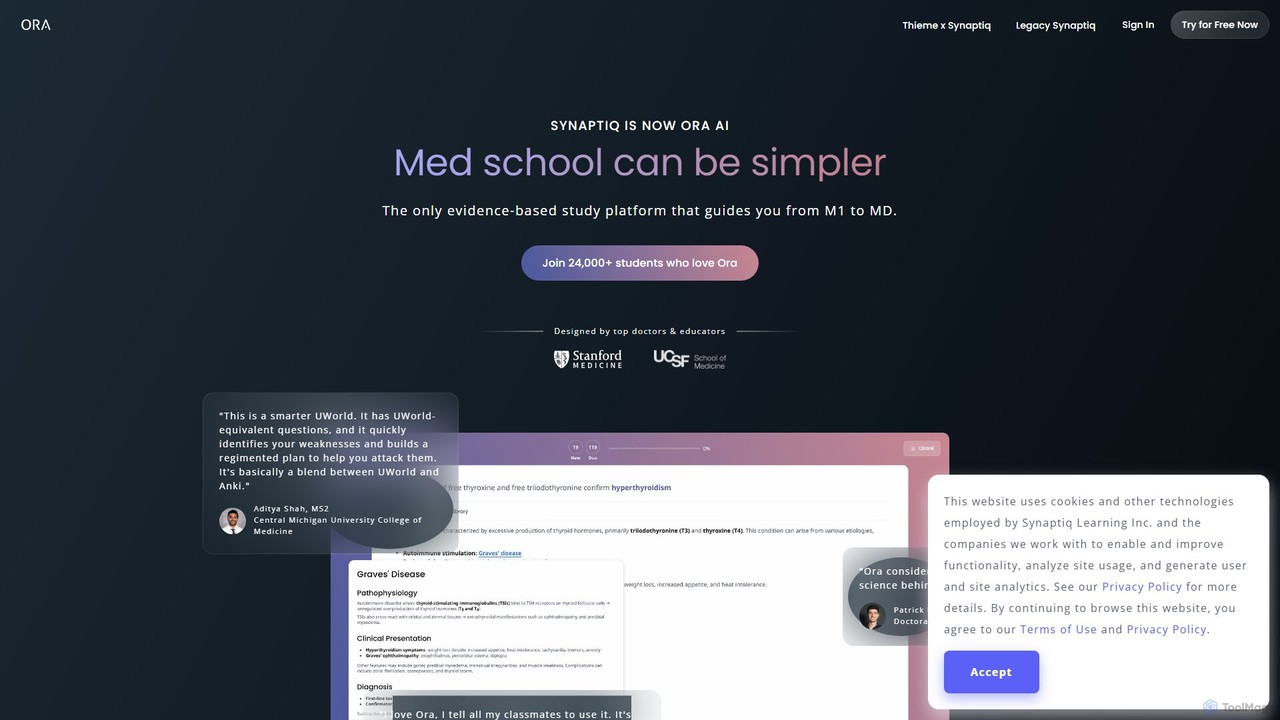
Ora AI (formerly Synaptiq) is an evidence-based, AI-powered study platform for medical students and professionals. It uses adaptive …
Ora AI (formerly Synaptiq) is an evidence-based, AI-powered study platform for medical students and professionals. It uses adaptive learning, high-quality question banks, and spaced repetition to create personalized study plans, identify weaknesses, and optimize preparation for board exams and medical coursework.
About Learning
AI Learning tools are a category of software that leverages artificial intelligence to create personalized, adaptive, and interactive educational experiences. They utilize machine learning algorithms to analyze a user's performance, identify knowledge gaps, and adjust learning paths in real-time. These tools are designed to enhance knowledge retention, accelerate skill acquisition, and make learning more engaging for a wide range of users. Within the broader field of AI for Science, these tools specifically focus on the cognitive processes of learning and knowledge transfer, moving beyond simple information delivery.
Core Features
- Adaptive Learning Paths: Automatically customizes curriculum and difficulty based on individual learner performance and pace.
- Intelligent Tutoring Systems (ITS): Provides real-time, step-by-step guidance, hints, and feedback on complex problems.
- Automated Assessment & Feedback: Instantly grades assignments, quizzes, and even essays, offering targeted, constructive criticism.
- Interactive Simulations: Creates realistic, risk-free virtual environments for learners to practice skills and apply knowledge.
Use Cases
AI Learning tools are widely used in corporate training for employee upskilling, in academic institutions to supplement traditional teaching, and by individuals for self-paced study. Roles such as instructional designers, corporate trainers, teachers, and lifelong learners utilize these tools to create more effective and efficient educational programs, from language acquisition to complex technical training.
How to Choose
When selecting an AI Learning tool, consider the depth of its subject matter coverage and the sophistication of its adaptive algorithms. Evaluate its integration capabilities with existing Learning Management Systems (LMS). Also, assess the quality of its analytics for tracking learner progress and ensure its data privacy and security policies meet your standards. The user interface's intuitiveness is also crucial for learner engagement.

LearningUse Cases
Adaptive Corporate Compliance Training
An HR manager at a large financial firm needs to ensure all 5,000 employees complete and understand the annual anti-money laundering (AML) training. Instead of a one-size-fits-all video, they use an AI Learning tool. The tool presents scenarios and questions, adjusting the difficulty and content based on each employee's responses. If an employee struggles with a specific concept, the AI provides additional examples and micro-lessons until mastery is demonstrated. This approach reduces training time for knowledgeable staff by 40% and provides auditable proof of comprehension for regulators, ensuring higher engagement and verifiable compliance.
Personalized Language Fluency Practice
A student preparing for an English proficiency test uses an AI language tutor to improve their speaking skills. The student engages in simulated conversations with an AI chatbot on various topics. The AI provides instant feedback on their pronunciation, grammar, and vocabulary choice, highlighting specific errors and suggesting better phrasing. It also tracks recurring mistakes and generates targeted drills, such as practicing difficult vowel sounds or complex sentence structures. This allows the student to practice anytime, receive objective feedback that a human partner might miss, and focus precisely on their weakest areas, accelerating their path to fluency.
AI-Powered STEM Problem Solving Guidance
A high school student is struggling with calculus homework. They use an AI learning platform that allows them to input a complex problem. Instead of giving the final answer, the AI acts as a Socratic tutor. It breaks the problem down and asks guiding questions, such as 'What is the first step to finding the derivative here?' or 'Have you considered using the chain rule?'. It provides hints and explains underlying concepts only when the student gets stuck. This interactive process helps the student build problem-solving skills and a deeper conceptual understanding, rather than simply copying a solution.
Automated Essay Scoring and Feedback
A university professor teaching a large introductory course with 300 students needs an efficient way to grade weekly writing assignments. They use an AI tool that analyzes each essay for structure, grammar, clarity, and argument strength based on a pre-defined rubric. The tool provides an initial score and generates personalized feedback for each student, highlighting areas for improvement, such as 'This paragraph lacks a clear topic sentence' or 'Consider providing more evidence to support this claim.' This frees up the professor's time to focus on higher-level conceptual feedback and in-class discussions, while students receive immediate, consistent feedback to improve their writing skills.
Customized Exam Preparation Plans
A candidate preparing for the CFA (Chartered Financial Analyst) exam uses an AI-powered prep course. They begin with a diagnostic test that assesses their strengths and weaknesses across all topics. Based on the results, the AI generates a personalized study plan that prioritizes their weakest areas, such as derivatives or portfolio management. The platform provides adaptive quizzes that become more challenging as the candidate improves. It also predicts their likely score on the actual exam and suggests specific modules to review to maximize their score improvement, making their study time more efficient and targeted.
Interactive Skill Simulation for Professionals
A surgical resident uses an AI-powered virtual reality (VR) platform to practice a complex laparoscopic procedure. The simulation provides realistic haptic feedback and models potential complications, such as unexpected bleeding. The AI coach monitors their movements, instrument handling, and decision-making in real-time. After the simulation, it provides a detailed performance report, highlighting inefficiencies in their technique and suggesting specific areas for practice. This allows the resident to gain valuable hands-on experience and refine their skills in a safe, controlled environment before performing the procedure on a real patient.