ToolMage
Sign in

Best 3 Physics AI tools for Science

Popular Physics AI tools in Science include Physics AI, Navier AI, and Mathify, helping you work more efficiently.

Freemium

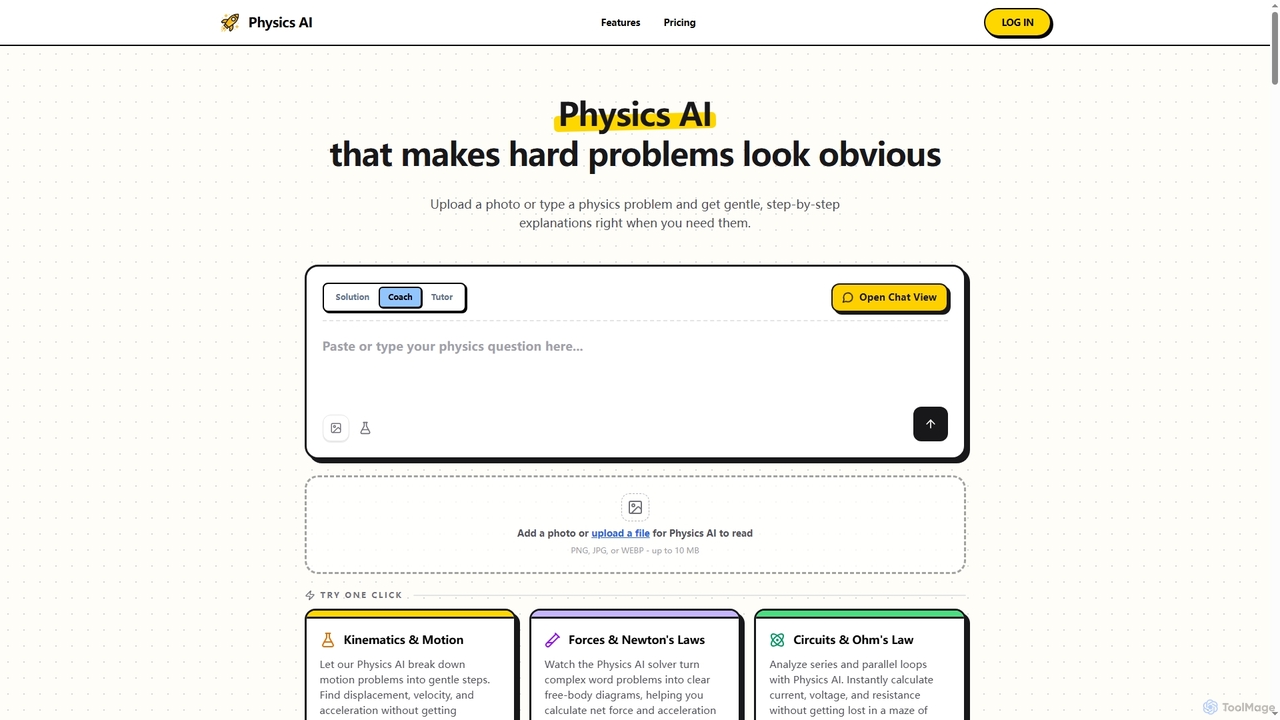
Physics AI

Physics AI is a free online physics solver and tutor that provides step-by-step explanations for complex problems. Users can upload photos or type physics questions to receive instant, gentle guidance and solutions across various physics topics.

Homework Helper
Visits 16.7KFavorites 45Likes 51
Freemium

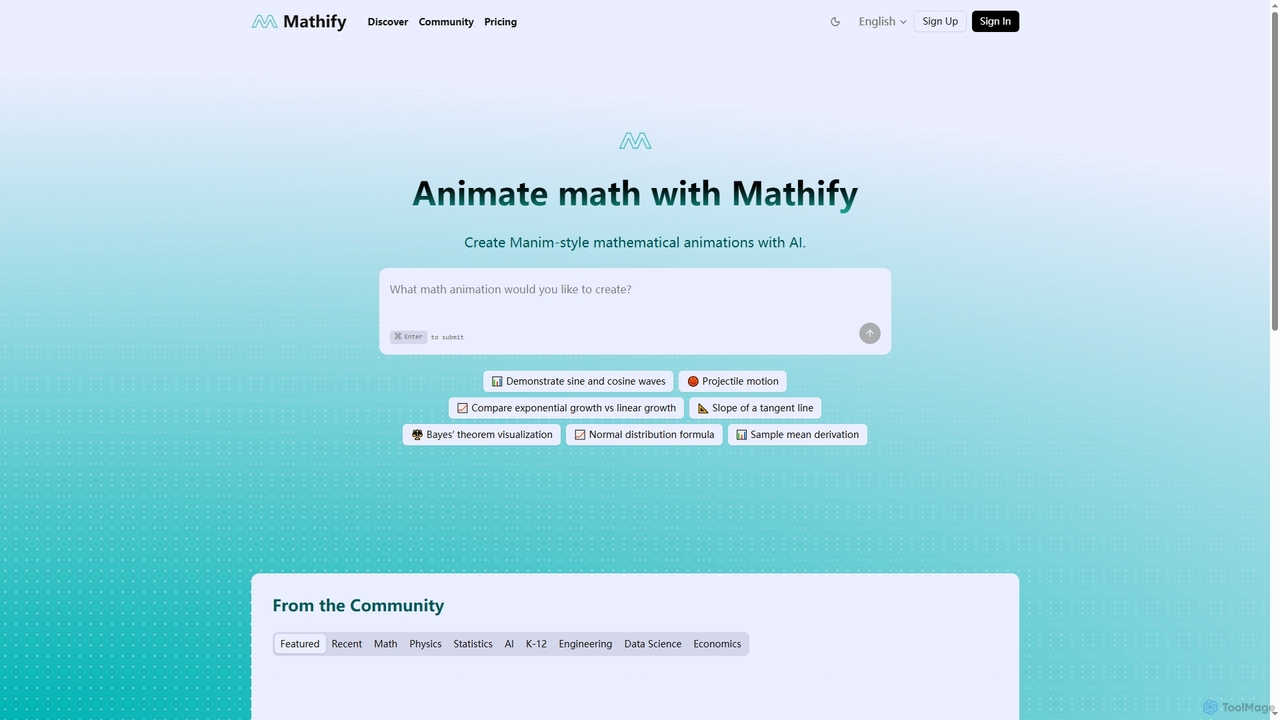
Mathify

Mathify is an AI-powered tool that simplifies the creation of Manim-style mathematical animations. It enables users to visualize complex mathematical and scientific concepts, making abstract ideas more accessible for education, research, and content creation.

Ai Development Tools
Visits 5KFavorites 91Likes 87
Paid

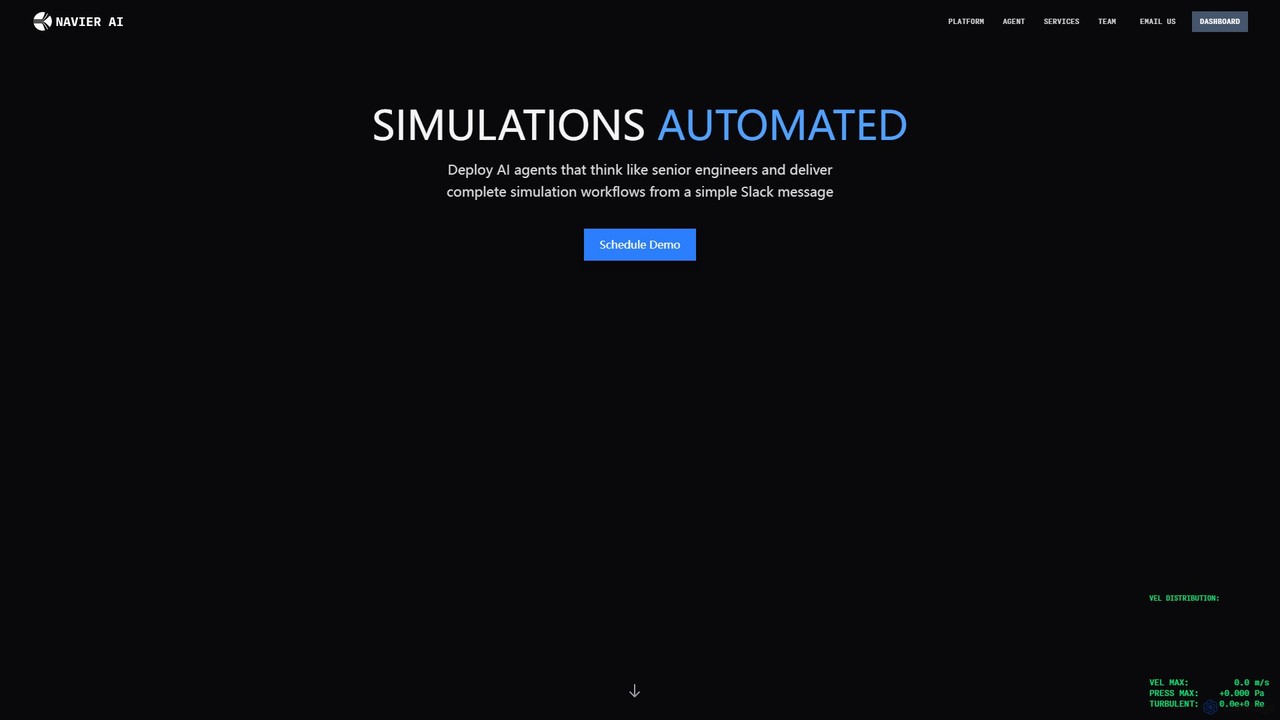
Navier AI

Navier AI deploys an autonomous AI agent that functions like a senior engineer, automating complete Computational Fluid Dynamics (CFD) simulation workflows from a simple Slack message. It integrates simulation, AI, and collaboration to accelerate design, analysis, and iteration cycles, offering a 95% reduction in time.

Api
Visits 7.8KFavorites 116Likes 110

About Physics

AI Physics tools are a specialized class of software that leverages machine learning to model, simulate, and analyze complex physical phenomena. These tools often employ neural networks and deep learning algorithms to approximate solutions to differential equations or analyze vast datasets from experiments, significantly reducing computational time compared to traditional numerical methods. Their primary value lies in accelerating research and development in fields like materials science, quantum mechanics, and astrophysics by enabling faster exploration of complex systems. They empower researchers and engineers to tackle problems that were previously computationally prohibitive.

Core Features

  • Accelerated Simulation: Uses AI surrogate models to drastically speed up simulations in areas like fluid dynamics (CFD) and structural mechanics, often by orders of magnitude.
  • Data-Driven Discovery: Analyzes large experimental datasets to identify hidden patterns, detect anomalies, or even derive physical equations directly from observations.
  • Quantum System Modeling: Simulates the behavior of quantum systems, predicting molecular properties and material characteristics with high efficiency.
  • Inverse Problem Solving: Determines causal factors from a set of observations, useful for material design or parameter estimation in physical models.

Applicable Scenarios

These tools are primarily used in academic research, advanced engineering, and R&D departments. For instance, a materials scientist might use an AI tool to predict the properties of novel alloys, while an astrophysicist could simulate galaxy formation more rapidly. In engineering, they are applied to optimize aerodynamic designs or model complex thermal systems.

Selection Criteria

When choosing an AI Physics tool, consider its specific domain focus—whether it's tailored for quantum chemistry, fluid dynamics, or another niche. Evaluate the model's accuracy and the methods used for validation against established physical laws. Assess its integration capabilities with existing scientific computing environments like Python or MATLAB, and consider the required computational resources, such as GPU or cloud computing access.

Featured tool rankings

Physics use cases

1

Accelerating Aerodynamic Design Simulation

An automotive engineer working on a new electric vehicle needs to optimize its body shape for minimal air resistance. Using a traditional CFD solver would require weeks to simulate just a few design variations. Instead, they use an AI Physics tool trained on previous CFD data. The engineer can now input hundreds of slightly modified 3D models and receive near-instantaneous drag coefficient predictions. This allows for rapid iteration and exploration of a much wider design space, leading to a 10% reduction in aerodynamic drag in just a few days, a result that would have previously taken months.

2

Discovering New Materials with Quantum Simulation

A materials scientist is searching for a new compound with specific thermoelectric properties. Simulating the quantum mechanical behavior of thousands of potential atomic structures with traditional methods like Density Functional Theory (DFT) is computationally infeasible. By using an AI Physics tool, the scientist can screen a vast library of materials. The AI model, trained on a database of known material properties, rapidly predicts the electronic band structure and thermal conductivity of new compounds, identifying a dozen promising candidates for further, more accurate DFT analysis. This AI-driven screening process reduces the search time from years to weeks.

3

Analyzing Particle Collision Data in High-Energy Physics

A particle physicist at CERN analyzes petabytes of data from the Large Hadron Collider (LHC) to find evidence of rare particle decays. Manually programming event selection criteria is time-consuming and may miss unexpected signals. The research team deploys an AI Physics tool with a deep neural network classifier. The AI is trained on simulated data to distinguish between signal events and background noise with high accuracy. It processes the real experimental data, flagging a small subset of events for human review. This automated analysis significantly increases the efficiency and sensitivity of the search, enabling the discovery of phenomena that might otherwise be lost in the noise.

4

Deriving Physical Equations from Experimental Data

A research group studying complex fluid dynamics has collected extensive data on turbulent flow but struggles to find a concise mathematical model that describes it. They use an AI Physics tool featuring symbolic regression. The tool ingests the time-series data of fluid velocity and pressure. By exploring a vast space of mathematical expressions, the AI algorithm identifies a compact differential equation that accurately reproduces the observed dynamics. This new, AI-discovered equation provides the researchers with novel insights into the underlying principles of turbulence, potentially leading to a breakthrough in the field.

5

Optimizing Plasma Control in Fusion Reactors

Scientists working on a tokamak fusion reactor need to maintain a stable plasma at millions of degrees. This requires real-time adjustments to powerful magnetic fields, a complex control problem. A research team implements an AI Physics tool based on reinforcement learning. The AI agent learns to control the magnetic coils by running millions of virtual experiments in a fast, AI-powered simulator. Once trained, the AI controller is deployed on the actual tokamak, where it successfully maintains plasma stability for longer durations than any human operator or traditional algorithm could, bringing us one step closer to clean fusion energy.

6

Solving Complex Physics Problems for Education

A university student studying advanced electromagnetism is stuck on a complex homework problem involving Maxwell's equations. The textbook solution is just a final answer with no intermediate steps. The student uses an AI Physics solver. They input the problem statement, and the AI provides a detailed, step-by-step derivation of the solution, explaining the application of each physical principle and mathematical theorem along the way. It also visualizes the electric and magnetic fields to aid understanding. This not only helps the student solve the current problem but deepens their conceptual understanding of the topic for future exams.

Physics FAQ

What are AI Physics tools?

AI Physics tools are specialized software that apply machine learning, particularly deep learning, to solve complex problems in physics. Unlike traditional simulators that rely on direct numerical computation of fundamental equations, these tools often learn from data to create fast, predictive models. Key features include accelerating simulations, discovering physical laws from data, and analyzing large experimental datasets. They are used in research fields like materials science, fluid dynamics, and particle physics to tackle computationally intensive tasks.

How do AI Physics tools differ from traditional simulation software?

The primary difference lies in their methodology. Traditional simulation software (like FEM or CFD solvers) directly solves fundamental physical equations using numerical methods. This is accurate but computationally very expensive. AI Physics tools, on the other hand, often act as 'surrogate models'. They are trained on data from traditional simulations or experiments and learn to approximate the results much faster. In essence:

  • Traditional Solvers: High accuracy, physics-based, but slow.
  • AI Tools: Very fast, data-driven, accuracy depends on training data.
AI tools are ideal for rapid design exploration, optimization, and inverse problems, while traditional solvers are often used for final validation and high-fidelity analysis.

Who should use AI Physics tools?

AI Physics tools are best suited for researchers, scientists, and advanced engineers in both academia and industry. Key users include:

  • Computational Physicists & Chemists: To accelerate simulations of complex systems like molecular dynamics or quantum mechanics.
  • Engineers (Aerospace, Automotive, etc.): For rapid prototyping and optimization of designs involving fluid dynamics or structural analysis.
  • Data Scientists in Scientific Fields: To analyze large datasets from experiments like particle colliders or telescopes.
  • Advanced Students & Educators: To solve complex problems and visualize physical phenomena for deeper understanding.
A background in the specific physics domain is highly recommended, and some familiarity with data science concepts can be beneficial for using these tools effectively.

Are AI-generated physics results reliable for research?

The reliability of AI-generated physics results is a critical and evolving topic. It depends heavily on the quality and quantity of training data, the model architecture, and rigorous validation. Generally, AI models are not used as a direct replacement for established physical laws or high-fidelity solvers. Instead, their role is often:

  • Exploratory: To quickly scan vast parameter spaces and identify promising candidates for further study.
  • Accelerative: To speed up parts of a larger simulation workflow.
  • Inspirational: To discover patterns or relationships that humans might miss.
For publication, results obtained from AI tools typically require thorough validation against experimental data or traditional, trusted simulation methods to ensure they are physically consistent and accurate.

What skills are needed to use AI Physics tools?

To effectively use AI Physics tools, a combination of domain knowledge and technical skills is beneficial. Firstly, a strong foundation in the relevant area of physics (e.g., fluid dynamics, quantum mechanics) is crucial to formulate problems correctly and interpret the results. Secondly, basic programming skills, often in Python, are necessary as many tools are libraries or require scripting for integration. Lastly, while deep expertise in machine learning isn't always required for off-the-shelf tools, a conceptual understanding of AI principles (like training data, validation, and model limitations) helps in troubleshooting and ensuring the responsible use of the technology.