Science Best in category 1 results Research Tools AI Tool

Popular AI tools in the Research Tools field of Science include Stempad, etc., helping you quickly improve efficiency.

Stempad

Stempad

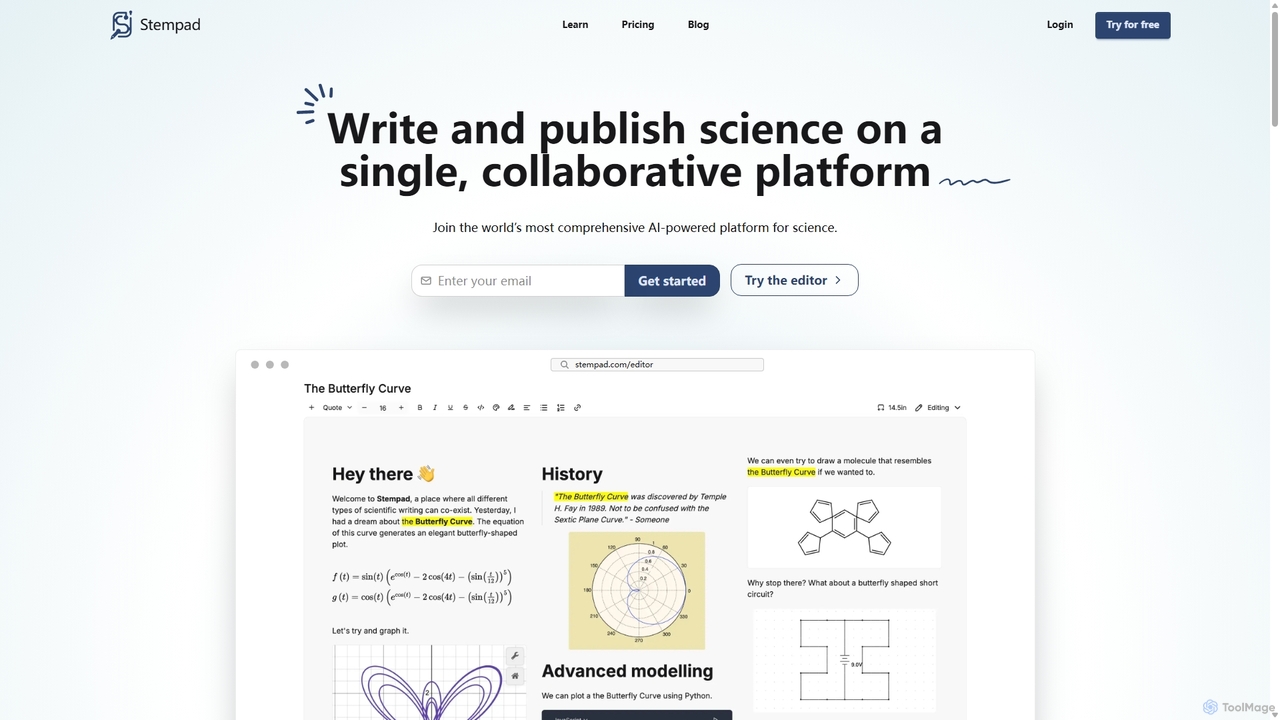
Stempad is an AI-powered, collaborative platform designed for scientific writing and note-taking. It streamlines the process of creating …

8.2K

About Research Tools

Research Tools are AI-powered applications designed to streamline and enhance various stages of the scientific and academic research process. These tools leverage advanced algorithms, natural language processing, and machine learning to automate tasks, analyze complex data, and generate insights. They significantly boost efficiency and accuracy for researchers, academics, and data scientists by accelerating literature reviews, data interpretation, and report generation.

Core Features

  • Automated Literature Review: Quickly scan, summarize, and synthesize vast amounts of academic papers and articles.
  • Data Analysis & Visualization: Process large datasets, identify patterns, perform statistical analysis, and generate interactive visualizations.
  • Hypothesis Generation: Suggest potential research questions and hypotheses based on existing knowledge and data trends.
  • Scientific Writing Assistance: Aid in drafting, editing, and formatting research papers, theses, and grant proposals, ensuring clarity and adherence to academic standards.
  • Experimental Design Support: Optimize experimental parameters, simulate outcomes, and identify potential biases.

Applicable Scenarios

AI research tools are invaluable across diverse fields. Academics use them to accelerate thesis writing and literature reviews, while pharmaceutical companies leverage them for drug discovery and clinical trial data analysis. Market researchers apply these tools to analyze consumer behavior data, and environmental scientists use them for complex climate modeling and data interpretation.

How to Choose

When selecting an AI research tool, consider its specific functionalities (e.g., NLP for text analysis, statistical models for quantitative data), compatibility with your existing data formats and workflows, and the level of customization offered. Evaluate the accuracy of its outputs, the user-friendliness of its interface, and its pricing model, including any scalability options for team use.

Research ToolsUse Cases

1

Automating Literature Review for Thesis Writing

A graduate student needs to review hundreds of academic papers for their thesis. An AI research tool can quickly ingest a large corpus of articles, identify key themes, summarize findings, and highlight relevant citations, saving weeks of manual reading and synthesis, allowing the student to focus on critical analysis.

2

Accelerating Drug Discovery Data Analysis

Pharmaceutical researchers are sifting through vast genomic and proteomic datasets to identify potential drug targets. AI research tools can rapidly process and analyze these complex biological data, detect subtle patterns, and predict molecular interactions, significantly shortening the initial discovery phase and guiding experimental design.

3

Generating Market Research Insights from Consumer Data

A market analyst needs to understand consumer sentiment and purchasing trends from social media, surveys, and sales data. An AI research tool can perform sentiment analysis, cluster customer segments, and identify emerging trends, providing actionable insights for product development and marketing strategies in a fraction of the time.

4

Optimizing Experimental Parameters in Material Science

Material scientists are developing new alloys and need to determine optimal synthesis conditions. An AI research tool can simulate various experimental parameters, predict material properties, and suggest the most efficient combinations, reducing the number of costly physical experiments and accelerating R&D cycles.

5

Assisting in Grant Proposal Drafting for Funding

A research team is preparing a complex grant proposal requiring extensive background research and precise articulation of objectives. An AI research tool can help structure the proposal, suggest relevant literature, refine language for clarity and impact, and check for consistency, increasing the proposal's competitiveness.

6

Identifying Research Gaps in Emerging Technologies

A technology scout or R&D manager wants to identify unexplored areas within a rapidly evolving field like quantum computing. An AI research tool can analyze patents, scientific publications, and industry reports to pinpoint under-researched topics or potential future directions, informing strategic investment and innovation.

Research ToolsFrequently Asked Questions