Mathify
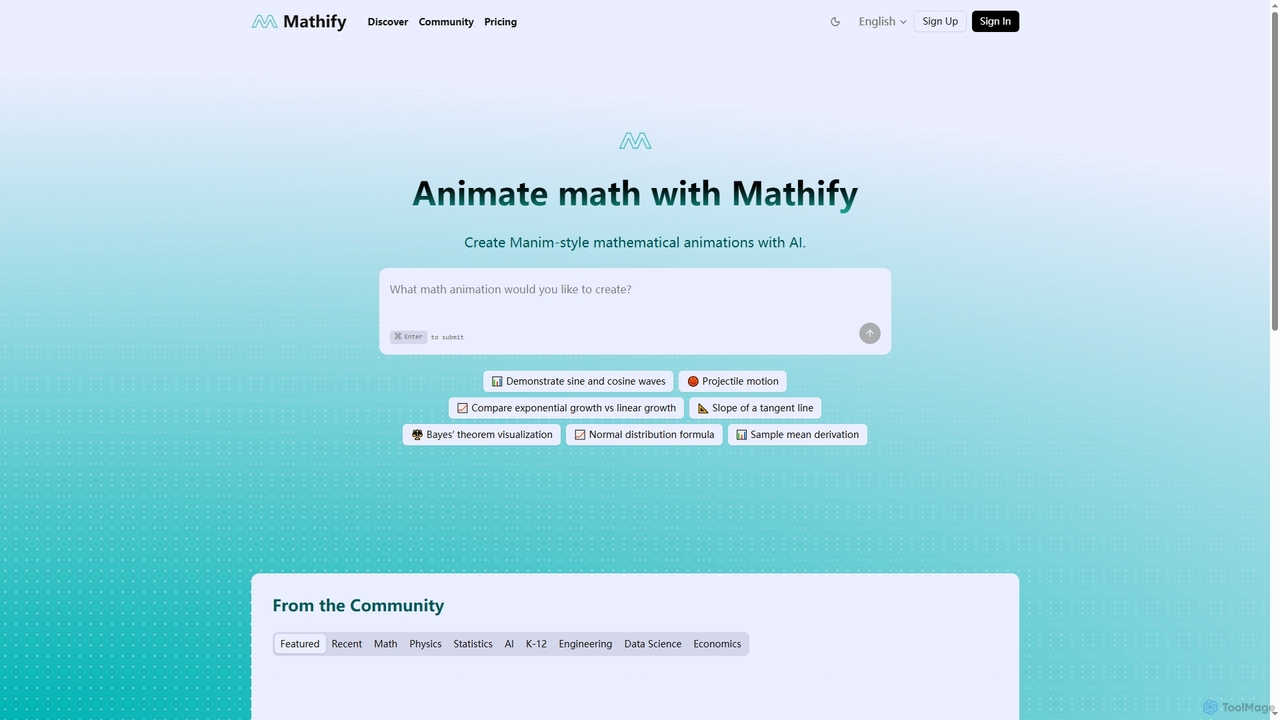
Mathify is an AI-powered tool that simplifies the creation of Manim-style mathematical animations. It enables users to visualize …
Mathify is an AI-powered tool that simplifies the creation of Manim-style mathematical animations. It enables users to visualize complex mathematical and scientific concepts, making abstract ideas more accessible for education, research, and content creation.
About Statistics
Statistics tools are AI-powered platforms designed to automate, enhance, and accelerate the process of statistical analysis, modeling, and inference. Leveraging advanced algorithms and machine learning, these tools efficiently process vast datasets to identify patterns, test hypotheses, and generate predictive models. They provide critical insights for informed decision-making across scientific research, business intelligence, and various analytical fields, serving as a powerful extension within the broader domain of scientific AI tools.
Core Features
- Automated Data Preprocessing: Cleans, transforms, and prepares raw data for analysis, handling missing values and outliers.
- Advanced Statistical Modeling: Implements complex regression, classification, clustering, and time-series models with minimal manual intervention.
- Hypothesis Testing Automation: Conducts various statistical tests (e.g., t-tests, ANOVA, chi-squared) and interprets results automatically.
- Predictive Analytics: Builds and validates predictive models to forecast future trends and outcomes based on historical data.
- Interactive Data Visualization: Generates dynamic charts, graphs, and dashboards to visually represent statistical findings and insights.
Use Cases
AI Statistics tools are invaluable for researchers analyzing experimental data, business analysts predicting market trends, and social scientists interpreting survey results. They streamline complex calculations, reduce human error, and enable deeper exploration of data relationships, accelerating discovery and improving strategic planning.
How to Choose
When selecting an AI Statistics tool, consider the range of statistical methods supported, its data integration capabilities with existing systems, and the intuitiveness of its user interface. Evaluate its scalability for handling large datasets, the explainability of its AI models, and the quality of its reporting features to ensure it meets specific analytical needs.
StatisticsUse Cases
Medical Research Data Analysis
Medical researchers utilize AI statistics tools to analyze vast datasets from clinical trials, identifying significant correlations between drug dosages and patient outcomes. These tools automate complex statistical tests, such as survival analysis and multivariate regression, to determine drug efficacy, predict adverse reactions, and optimize treatment protocols, significantly accelerating the discovery phase and improving patient safety assessments.
Market Trend Prediction
Business analysts in retail or finance employ AI statistics platforms to forecast consumer behavior and market shifts. By analyzing historical sales data, social media trends, and economic indicators, these tools build sophisticated predictive models that identify emerging trends, optimize inventory management, and inform strategic marketing campaigns, leading to more accurate business decisions.
Social Science Survey Interpretation
Sociologists and political scientists leverage AI statistics tools to process and interpret large-scale survey data, uncovering nuanced public opinions and demographic patterns. The tools perform advanced statistical analyses like factor analysis and structural equation modeling to validate hypotheses about societal trends, voter behavior, or educational impacts, providing robust evidence for policy recommendations.
Manufacturing Quality Control
Engineers in manufacturing use AI statistics tools to monitor production lines and predict potential defects. By analyzing sensor data from machinery, material properties, and environmental conditions, these tools identify statistical anomalies that indicate impending equipment failure or product quality issues, enabling proactive maintenance and process adjustments to minimize waste and improve product reliability.
Environmental Impact Modeling
Environmental scientists apply AI statistics tools to model complex ecological systems and predict environmental changes. Analyzing climate data, pollution levels, and biodiversity metrics, these tools can forecast the spread of invasive species, assess the impact of climate policies, or identify critical areas for conservation, supporting evidence-based environmental management strategies.
Financial Risk Assessment
Financial institutions deploy AI statistics tools for sophisticated risk assessment, particularly in credit scoring and fraud detection. These platforms analyze applicant financial histories, transaction patterns, and market volatility to build robust statistical models that predict default probabilities or identify suspicious activities, enhancing decision-making for loan approvals and safeguarding against financial crime.