Science Best in category 1 results Tools AI Tool

Popular AI tools in the Tools field of Science include Mushroomcheck, etc., helping you quickly improve efficiency.

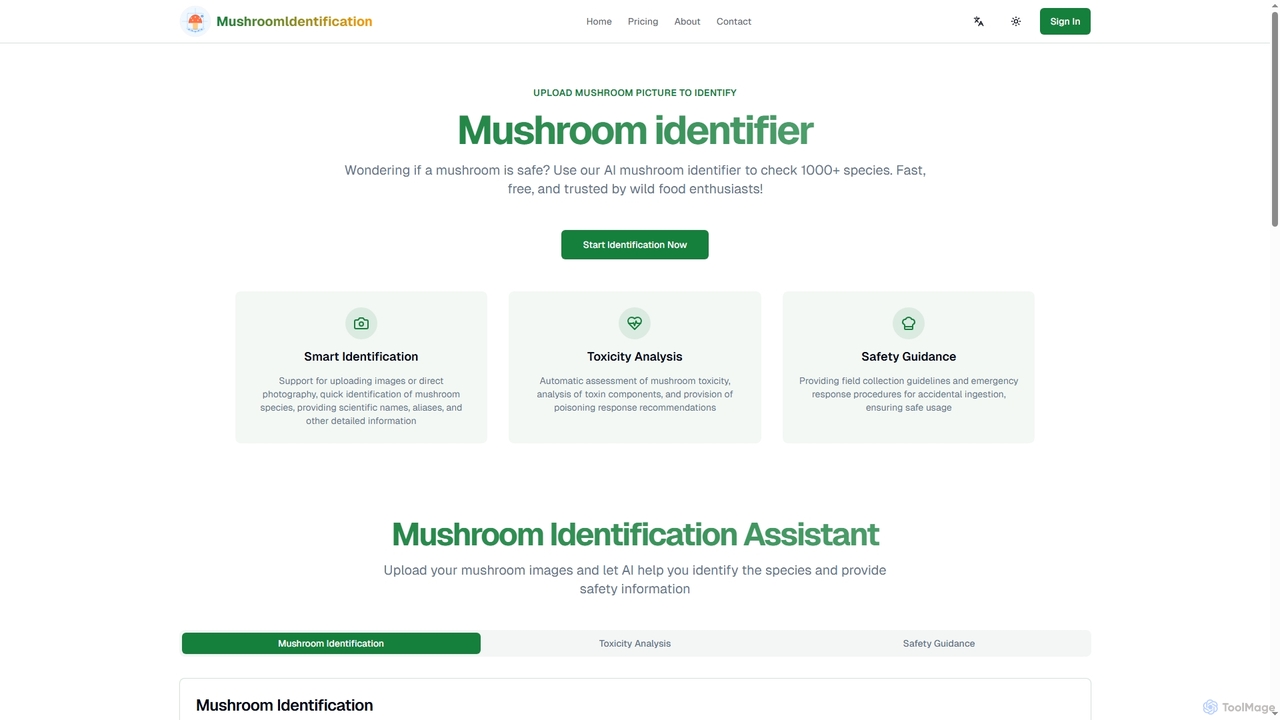
Mushroomcheck

Mushroomcheck

An AI-powered tool for identifying over 1,000 mushroom species from photos. It offers fast species recognition, toxicity analysis, …

3.3K

About Tools

AI Science Tools are a specialized category of software that applies artificial intelligence to accelerate scientific research and discovery. These tools leverage machine learning models, neural networks, and advanced algorithms to analyze complex scientific data, simulate experiments, and predict outcomes. Their primary value lies in uncovering patterns and insights from vast datasets that are beyond human capacity, significantly reducing research time and costs. They empower researchers to test hypotheses in virtual environments and generate new avenues for investigation.

Core Features

  • Predictive Modeling: Constructs models to forecast experimental results, molecular interactions, or physical phenomena based on existing data.
  • Complex Data Analysis: Processes and identifies significant patterns in large-scale datasets, such as genomic sequences, astronomical images, or climate data.
  • Computational Simulation: Creates dynamic virtual models to simulate complex systems, allowing for risk-free experimentation and analysis.
  • Hypothesis Generation: Analyzes existing literature and data to suggest novel research questions and potential correlations for further study.
  • Automated Data Interpretation: Automates the classification and interpretation of scientific images, signals, or other raw data outputs.

Use Cases

These tools are pivotal in fields like drug discovery, materials science, genomics, astrophysics, and climate modeling. For example, a biochemist might use an AI tool to predict a drug candidate's efficacy, while a climate scientist could use another to refine climate change projections by analyzing terabytes of satellite data.

How to Choose

When selecting an AI Science Tool, consider its specificity to your research domain (e.g., biology vs. physics). Evaluate its compatibility with your data formats, the validation and accuracy of its underlying models, its integration capabilities with lab instruments or databases, and the computational resources it requires.

ToolsUse Cases

1

Accelerating Drug Discovery Screening

A biochemist at a pharmaceutical company is tasked with screening thousands of chemical compounds to find potential drug candidates for a specific protein target. Instead of costly and time-consuming physical lab tests for every compound, they use an AI tool. The researcher inputs the 3D structure of the target protein and the chemical libraries. The AI model then predicts the binding affinity and potential efficacy of each compound, ranking the most promising ones in hours instead of months. This allows the research team to focus their physical testing resources only on the top candidates, drastically accelerating the preclinical phase of drug development.

2

Identifying Gene Mutations in Genomic Data

A geneticist is studying a rare disease and has access to whole-genome sequencing data from hundreds of patients. Manually comparing these vast datasets to find common mutations is nearly impossible. The researcher uses an AI-powered genomics tool to process and align the sequences. The tool's algorithm automatically flags statistically significant genetic variants that are prevalent in the patient group but absent in a control population. This pinpoints a small number of candidate genes for further investigation, providing a clear direction for subsequent functional studies and saving months of manual data analysis.

3

Predicting Properties of New Materials

A materials scientist aims to design a new alloy with specific properties like high tensile strength and corrosion resistance for the aerospace industry. Instead of the traditional trial-and-error method of physically creating and testing countless alloy combinations, they use an AI simulation tool. By inputting the elemental compositions and desired properties, the AI model runs thousands of virtual experiments. It predicts the atomic structure and resulting macroscopic properties of potential alloys, identifying a few highly promising candidates. This AI-driven approach significantly reduces material waste and lab time, enabling faster innovation in materials science.

4

Improving Climate Change Model Accuracy

A climatologist works on refining global climate models to produce more accurate long-term forecasts. These models depend on processing immense volumes of historical and real-time data from satellites, ocean buoys, and weather stations. The scientist uses an AI tool to identify complex, non-linear patterns in this data that traditional statistical methods might miss. The AI can detect subtle correlations between sea surface temperatures in one region and rainfall patterns in another, helping to improve the model's predictive algorithms. This leads to more reliable projections of future climate scenarios, which are crucial for policy-making and risk assessment.

5

Automating Classification of Astronomical Objects

An astrophysicist is analyzing images from a sky survey telescope, which generates millions of images of galaxies, stars, and other celestial objects. Manually classifying each object is an impossible task. They employ an AI tool trained on a large dataset of previously classified astronomical objects. The tool automatically processes new images, identifying and categorizing galaxies by type (e.g., spiral, elliptical) and flagging anomalies or potential new discoveries like supernovae. This automation allows the astrophysicist to focus on analyzing the interesting findings rather than on the tedious task of classification, dramatically increasing the pace of discovery.

6

Streamlining Scientific Literature Review

A PhD student is starting a new research project and needs to conduct a comprehensive literature review, a process that can take weeks. They use an AI tool designed for scientific literature analysis. The student inputs their core research keywords and questions. The AI scans millions of academic papers, summarizes the most relevant articles, identifies key themes and research gaps, and even generates a visual map of how different concepts and authors are connected. This provides the student with a structured overview of the current state of research in their field within a day, allowing them to formulate a novel hypothesis much more efficiently.

ToolsFrequently Asked Questions