Archbee
Archbee is an AI-powered knowledge portal platform designed for teams and customers. It transforms static documentation into interactive, …
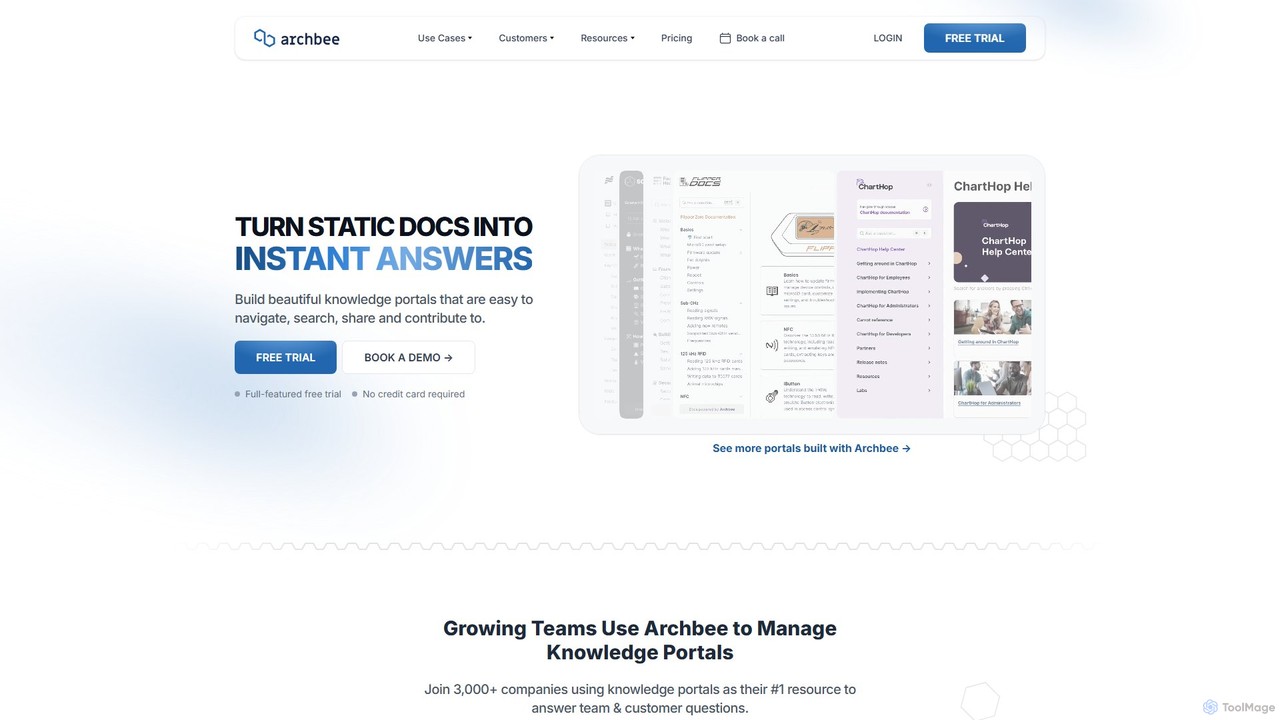
Archbee is an AI-powered knowledge portal platform designed for teams and customers. It transforms static documentation into interactive, searchable knowledge bases, enabling instant answers to questions. It's ideal for creating product docs, API documentation, internal wikis, and customer help centers with powerful collaboration and content management features.
About Wikis
AI Wikis are intelligent knowledge management platforms that leverage artificial intelligence to transform how teams create, organize, and access information. These tools utilize advanced natural language processing (NLP), machine learning, and semantic search capabilities to go beyond traditional static documentation, offering a more dynamic and interactive experience. They empower teams to build interconnected knowledge bases that are easier to navigate, update, and derive insights from, significantly enhancing team collaboration, decision-making, and overall productivity by making institutional knowledge readily available and actionable.
Core Features
- AI-Powered Content Generation: Automatically drafts summaries, expands notes, or generates new content, such as meeting minutes or project briefs, based on existing data or user prompts, saving significant time.
- Intelligent Search & Discovery: Provides semantic search, natural language querying, and personalized content recommendations, allowing users to find precise information quickly, even with vague queries.
- Knowledge Graph & Interlinking: Automatically identifies relationships between concepts, documents, and data points, building a dynamic knowledge graph for deeper insights and easier navigation through complex information structures.
- Automated Categorization & Tagging: Uses AI to automatically organize content, assign relevant tags, and suggest categories, reducing manual effort, improving consistency, and ensuring discoverability.
- Content Summarization & Q&A: Generates concise summaries of long documents, discussions, or threads, and can answer specific questions based on the wiki's content, accelerating information absorption.
Applicable Scenarios
AI Wikis are invaluable for organizations requiring efficient knowledge sharing and rapid information access across diverse teams. Software development teams use them for automated documentation of codebases, API specifications, and project requirements, ensuring all team members have up-to-date information. Marketing and sales teams leverage them to centralize product information, campaign strategies, customer insights, and competitive analysis, enabling faster response times and consistent messaging. Research institutions and consulting firms benefit from their ability to synthesize vast amounts of data, generate insightful reports, and manage complex projects, fostering a culture of informed decision-making and continuous learning.
How to Choose
When selecting an AI Wiki, carefully consider its AI capabilities, such as the sophistication of its content generation, intelligent search, summarization, and knowledge graph features. Evaluate its integration with your existing team collaboration tools, including project management software, communication platforms, and CRM systems, to ensure seamless workflows. Assess its scalability to accommodate your growing knowledge base and user numbers, and review its security protocols and data privacy policies, especially for sensitive information. Finally, prioritize user-friendliness, intuitive interfaces, and robust access controls to ensure broad adoption and effective knowledge contribution across your team.

WikisUse Cases
Streamlining Onboarding with Personalized Knowledge Paths
HR and team leads can utilize AI Wikis to create dynamic onboarding experiences for new employees. By inputting a new hire's role and department, the AI Wiki can automatically curate a personalized learning path, linking relevant documents, training modules, and team contacts. This reduces the manual effort of preparing onboarding materials and ensures new team members quickly access the specific knowledge they need, accelerating their integration and productivity by up to 30%.
Automated Documentation for Software Development Projects
Software development teams can leverage AI Wikis to automate the creation and maintenance of technical documentation. As code is committed or project specifications are updated, the AI can analyze changes and automatically generate or update API documentation, user manuals, and feature descriptions. This ensures documentation remains current without significant manual overhead, allowing developers to focus on coding while maintaining a comprehensive and accessible knowledge base for the entire team.
Enhancing Customer Support with an Intelligent Knowledge Base
Customer support teams can transform their internal knowledge base into an intelligent resource using AI Wikis. Agents can use natural language queries to instantly find answers to complex customer issues, even if the exact keywords aren't present. The AI can also suggest related articles or solutions based on the query context, reducing average handling time by 20% and improving first-call resolution rates by providing quick, accurate information to support staff.
Centralizing Marketing Campaign Strategy and Assets
Marketing teams can use AI Wikis to centralize all aspects of their campaign strategies, from initial brainstorming to asset management. The AI can help organize campaign briefs, target audience research, content calendars, and digital assets, automatically linking related materials. This ensures all team members have a single source of truth for campaign details, facilitating seamless collaboration, reducing information silos, and accelerating campaign execution by ensuring consistent messaging and easy access to approved assets.
Synthesizing Research and Generating Insight Reports
Analysts and researchers in consulting or R&D can utilize AI Wikis to synthesize vast amounts of information from various sources. By ingesting research papers, market reports, and internal data, the AI can identify key themes, summarize findings, and even draft initial insight reports or executive summaries. This significantly reduces the time spent on manual data aggregation and analysis, allowing experts to focus on deeper interpretation and strategic recommendations, accelerating research cycles.
Facilitating Cross-Functional Project Knowledge Sharing
Cross-functional project teams can use AI Wikis to create a dynamic, shared knowledge hub for all project-related information. From meeting notes and decision logs to technical specifications and stakeholder feedback, the AI automatically links related content and provides intelligent search. This ensures every team member, regardless of department, has access to the latest project status, historical context, and critical decisions, fostering transparency and improving project coordination and delivery efficiency.