Setapp
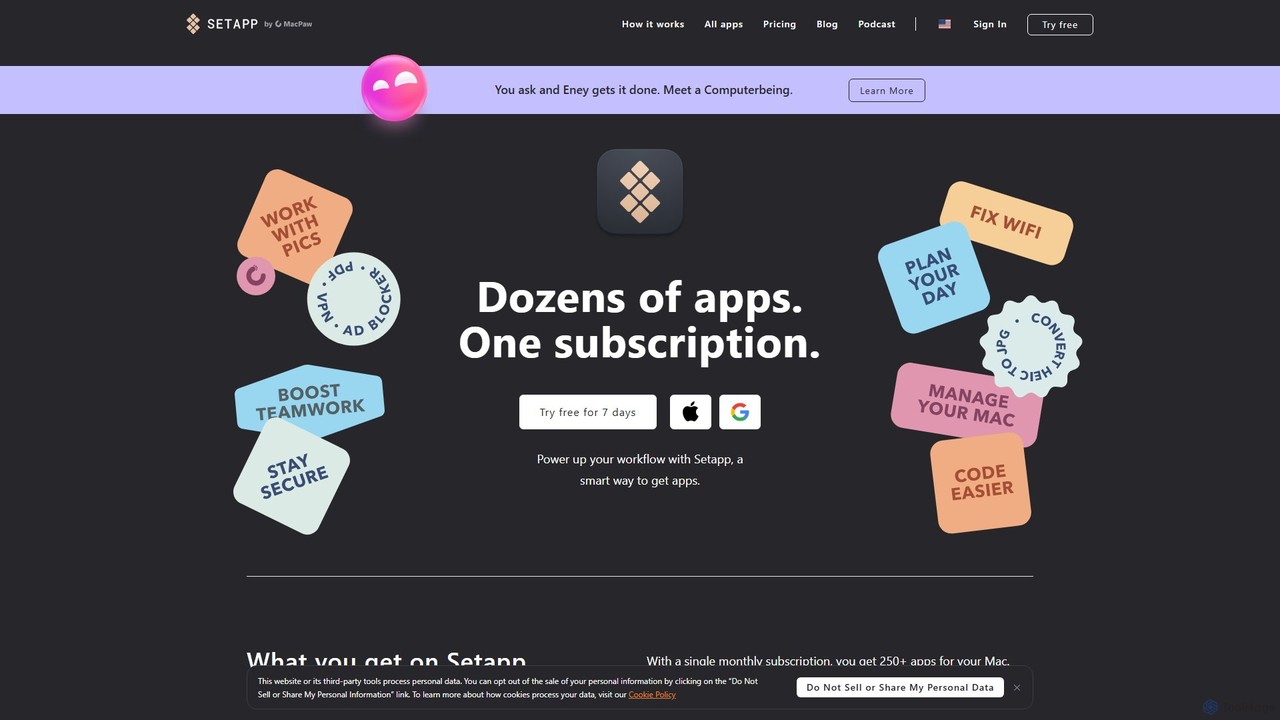
Setapp is a subscription service for macOS and iOS, offering unlimited access to a curated library of over …
Setapp is a subscription service for macOS and iOS, offering unlimited access to a curated library of over 250+ high-quality applications for a single monthly fee. It acts as a unified toolkit for various tasks, from productivity and development to system maintenance and creative work, simplifying software acquisition and management.
4DDiG
4DDiG is a comprehensive AI-powered software suite for Windows and Mac, specializing in data recovery, file repair, and …
4DDiG is a comprehensive AI-powered software suite for Windows and Mac, specializing in data recovery, file repair, and system utilities. It recovers over 2000 data types from various storage devices, repairs corrupted photos and videos with AI enhancement, and offers tools for system maintenance like partition management and DLL fixing.
About System Maintenance
AI System Maintenance tools are a specialized category of utilities that use artificial intelligence to proactively monitor, analyze, and optimize the health and performance of computer systems. Leveraging machine learning models, these tools can predict potential failures, detect subtle anomalies, and automate complex maintenance tasks that traditionally require significant manual intervention. Their primary value lies in transforming system administration from a reactive to a predictive model, significantly reducing downtime and improving operational efficiency. This intelligent approach allows for self-healing capabilities and data-driven resource management.
Core Features
- Predictive Failure Analysis: Uses historical data and ML algorithms to forecast potential hardware or software issues before they cause outages.
- Automated Anomaly Detection: Continuously monitors system metrics to identify unusual patterns that may indicate performance degradation or security threats.
- Intelligent Resource Optimization: Dynamically allocates resources like CPU and memory based on real-time workload analysis to ensure optimal performance.
- Automated Root Cause Analysis: Quickly pinpoints the source of system errors or performance bottlenecks by analyzing logs and dependency maps.
- Self-Healing and Remediation: Automatically executes corrective actions, such as restarting services or applying patches, to resolve detected issues.
Applicable Scenarios
These tools are essential for IT operations (ITOps), Site Reliability Engineering (SRE), and DevOps teams managing complex infrastructures. They are widely used in data centers, cloud environments (AWS, Azure, GCP), and large enterprises to maintain the stability of critical servers, applications, and networks. For instance, an e-commerce platform can use them to prevent website crashes during peak traffic, and a financial institution can ensure the uninterrupted operation of its trading systems.
Selection Criteria
When choosing an AI System Maintenance tool, consider its integration capabilities with your existing monitoring stack (e.g., Prometheus, Datadog). Evaluate the scope of its automation, from simple alerting to fully automated remediation. Assess its scalability to ensure it can handle your infrastructure's growth. Finally, examine the clarity of its analytics and reporting to ensure the insights provided are actionable for your team.

System MaintenanceUse Cases
Proactive Server Hardware Failure Prediction
A data center administrator is responsible for maintaining hundreds of physical servers. Instead of waiting for a critical failure, they use an AI System Maintenance tool to analyze sensor data, error logs, and performance history. The AI model identifies a server's power supply unit is showing early signs of degradation, predicting a 95% chance of failure within the next 72 hours. The system automatically creates a high-priority ticket with all diagnostic data. The administrator can then schedule a replacement during a planned maintenance window, preventing unexpected downtime and data loss for their clients.
Automated Performance Tuning for Web Applications
A DevOps engineer for an e-commerce site needs to ensure high availability and low latency, especially during sales events. An AI System Maintenance tool continuously monitors application performance metrics (APM) and infrastructure load. When it detects a growing user load, the AI predicts a potential bottleneck in the database connection pool. Instead of just sending an alert, the tool automatically executes a pre-approved playbook to scale up the database replicas and re-allocate memory. This self-healing action maintains a smooth user experience without any manual intervention, even during unpredictable traffic spikes.
Intelligent Security Patch Management
An IT security team for a large corporation manages thousands of endpoints. Manually prioritizing and deploying security patches is overwhelming. They implement an AI System Maintenance tool that correlates vulnerability data from CVE databases with their internal asset inventory and network topology. The AI prioritizes patches not just by severity, but by the actual risk they pose to critical systems. It identifies which systems are publicly exposed or house sensitive data, pushing those patches to the top of the queue. The tool then automates the deployment and verification process, reducing the window of exposure from weeks to hours.
Cloud Cost Optimization via Resource Management
A cloud architect aims to reduce their company's monthly cloud spending without impacting performance. They use an AI System Maintenance tool that analyzes historical and real-time usage patterns of their cloud resources (VMs, databases, storage). The AI identifies that a cluster of development servers is over-provisioned and mostly idle during weekends. Based on this insight, the tool automatically generates and applies a schedule to scale down these resources on Friday evening and scale them back up on Monday morning, resulting in significant cost savings. It also flags orphaned resources, like unattached storage volumes, for deletion.
Automated Log Analysis for Troubleshooting
A Site Reliability Engineer (SRE) receives an alert about intermittent application errors. Manually sifting through millions of log entries from dozens of microservices is a daunting task. They feed the logs into an AI System Maintenance tool. The AI uses Natural Language Processing (NLP) and anomaly detection to cluster the logs, filter out the noise, and identify a rare error message that correlates perfectly with the timeline of the incidents. The tool highlights the specific microservice and code line responsible, reducing the mean time to resolution (MTTR) from hours to minutes and allowing the SRE to focus on fixing the bug rather than finding it.
Network Anomaly Detection for Security
A network administrator for a financial services company needs to protect against sophisticated cyber threats. They deploy an AI System Maintenance tool that establishes a baseline of normal network traffic patterns. The tool then monitors traffic in real-time. It detects a subtle but unusual pattern: a workstation is communicating with an external server in a foreign country at 3 AM, using an encrypted protocol it has never used before. This deviates from the established baseline. The AI flags this as a high-risk anomaly, potentially indicating a malware infection or data exfiltration attempt, and automatically quarantines the workstation from the network to prevent further damage while alerting the security team.