Ai Infrastructure Best in category 2 results Model Orchestration AI Tool

Popular AI tools in the Model Orchestration field of Ai Infrastructure include Trigger.dev、Gtwy, etc., helping you quickly improve efficiency.

Gtwy

Gtwy

Gtwy is a unified AI gateway platform providing a single API to access top models like GPT-4, Claude, …

3.7K
Trigger.dev

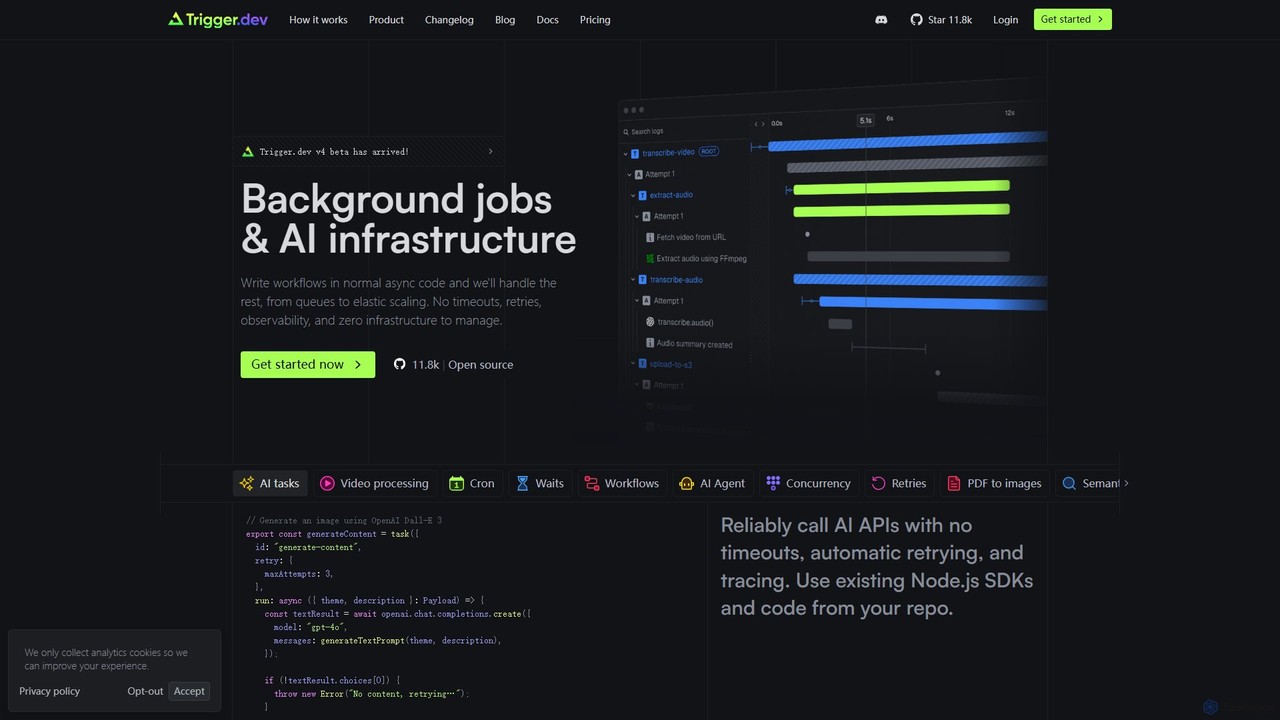
Trigger.dev

Trigger.dev is an open-source platform for developers to build, run, and manage long-running background jobs and AI workflows. …

337.6K

About Model Orchestration

Model Orchestration is a category of AI tools designed to manage, deploy, and coordinate multiple AI models to work together seamlessly within complex applications. These platforms enable the creation of sophisticated AI workflows by chaining models, managing data flow, and ensuring efficient resource utilization. They are essential for building robust, scalable, and adaptable AI systems that leverage diverse model capabilities within the broader AI infrastructure.

Core Features

  • Model Deployment & Management: Streamlined deployment of various AI models (e.g., LLMs, vision models) and their lifecycle management.
  • Workflow Chaining: Tools to connect and sequence multiple models, allowing the output of one to feed into the input of another.
  • Data & API Integration: Seamless integration with data sources and external APIs to facilitate model inputs and outputs.
  • Monitoring & Observability: Real-time tracking of model performance, resource usage, and workflow execution for debugging and optimization.
  • Version Control & Experimentation: Managing different model versions and facilitating A/B testing or experimentation with new model configurations.

Use Cases

Enterprises building multi-stage AI applications, data scientists managing complex model pipelines, and developers creating intelligent agents that combine different AI capabilities. It's used in scenarios requiring dynamic model selection and adaptive AI responses across various industries.

How to Choose

Consider the range of model types supported, ease of integration with existing infrastructure, scalability for future growth, and the robustness of monitoring and debugging tools. Evaluate the flexibility in defining complex workflows, security features, and the cost-effectiveness of the platform for your specific needs.

Model OrchestrationUse Cases

1

Building Multi-Agent AI Systems

AI developers create sophisticated AI agents that combine specialized models for tasks like natural language understanding, image generation, and decision-making. Model orchestration tools manage the interaction, data exchange, and sequential execution between these diverse models, enabling the agent to perform complex, multi-modal tasks autonomously and efficiently.

2

Automating Complex Data Processing Pipelines

Data engineers and analysts use orchestration platforms to build automated pipelines where raw data is processed through a series of AI models. For instance, text data might first go through a sentiment analysis model, then an entity extraction model, and finally a summarization model, with orchestration ensuring smooth data flow and error handling at each stage, saving significant manual effort.

3

Dynamic AI Response Generation

Customer service platforms leverage model orchestration to dynamically select and combine AI models based on user queries. A query might first be classified by a topic model, then routed to a relevant knowledge base search model, and finally summarized or rephrased by a large language model, providing a highly personalized and accurate response in real-time, improving customer satisfaction.

4

Optimizing Resource Allocation for AI Workloads

Cloud architects and MLOps teams utilize model orchestration to efficiently manage computational resources for various AI models. These tools can dynamically scale model deployments up or down based on demand, route requests to the most cost-effective or performant model instance, and ensure high availability for critical AI services, leading to significant cost savings and improved reliability.

5

Developing Adaptive Content Creation Workflows

Content creators and marketers employ orchestration to generate diverse content types. A workflow might involve an image generation model, followed by an object detection model to tag elements, and then a text generation model to write descriptions, all coordinated to produce rich, multi-modal content tailored to specific campaigns, significantly accelerating content production cycles.

6

Real-time Fraud Detection with Chained Models

Financial institutions implement model orchestration for real-time fraud detection. Transactions are passed through a sequence of models: first, a rule-based engine for initial checks, then a machine learning model for anomaly detection, and finally, a deep learning model for behavioral analysis. Orchestration ensures low-latency execution and immediate flagging of suspicious activities, minimizing financial risks.

Model OrchestrationFrequently Asked Questions