David AI
David AI provides high-quality, research-grade audio datasets for training advanced speech and conversational AI models. It offers diverse, …
David AI provides high-quality, research-grade audio datasets for training advanced speech and conversational AI models. It offers diverse, large-scale datasets, including multilingual conversations, multi-speaker audio, and expert dialogues, with options for custom dataset creation to unlock new AI capabilities.
Lilac
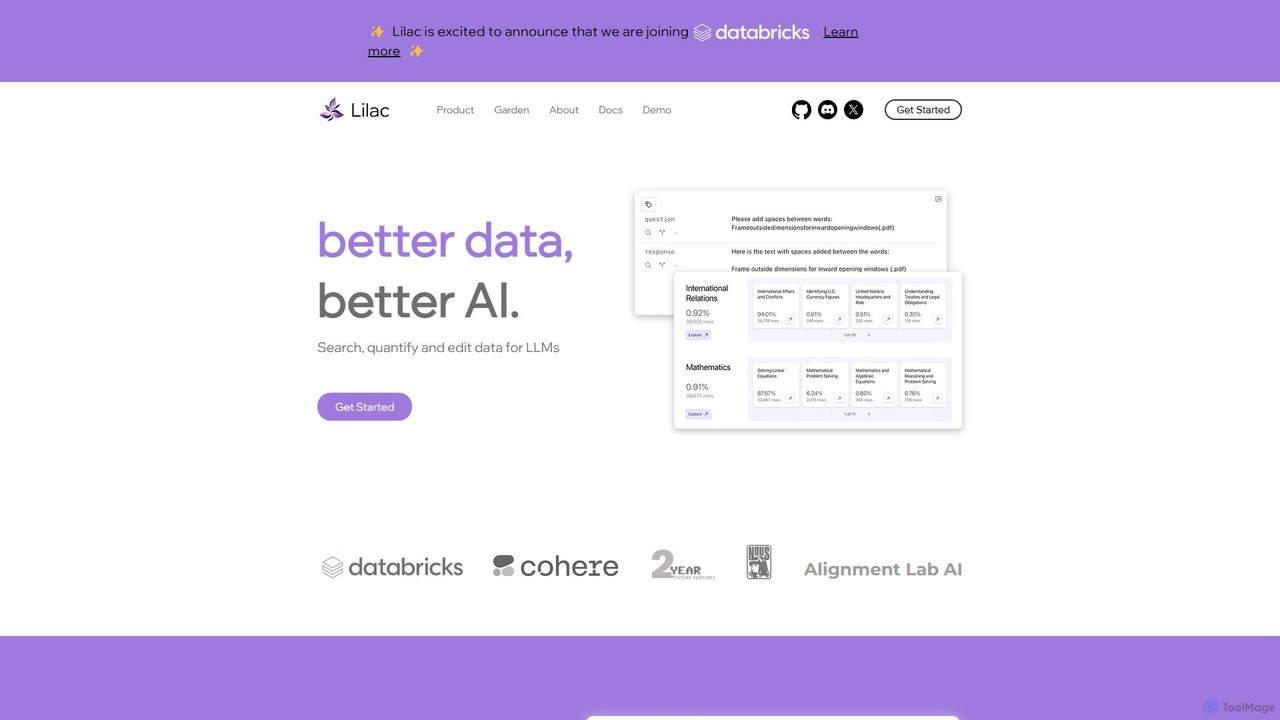
Lilac is an open-source tool for data scientists and ML engineers to explore, clean, and improve datasets for …
Lilac is an open-source tool for data scientists and ML engineers to explore, clean, and improve datasets for large language models (LLMs). It offers powerful semantic search, data clustering, and quality analysis to build better AI.
About Model Training
Model Training tools are specialized AI infrastructure components that provide environments and resources for building, refining, and optimizing machine learning models. These platforms enable data scientists and developers to iteratively train algorithms using vast datasets, transforming raw data and code into high-performing, deployable AI solutions. They are essential for achieving the desired accuracy and efficiency required for real-world AI applications.
Core Features
- Data Preprocessing & Augmentation: Tools for cleaning, transforming, and expanding datasets to improve model robustness.
- Algorithm Selection & Customization: Support for various machine learning algorithms and frameworks, allowing for tailored model development.
- Hyperparameter Tuning: Automated or guided optimization of model parameters to maximize performance.
- Distributed Training: Ability to scale training across multiple GPUs or machines for faster processing of large datasets.
- Model Evaluation & Validation: Metrics and tools to assess model accuracy, bias, and generalization capabilities.
Applicable Scenarios
Model training tools are indispensable for organizations developing custom AI solutions. Data science teams use them to build predictive analytics models for financial forecasting, healthcare diagnostics, and customer behavior analysis. AI researchers leverage these platforms to experiment with novel neural network architectures and advance the state-of-the-art in machine learning.
How to Choose
When selecting a model training platform, consider its scalability to handle your data volume and computational needs, support for your preferred AI frameworks (e.g., TensorFlow, PyTorch), and integration capabilities with other MLOps tools. Evaluate the cost-effectiveness, data security features, and the level of automation provided for tasks like hyperparameter tuning and experiment tracking.
Model TrainingUse Cases
Developing Custom Fraud Detection Models
Financial institutions' data scientists utilize model training platforms to build and refine AI models capable of identifying fraudulent transactions. By feeding historical transaction data, including both legitimate and fraudulent cases, into these platforms, they can iteratively train models to recognize complex patterns indicative of fraud. This process involves selecting appropriate algorithms, tuning hyperparameters, and evaluating model performance against new data, ultimately leading to a robust system that can flag suspicious activities in real-time, significantly reducing financial losses.
Optimizing Computer Vision Models for Manufacturing
Engineers in manufacturing leverage model training tools to optimize computer vision models for quality control and defect detection. By training models on vast datasets of product images, including both flawless and defective items, they can fine-tune the AI to accurately identify anomalies on production lines. This leads to automated inspection systems that reduce manual errors, increase throughput, and ensure consistent product quality, saving significant operational costs and improving customer satisfaction.
Training NLP Models for Customer Service Chatbots
AI developers train Natural Language Processing (NLP) models using specialized platforms to power intelligent customer service chatbots. By feeding the models with large volumes of customer queries, conversation logs, and knowledge base articles, they teach the AI to understand user intent, extract key information, and generate relevant responses. This iterative training process enhances the chatbot's ability to handle diverse inquiries, reduce response times, and improve overall customer satisfaction, freeing up human agents for more complex issues.
Personalizing Content Recommendation Engines
Media companies and e-commerce platforms utilize model training tools to build and continuously refine recommendation engines that personalize content for users. Data scientists train collaborative filtering or deep learning models on user interaction data (e.g., views, purchases, ratings) to predict preferences. This leads to highly accurate recommendations for movies, products, or articles, significantly increasing user engagement, conversion rates, and overall revenue by presenting relevant content tailored to individual tastes.
Improving Medical Image Diagnosis Accuracy
Healthcare researchers and medical AI developers use model training platforms to enhance the accuracy of diagnostic AI models for medical imaging. By training deep learning models on vast, annotated datasets of X-rays, MRIs, and CT scans, they enable the AI to detect subtle anomalies indicative of diseases like cancer or pneumonia. This rigorous training process helps create AI assistants that can support radiologists in making faster, more accurate diagnoses, potentially saving lives and improving patient outcomes.
Developing Predictive Maintenance Models
Industrial engineers and data scientists in manufacturing and energy sectors leverage model training tools to build predictive maintenance models. By training AI on sensor data from machinery, historical failure logs, and operational parameters, they can predict equipment breakdowns before they occur. This enables proactive maintenance scheduling, reduces costly downtime, extends asset lifespan, and optimizes operational efficiency, leading to significant cost savings and improved safety across industrial operations.