ToolMage
Sign in

Best 25 Ai Models AI tools

Popular Ai Models AI tools include Google AI for Developers, Google AI, Cerebras, Hume AI, PricePerToken, Upstage, Moondream, Darknet, Cleora, and Ray3, helping you work more efficiently.

AgentQL
Freemium

AgentQL

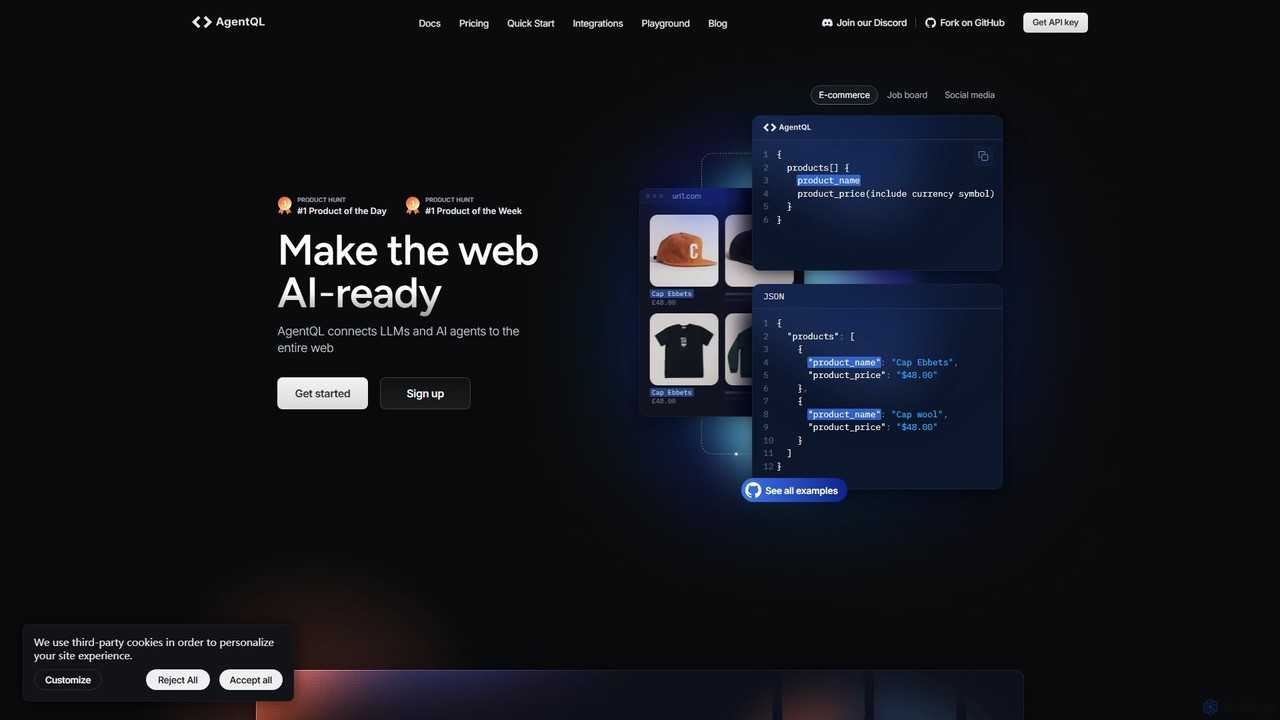
AgentQL is a developer toolset that connects LLMs and AI agents to the web. It uses an AI-powered query language to robustly extract structured data and automate web interactions, serving as a powerful, self-healing alternative to fragile XPath and CSS selectors.

Llm
Visits 25.3KFavorites 128Likes 139

About Ai Models

AI Models are foundational algorithms trained on vast datasets to recognize patterns, make predictions, or generate new content. These models, often built on neural network architectures, form the core intelligence behind various AI applications. They enable software to understand language, interpret images, and forecast trends with remarkable accuracy. Accessing these models, often via APIs, allows developers and businesses to integrate advanced AI capabilities into their products and workflows without building them from scratch.

Core Features

  • Predictive Analysis: Forecasts future outcomes or trends based on historical data patterns.
  • Natural Language Processing (NLP): Understands, interprets, and generates human language for tasks like translation or summarization.
  • Computer Vision: Processes and analyzes visual information from images or videos to identify objects and scenes.
  • Generative Capabilities: Creates original content, including text, images, code, or audio, based on input prompts.
  • Fine-Tuning & Customization: Allows adaptation of a pre-trained model to specific tasks or datasets for improved performance.

Use Cases

AI Models are utilized across numerous sectors. Developers integrate them into applications to power features like intelligent chatbots or recommendation engines. Data scientists use them for complex data analysis, such as fraud detection in finance or medical diagnosis in healthcare. Enterprises deploy them to automate internal processes, optimize supply chains, and gain competitive insights from market data.

How to Choose

Selecting an AI Model depends on your specific needs. First, evaluate the model's primary function (e.g., language, vision, data analysis) and its performance on relevant benchmarks. Consider the ease of integration, focusing on API documentation, SDKs, and community support. Assess the pricing structure—whether it's pay-per-use, subscription-based, or open-source. Finally, consider scalability and the provider's infrastructure to ensure it can handle your expected workload.

Featured tool rankings

Ai Models use cases

1

Building an Intelligent Customer Service Chatbot

A developer at an e-commerce company is tasked with reducing customer support response times. By integrating a powerful Natural Language Processing (NLP) model via its API, they build a chatbot. This chatbot can understand complex customer queries, access order information, and provide instant, accurate responses 24/7. The result is a significant reduction in support tickets and an increase in customer satisfaction, as users get immediate help without waiting for a human agent.

2

Automating Marketing Content Creation

A marketing team needs to produce a high volume of content for social media, blogs, and email campaigns. They use a generative AI model specialized in text creation. By providing brief outlines or keywords, the model generates well-structured drafts for blog posts, multiple variations of ad copy, and engaging social media captions. This allows the team to scale their content production efforts, maintain a consistent publishing schedule, and focus more time on strategy and creative direction rather than manual writing.

3

Developing a Product Recommendation Engine

An online retail platform wants to increase user engagement and sales. A data scientist on the team uses a predictive AI model trained on user browsing history, purchase data, and product attributes. The model identifies patterns and predicts which products a user is most likely to be interested in. This personalized recommendation engine is then integrated into the website, showing relevant products on the homepage and product pages, leading to higher conversion rates and improved customer loyalty.

4

Analyzing Medical Images for Diagnostics

In a healthcare research setting, a radiologist uses a computer vision model trained to detect anomalies in medical scans like X-rays and MRIs. By uploading a scan, the model highlights potential areas of concern that might be subtle to the human eye. This serves as a powerful second opinion, helping the radiologist to identify potential issues faster and with greater confidence. The use of the model streamlines the diagnostic workflow and can contribute to earlier detection of diseases.

5

Real-Time Financial Fraud Detection

A financial technology company needs to protect its users from fraudulent transactions. They deploy a machine learning model that analyzes transaction data in real-time, including amount, location, time, and user history. The model is trained to recognize patterns indicative of fraud. When a suspicious transaction occurs, the model flags it instantly, allowing the system to block the payment and notify the user. This proactive approach significantly reduces financial losses for both the company and its customers.

6

Assisting Software Development with Code Generation

A software developer is working on a complex new feature and needs to write a significant amount of boilerplate code. Instead of writing it manually, they use a code generation AI model. By describing the required function in natural language, the model generates clean, efficient code in the desired programming language. It can also be used to explain existing code snippets, suggest bug fixes, and translate code from one language to another, dramatically speeding up the development cycle and reducing human error.

Ai Models FAQ

What is an AI Model?

An AI Model is a digital file or program that has been trained on a set of data to recognize certain types of patterns or perform specific tasks. It is the core component of an AI system that makes decisions or predictions. For example, a language model predicts the next word in a sentence, while a computer vision model can identify objects in an image. These models are the engines that power AI applications.

How do I choose the right AI Model for my project?

To choose the right AI model, consider these factors:

  • Task Specificity: Does the model specialize in your required task (e.g., text generation, image classification, data prediction)?
  • Performance: Evaluate its accuracy, speed, and other relevant metrics on benchmarks that resemble your use case.
  • Integration & API: Check for clear documentation, available SDKs, and ease of integration into your existing tech stack.
  • Cost: Understand the pricing model (e.g., per API call, per token, subscription) and how it scales with usage.
  • Customization: Determine if you need a pre-trained model for general tasks or one that can be fine-tuned with your own data for specialized needs.
What's the difference between a pre-trained model and a custom model?

A pre-trained model is a general-purpose model developed by organizations like Google or OpenAI and trained on massive, diverse datasets. It's ready to use for a wide range of common tasks. A custom model, on the other hand, is either built from scratch or, more commonly, is a pre-trained model that has been further trained (fine-tuned) on a specific, smaller dataset. This fine-tuning makes the model an expert in a particular niche, often yielding higher accuracy for that specific task than a general-purpose model.

What are the main types of tasks AI Models can perform?

AI Models can perform a wide variety of tasks, which generally fall into several categories:

  • Classification: Assigning a label to an input, such as spam detection in emails or sentiment analysis of text.
  • Regression: Predicting a continuous value, like forecasting stock prices or estimating property values.
  • Generation: Creating new data, such as writing text, composing music, or generating realistic images.
  • Clustering: Grouping similar data points together without pre-existing labels, used in customer segmentation or anomaly detection.
  • Translation: Converting information from one form to another, like translating between languages or transcribing speech to text.
Who typically uses AI Models?

AI Models are used by a diverse range of individuals and organizations. Software developers and engineers integrate model APIs into applications to create intelligent features. Data scientists and researchers use models to analyze data, test hypotheses, and build predictive systems. Businesses and enterprises deploy them to automate workflows, enhance customer service, and gain market insights. Even content creators and marketers use generative models to assist in creating text, images, and other media.