Finsheet
Finsheet is a powerful add-on for Excel and Google Sheets, providing institutional-grade financial data directly into your spreadsheets. …
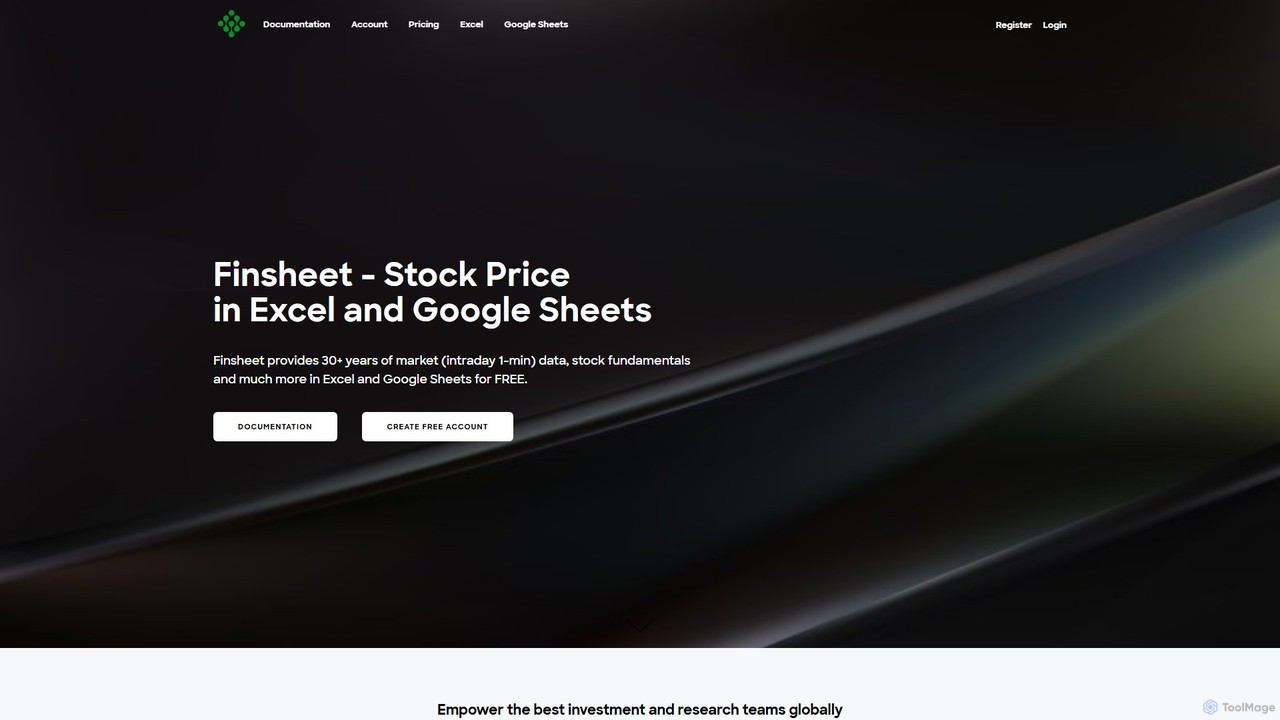
Finsheet is a powerful add-on for Excel and Google Sheets, providing institutional-grade financial data directly into your spreadsheets. Access over 30 years of historical and real-time data for global stocks, ETFs, forex, and cryptocurrencies. With simple, no-code functions, investors and analysts can easily perform market research, build financial models, and monitor portfolios without leaving their favorite spreadsheet application.
About Market Data
Market Data tools are AI-powered platforms that aggregate, analyze, and deliver real-time and historical information from financial, consumer, and industry markets. These tools utilize machine learning algorithms and extensive API connections to process vast datasets, identifying trends, patterns, and predictive signals that are not apparent through manual analysis. They provide crucial intelligence for making informed investment decisions, conducting competitive analysis, and formulating business strategies. By transforming raw data into actionable insights, these platforms empower users to react swiftly to market changes and uncover new opportunities.
Core Features
- Real-Time Data Feeds: Access to live-streaming data for stocks, cryptocurrencies, commodities, and foreign exchange markets with low latency.
- Historical Data Analysis: Provides extensive historical datasets for backtesting trading strategies and performing long-term trend analysis.
- Sentiment Analysis: Scans news articles, social media, and financial reports to gauge market sentiment towards specific assets or brands.
- Predictive Modeling: Employs machine learning models to forecast price movements, volatility, and market trends based on historical patterns.
- API Access & Integration: Offers robust APIs for integrating market data directly into custom applications, trading bots, or internal dashboards.
Use Cases
These tools are essential for financial institutions, including hedge funds and investment banks, for algorithmic trading and portfolio management. Corporate strategy teams use them to monitor industry trends, track competitors, and assess market entry opportunities. Additionally, market researchers and economists rely on this data for macroeconomic analysis and consumer behavior studies.
How to Choose
When selecting a Market Data tool, consider the breadth and depth of its data coverage across different asset classes and regions. Evaluate the data's update frequency and latency to ensure it meets your needs for timeliness. Assess the platform's built-in analytical capabilities, such as charting tools and predictive analytics. Finally, examine the quality of its API documentation and integration support if you plan to build custom solutions.

Market DataUse Cases
Backtesting Algorithmic Trading Strategies
A quantitative analyst at a hedge fund needs to validate a new trading algorithm before deploying it with real capital. Using a Market Data tool, they access decades of granular historical price data for specific stocks and indices. The analyst runs simulations of the algorithm against this historical data to measure its hypothetical performance, including profitability, maximum drawdown, and risk-adjusted returns. This process allows them to refine parameters, identify weaknesses, and gain confidence in the strategy's viability, significantly reducing the risk of live trading losses.
Monitoring Competitor Pricing in E-commerce
An e-commerce manager for a consumer electronics brand needs to maintain competitive pricing. They use a Market Data tool with web scraping capabilities to automatically track the prices of their key products across major online retailers and marketplaces in real-time. The tool aggregates this data into a dashboard, highlighting price changes and flagging when their prices are no longer competitive. This automated intelligence allows the manager to implement a dynamic pricing strategy, adjusting prices swiftly to match market conditions, maximize sales, and protect profit margins without hours of manual research.
Assessing Market Entry into a New Region
A corporate strategist is tasked with evaluating the potential of expanding their company's services into Southeast Asia. They leverage a Market Data platform that provides macroeconomic indicators, consumer spending habits, demographic data, and industry-specific growth forecasts for the region. The AI tool analyzes this data to generate a market opportunity score for each country, identifying the most promising locations. It also provides insights into the competitive landscape and potential regulatory hurdles. This data-driven approach replaces months of manual research, enabling a faster, more accurate decision on where to invest resources for international growth.
Gauging Public Sentiment for Brand Management
A public relations manager for a global automotive brand wants to track public perception following a major product recall. They use a Market Data tool that specializes in sentiment analysis. The tool continuously scans millions of news articles, blog posts, and social media mentions related to the brand and the recall. It then classifies the sentiment as positive, negative, or neutral and visualizes trends over time. This allows the PR team to measure the effectiveness of their crisis communication efforts, identify key concerns among the public, and proactively address negative narratives before they escalate.
Identifying Undervalued Real Estate Investments
A real estate investment firm aims to find undervalued properties in emerging urban areas. They use a specialized Market Data tool that aggregates property listings, historical sales prices, rental yield data, local demographic shifts, and new infrastructure projects. The AI analyzes these diverse datasets to identify neighborhoods with high growth potential that the broader market may have overlooked. The platform generates reports highlighting specific properties that are priced below the tool's estimated market value, allowing the firm to focus its acquisition efforts on assets with the highest potential for appreciation.
Forecasting Commodity Prices for Supply Chain Management
A supply chain manager for a large manufacturing company needs to anticipate fluctuations in raw material costs, such as aluminum and copper. They use an AI Market Data tool that analyzes historical commodity prices, shipping costs, geopolitical news, and even weather pattern data. The tool's predictive models generate short-term and long-term price forecasts for key commodities. This foresight enables the manager to make strategic procurement decisions, such as locking in prices with suppliers in advance or adjusting inventory levels, thereby mitigating the risk of cost overruns and ensuring production stability.