ToolMage
Sign in

Best 1 Personal Data AI tools for Data

Popular Personal Data AI tools in Data include Screenpipe, helping you work more efficiently.

Screenpipe
Freemium

Screenpipe

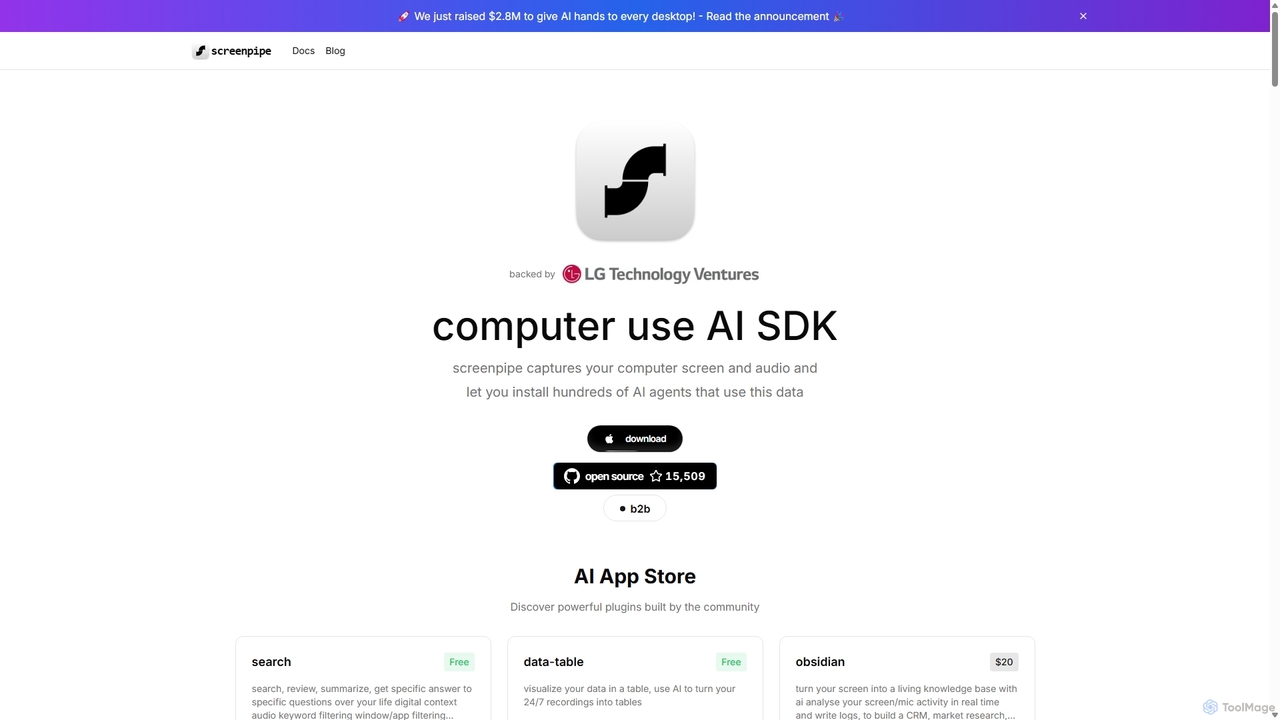
Screenpipe is an open-source AI SDK that captures your computer's screen and audio 24/7, creating a local, private digital memory. It powers a rich ecosystem of AI agents that can search, summarize, and automate tasks based on your complete digital context, turning your computer usage into a powerful, personalized AI.

Personal Data
Visits 56KFavorites 96Likes 111

About Personal Data

Personal Data tools are AI-powered solutions designed to manage, protect, and analyze information directly related to identifiable individuals. These tools leverage advanced AI algorithms, including natural language processing and machine learning, to process sensitive information while ensuring privacy and compliance. They provide critical capabilities for individuals and organizations to handle personal information responsibly, from enhancing security to enabling personalized experiences.

Core Features

  • Privacy Enhancement: Anonymize, pseudonymize, or encrypt personal data to reduce identification risks.
  • Identity Verification: Authenticate user identities using biometric or behavioral data with AI analysis.
  • Personalized Recommendations: Analyze user preferences and behavior to deliver tailored content or product suggestions.
  • Data Compliance Management: Assist in adhering to regulations like GDPR or CCPA by identifying and managing personal data.
  • Sensitive Data Discovery: Automatically locate and classify sensitive personal information across various data sources.

Applicable Scenarios

Organizations across healthcare, finance, e-commerce, and marketing frequently utilize Personal Data tools. For instance, a healthcare provider might use them to anonymize patient records for research, while an e-commerce platform could leverage them to offer highly personalized product recommendations based on browsing history and purchase patterns, all while respecting user privacy settings.

How to Choose

When selecting Personal Data tools, consider the specific type of data you handle and the regulatory compliance requirements (e.g., GDPR, CCPA). Evaluate the tool's data anonymization capabilities, the accuracy of its identity verification, and its ability to integrate with existing data infrastructure. Scalability, security protocols, and the vendor's reputation for privacy are also crucial factors.

Personal Data use cases

1

Automated Data Anonymization for Research

Researchers in medical or social sciences use AI-powered Personal Data tools to automatically anonymize large datasets containing sensitive individual information. The tools identify and redact or transform personally identifiable information (PII) while preserving data utility for statistical analysis, ensuring ethical research practices and compliance with privacy regulations.

2

Enhanced Customer Identity Verification

Financial institutions and online service providers deploy Personal Data tools for robust customer onboarding and transaction verification. AI analyzes various data points, including biometrics, document scans, and behavioral patterns, to quickly and accurately confirm user identities, significantly reducing fraud and enhancing security for sensitive financial operations.

3

Personalized Content Delivery in E-commerce

E-commerce platforms utilize Personal Data tools to analyze individual browsing history, purchase behavior, and expressed preferences. This enables the AI to generate highly personalized product recommendations, dynamic website layouts, and targeted marketing messages, improving user engagement and conversion rates while respecting user privacy settings.

4

GDPR/CCPA Compliance Auditing

Data privacy officers and legal teams employ Personal Data tools to conduct automated audits of their organization's data handling practices. These tools scan databases and documents to identify personal data, map data flows, and assess compliance with regulations like GDPR or CCPA, streamlining the process of maintaining legal adherence and responding to data subject requests.

5

Secure Employee Data Management

HR departments in large enterprises use Personal Data tools to securely manage sensitive employee information, including payroll, health records, and performance reviews. The AI helps classify and protect this data, control access permissions, and ensure compliance with employment privacy laws, reducing the risk of data breaches and internal misuse.

6

Targeted Advertising with Privacy Preservation

Marketing agencies leverage Personal Data tools to create highly targeted advertising campaigns without directly exposing individual user identities. AI aggregates and analyzes anonymized demographic and behavioral data to identify audience segments, allowing for effective ad placement and optimization while upholding user privacy and adhering to evolving data protection standards.

Personal Data FAQ

What are Personal Data AI tools?

Personal Data AI tools are software solutions that use artificial intelligence to manage, protect, and derive insights from information related to identifiable individuals. They focus on tasks like anonymization, identity verification, and personalized experiences, all while prioritizing privacy and regulatory compliance. These tools are crucial for handling sensitive information responsibly in various sectors.

How do Personal Data tools ensure privacy?

Personal Data tools employ several techniques to ensure privacy, including data anonymization (removing direct identifiers), pseudonymization (replacing identifiers with artificial ones), encryption, and differential privacy (adding noise to data to prevent individual identification). They also help enforce access controls and comply with data protection regulations like GDPR, minimizing the risk of unauthorized access or misuse.

What's the difference between Personal Data tools and general Data Management tools?

General Data Management tools handle all types of data, focusing on storage, organization, and basic processing. Personal Data tools, a specialized subset, specifically focus on data related to identifiable individuals, with a strong emphasis on privacy, security, and regulatory compliance (e.g., GDPR, CCPA). They offer advanced features like anonymization, consent management, and identity verification, which are less central to broader data management.

Who benefits most from using Personal Data AI tools?

A wide range of entities benefit, including businesses in regulated industries like healthcare, finance, and legal, which handle large volumes of sensitive customer or patient data. E-commerce and marketing companies use them for personalized experiences while maintaining privacy. Additionally, researchers, HR departments, and individuals concerned with their digital footprint can leverage these tools for data protection and management.

What are the key considerations when choosing a Personal Data AI tool?

Key considerations include the tool's compliance capabilities with relevant regulations (GDPR, CCPA), its data anonymization and pseudonymization techniques, and the accuracy of its identity verification features. Evaluate its integration capabilities with your existing systems, the level of security protocols implemented, and the vendor's reputation for data privacy and ethical AI practices. Cost, scalability, and user-friendliness are also important.