ToolMage
Sign in

Best 98 Machine Learning AI tools for Developer Tools

Popular Machine Learning AI tools in Developer Tools include Hugging Face, Kaggle, Ollama, Google DeepMind, Supervised.co, Runpod, HEROZ, Replicate, Appen, and Labelbox, helping you work more efficiently.

Bakery
Freemium

Bakery

Bakery is an end-to-end platform for developers, ML engineers, and AI startups to easily fine-tune, deploy, and monetize open-source AI models. It provides a one-click solution to transform datasets into powerful, monetizable AI applications without complex infrastructure management.

Monetization
Visits 4.7KFavorites 136Likes 131
FinetuneFast
Paid

FinetuneFast

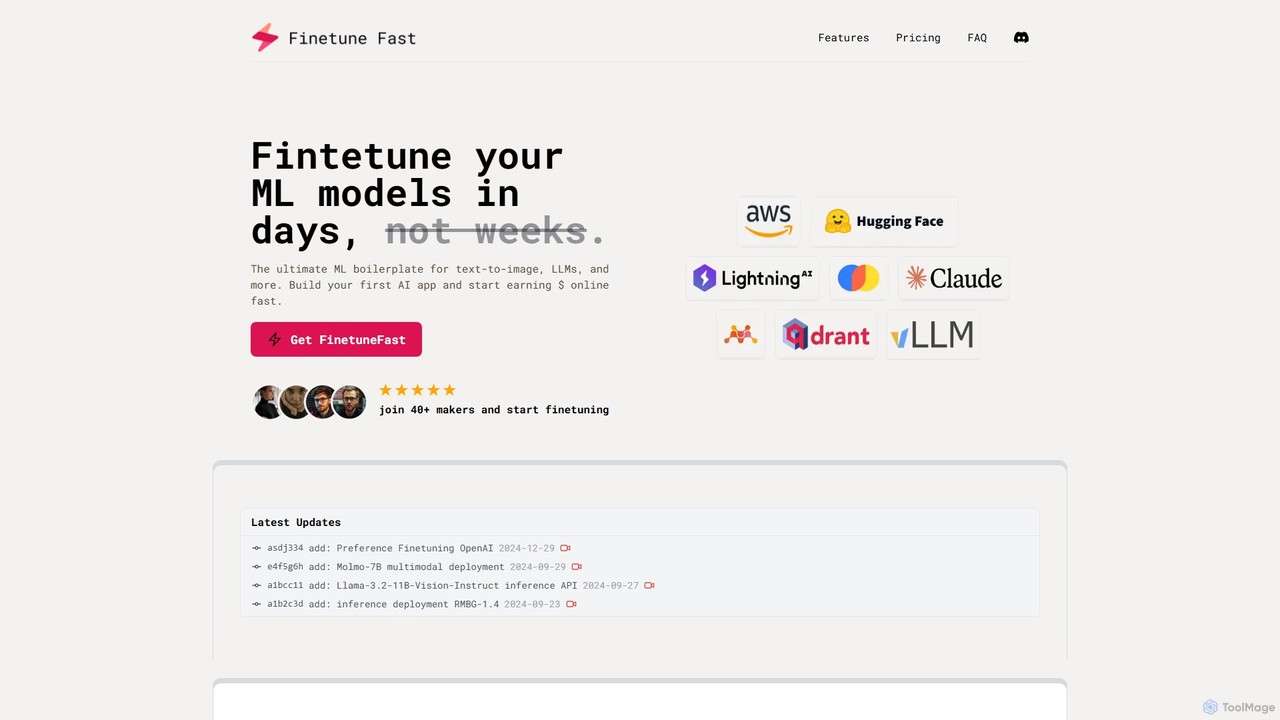
FinetuneFast is a comprehensive ML boilerplate for developers and ML engineers. It provides production-ready code templates to rapidly fine-tune, deploy, and scale AI models like LLMs and text-to-image generators, cutting development time from weeks to days.

Boilerplate
Visits 4.6KFavorites 116Likes 110

About Machine Learning

Machine Learning tools are a specialized category within developer tools that empower systems to learn from data, identify complex patterns, and make intelligent predictions or decisions without explicit programming. These tools leverage advanced algorithms and statistical models to automate data analysis, build predictive models, and enable adaptive behaviors. They are crucial for developers aiming to integrate intelligence into applications, automate complex processes, and derive actionable insights from vast datasets.

Core Features

  • Data Preprocessing & Feature Engineering: Tools for cleaning, transforming, and selecting relevant features from raw data to optimize model performance.
  • Model Training & Optimization: Platforms to build, train, and fine-tune various machine learning models (e.g., supervised, unsupervised, reinforcement learning) using diverse algorithms.
  • Model Evaluation & Validation: Capabilities to assess model accuracy, robustness, and generalization using metrics like precision, recall, F1-score, and cross-validation techniques.
  • Model Deployment & Monitoring: Features for deploying trained models into production environments and continuously monitoring their performance and drift over time.

Use Cases

Machine Learning tools are widely adopted across industries for tasks requiring data-driven intelligence. They enable developers to build applications for predictive analytics in finance, create personalized recommendation systems for e-commerce, and develop sophisticated natural language processing solutions for customer service automation.

How to Choose

Selecting the right Machine Learning tool involves evaluating several factors: the range of supported algorithms and frameworks, scalability for handling large datasets, integration capabilities with existing data pipelines and development environments, and the level of abstraction or control offered to developers. Consider also the community support, documentation, and pricing model.

Featured tool rankings

Machine Learning use cases

1

Building Predictive Models for Business Forecasting

Data scientists and business analysts utilize Machine Learning tools to develop models that forecast key business metrics like sales, customer churn, or stock prices. By feeding historical data into algorithms, they can identify trends and predict future outcomes, enabling proactive decision-making and strategic planning for enterprises.

2

Developing Personalized Recommendation Engines

E-commerce platforms and streaming services leverage Machine Learning tools to create highly personalized recommendation systems. By analyzing user behavior, preferences, and historical interactions, these tools suggest relevant products, content, or services, significantly enhancing user experience and driving engagement and sales.

3

Automating Anomaly Detection in Cybersecurity

Cybersecurity professionals employ Machine Learning tools to detect unusual patterns in network traffic, user behavior, or system logs that may indicate security breaches or fraudulent activities. These tools can identify deviations from normal baselines in real-time, allowing for rapid response and mitigation of potential threats, significantly enhancing an organization's security posture.

4

Creating Intelligent Chatbots and NLP Applications

Developers utilize Machine Learning tools to build sophisticated natural language processing (NLP) applications, including intelligent chatbots, sentiment analysis engines, and language translation services. These tools enable machines to understand, interpret, and generate human language, revolutionizing customer service, content analysis, and communication platforms.

5

Implementing Computer Vision for Quality Control

Manufacturing and healthcare industries deploy Machine Learning tools for computer vision applications in quality control. By training models on images or video feeds, these tools can automatically detect defects in products, identify anomalies in medical scans, or monitor assembly lines, significantly improving efficiency and accuracy while reducing human error.

6

Optimizing Resource Allocation and Scheduling

Logistics, energy, and urban planning sectors leverage Machine Learning tools to optimize complex resource allocation and scheduling problems. By analyzing vast amounts of data on demand, supply, constraints, and historical patterns, these tools can generate highly efficient schedules for deliveries, energy grids, or public transport, leading to significant cost savings and improved service levels.

Machine Learning FAQ

What are Machine Learning tools?

Machine Learning tools are software platforms and libraries that enable developers to build, train, and deploy models that learn from data. They typically feature capabilities for data preprocessing, algorithm selection, model evaluation, and deployment. These tools are used to create intelligent applications that can make predictions, classify data, or automate decision-making based on learned patterns.

How do Machine Learning tools differ from traditional programming?

Traditional programming relies on explicit, rule-based instructions to solve problems, where a developer defines every step. Machine Learning tools, conversely, enable systems to learn patterns and rules directly from data, without being explicitly programmed for each scenario. This data-driven approach allows ML models to adapt to new information and handle complex, dynamic problems that are difficult to define with fixed rules, such as image recognition or natural language understanding.

What are the essential components of a Machine Learning workflow?

A typical Machine Learning workflow involves several key stages. It begins with data collection and preprocessing, where raw data is cleaned and transformed. Next is feature engineering, selecting relevant variables. Then, model selection and training involves choosing an algorithm and fitting it to the data. This is followed by model evaluation and validation to assess performance. Finally, the trained model is moved to deployment and monitoring for real-world application and continuous oversight.

How can developers choose the best Machine Learning platform?

Developers should consider several factors when choosing an ML platform. Evaluate the range of supported algorithms and frameworks (e.g., TensorFlow, PyTorch), ensuring they align with project needs. Assess scalability and performance for handling data volume and processing speed. Look for robust integration capabilities with existing data infrastructure and development tools. Consider the ease of use, documentation, community support, and the cost model (open-source vs. commercial, cloud vs. on-premise) to find the best fit for their specific requirements and budget.

What are some common applications of Machine Learning in enterprise?

In enterprise settings, Machine Learning tools are applied across various functions. Common applications include fraud detection in finance, where models identify suspicious transactions; customer churn prediction in marketing, helping businesses retain clients; predictive maintenance in manufacturing, forecasting equipment failures; and supply chain optimization, improving logistics efficiency. These applications drive significant operational improvements and strategic advantages.