ToolMage
Sign in

Best 1 Ai Agent Builder AI tools for Productivity

Popular Ai Agent Builder AI tools in Productivity include Cotera, helping you work more efficiently.

Cotera
Freemium

Cotera

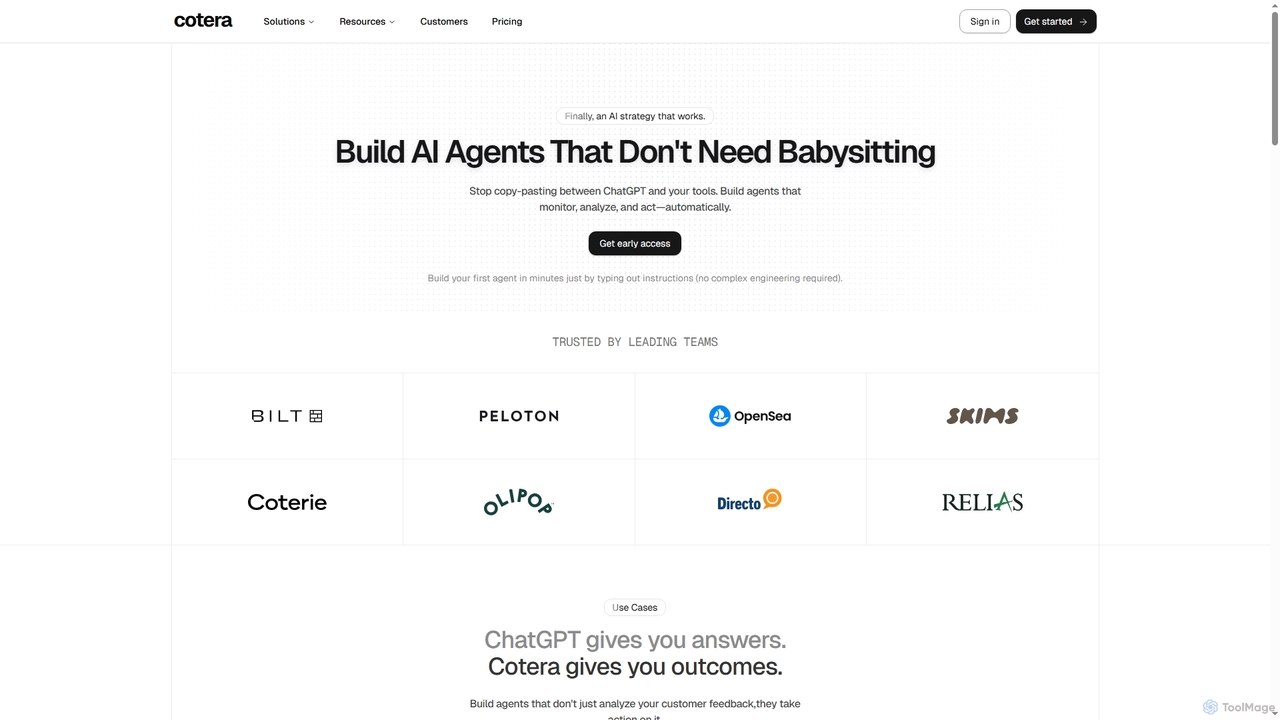
Cotera is an AI platform that empowers businesses to build autonomous AI agents capable of monitoring, analyzing, and acting automatically across various operations. It eliminates manual busywork by enabling users to create sophisticated agents with plain English instructions, integrating seamlessly with existing tools and data warehouses.

Support Automation
Visits 28.7KFavorites 165Likes 151

About Ai Agent Builder

AI Agent Builder tools are platforms designed to create, deploy, and manage autonomous AI agents capable of performing complex, multi-step tasks. These builders leverage large language models (LLMs) and other AI capabilities, providing frameworks for agents to reason, plan, execute actions, and learn from interactions. They empower users to automate sophisticated workflows and build intelligent assistants that can adapt to dynamic environments, significantly enhancing productivity across various domains.

Core Features

  • Visual Workflow Design: Intuitive interfaces for defining agent goals, steps, and decision-making logic without extensive coding.
  • Tool Integration: Seamless connection with external APIs, databases, and applications, allowing agents to interact with the real world.
  • Memory Management: Mechanisms for agents to store and retrieve information, enabling long-term context and learning.
  • Task Orchestration: Capabilities to break down complex goals into sub-tasks, prioritize, and manage their execution.
  • Monitoring & Debugging: Tools to track agent performance, identify issues, and refine agent behavior for optimal results.

Applicable Scenarios

AI Agent Builders are invaluable for developers, business analysts, and operations teams looking to automate intricate processes. They are used in creating intelligent customer service agents, automating data analysis pipelines, and building personalized educational tutors. Businesses leverage them to streamline complex operational tasks and enhance decision-making through autonomous data processing.

How to Choose

When selecting an AI Agent Builder, consider its ease of use and visual design capabilities, which impact development speed. Evaluate its integration ecosystem for compatibility with your existing tools and data sources. Assess the flexibility in customizing agent behavior and the robustness of its memory and learning features. Finally, review the scalability, pricing model, and community support to ensure it meets both current and future needs.

Ai Agent Builder use cases

1

Automating Complex Customer Support Workflows

Customer service managers can use AI Agent Builders to design autonomous agents that handle multi-stage customer inquiries. For instance, an agent can greet a customer, identify their issue, retrieve relevant information from a CRM, provide a solution, and escalate to a human agent only if necessary. This reduces response times, ensures consistent service quality, and frees up human agents for more complex cases, leading to higher customer satisfaction and operational efficiency.

2

Streamlining Data Analysis and Report Generation

Data analysts and researchers can leverage AI Agent Builders to create agents that autonomously collect, process, and analyze data from disparate sources. An agent can be configured to fetch data from databases, perform statistical analysis, identify trends, and then generate comprehensive reports or dashboards. This significantly reduces manual effort in data preparation and analysis, accelerates insights delivery, and allows human analysts to focus on strategic interpretation rather than repetitive tasks.

3

Developing Personalized Learning and Development Assistants

Educational institutions and corporate training departments can use AI Agent Builders to create personalized learning assistants. These agents can assess a learner's progress, recommend tailored resources, answer specific questions, and even generate practice exercises. By adapting to individual learning styles and paces, such agents enhance engagement and knowledge retention, providing a scalable solution for continuous education and skill development across diverse user groups.

4

Optimizing E-commerce Operations with Autonomous Agents

E-commerce businesses can utilize AI Agent Builders to create agents that automate various operational tasks. This includes agents for dynamic pricing adjustments based on market demand and competitor analysis, inventory management by predicting stock levels and reordering, and personalized product recommendations for customers. Such automation leads to optimized sales strategies, reduced stockouts, and improved customer experience, directly impacting revenue and operational efficiency.

5

Accelerating Software Development and Testing

Software development teams can employ AI Agent Builders to create agents that assist throughout the development lifecycle. Agents can be designed to generate code snippets, perform automated unit and integration testing, identify potential bugs, and even suggest refactoring improvements. This accelerates development cycles, enhances code quality, and allows human developers to focus on complex architectural challenges and innovative feature development, significantly boosting team productivity.

6

Automating Content Creation and Marketing Campaigns

Marketing professionals and content creators can use AI Agent Builders to construct agents that automate various aspects of content generation and campaign management. Agents can research trending topics, draft blog posts or social media updates, optimize content for SEO, and even schedule posts across platforms. This streamlines the content pipeline, ensures consistent brand messaging, and allows marketers to focus on strategic planning and audience engagement, leading to more effective and efficient campaigns.

Ai Agent Builder FAQ

What are AI Agent Builders?

AI Agent Builders are specialized platforms that enable users to design, develop, and manage autonomous AI agents. These agents are intelligent software entities capable of understanding goals, planning actions, executing tasks using various tools, and learning from their environment. They differ from simple chatbots or automation scripts by possessing advanced reasoning, memory, and the ability to adapt to dynamic situations, making them ideal for automating complex, multi-step workflows across diverse industries.

How do AI Agent Builders enhance productivity?

AI Agent Builders significantly boost productivity by automating complex, multi-step tasks that traditionally require human intervention or intricate coding. They allow businesses and individuals to create agents that can autonomously manage projects, process data, interact with various systems, and make informed decisions. This frees up human capital from repetitive or time-consuming operations, enabling teams to focus on strategic initiatives, innovation, and tasks that require unique human creativity and critical thinking, leading to overall operational efficiency and faster goal achievement.

What are the key components of an AI Agent Builder platform?

A typical AI Agent Builder platform includes several core components. It features an Agent Design Interface, often visual, for defining agent goals, behaviors, and decision trees. Tool Integration capabilities allow agents to connect with external services and APIs. Memory Management enables agents to store and retrieve information for long-term context. Task Orchestration modules help break down complex goals into manageable sub-tasks. Finally, Monitoring and Debugging Tools are crucial for tracking agent performance, identifying errors, and iteratively refining agent logic to ensure optimal operation and continuous improvement.

How do AI Agent Builders differ from traditional workflow automation tools?

AI Agent Builders differ significantly from traditional workflow automation tools (like RPA or BPM) primarily in their level of autonomy and intelligence. Traditional tools follow predefined, rigid rules and sequences, executing tasks exactly as programmed. AI Agent Builders, however, leverage LLMs to enable agents to reason, plan dynamically, adapt to unforeseen circumstances, and even learn from interactions. This allows them to handle more complex, ambiguous, and dynamic tasks that would overwhelm rule-based systems, offering true intelligent automation rather than just process execution.

Who can benefit most from using AI Agent Builders?

A wide range of users can benefit from AI Agent Builders. Developers and AI engineers can rapidly prototype, build, and deploy sophisticated agents without starting from scratch. Business analysts and operations managers can automate complex business processes, from customer service to supply chain management, without deep technical expertise. Content creators and marketers can streamline content generation and campaign management. Essentially, anyone looking to automate multi-step, intelligent tasks that require reasoning, adaptation, and interaction with various tools will find significant value in these platforms.