Humsana
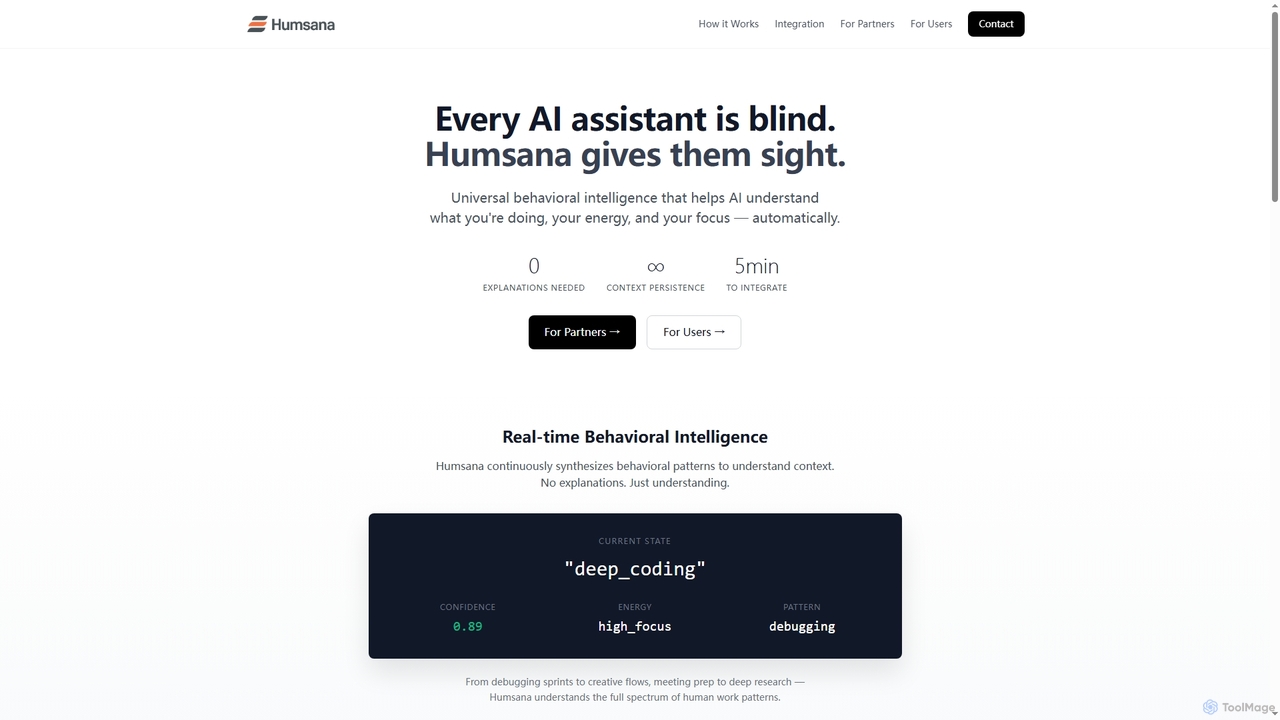
Humsana provides universal behavioral intelligence, giving AI assistants real-time context about user actions, energy, and focus. It enables …
Humsana provides universal behavioral intelligence, giving AI assistants real-time context about user actions, energy, and focus. It enables AI to understand what users are doing without explicit explanations, leading to more adaptive and relevant responses. Integrate quickly to enhance any AI assistant's awareness.
About Ai Assistant Enhancement
AI Assistant Enhancement tools are designed to significantly extend the capabilities and utility of existing AI assistants like ChatGPT, Copilot, or Claude. These platforms integrate with foundational AI models to provide advanced features such as personalized knowledge bases, sophisticated prompt management, and seamless workflow automation. By transforming generic AI interactions into highly specialized, efficient, and context-aware productivity engines, these tools empower users to tackle complex tasks with unprecedented ease and precision, making AI assistants truly indispensable for modern workflows.
Core Features
- Custom Knowledge Integration: Connects AI assistants to private documents, databases, or web sources, enabling them to provide highly accurate and context-aware responses based on proprietary information.
- Advanced Prompt Management: Organizes, optimizes, and automates the use of complex prompts, ensuring consistent, high-quality outputs and reducing the effort required for effective AI interaction.
- Workflow Automation: Integrates AI assistant outputs directly into existing applications and business processes, automating repetitive tasks and streamlining operations across various platforms.
- Personalized AI Personas: Allows users to define specific roles, tones, and expertise for the AI assistant, tailoring its interactions to match brand guidelines, project requirements, or individual preferences.
- Enhanced Memory & Context: Provides long-term memory and maintains conversational context across multiple sessions, leading to more coherent, relevant, and continuous interactions over time.
Applicable Scenarios
Professionals across diverse sectors, including content creation, customer support, software development, and data analysis, leverage these tools to amplify their productivity. They are particularly valuable for automating repetitive tasks, generating highly specific and branded content, and providing instant, accurate access to specialized information within an organization's unique operational context.
How to Choose
When selecting an AI Assistant Enhancement tool, consider its compatibility with your preferred foundational AI models and the depth of its knowledge base integration capabilities. Evaluate the flexibility of its workflow automation features, the ease of prompt management, and the level of personalization offered for AI personas. Additionally, scrutinize its security protocols for handling sensitive data, its scalability to meet future demands, and its pricing model for long-term cost-effectiveness.
Ai Assistant EnhancementUse Cases
Personalizing AI Assistant with Company-Specific Knowledge
Corporate knowledge workers often struggle with generic AI assistant responses that lack internal context. Enhancement tools allow businesses to upload proprietary documents, internal wikis, and historical data, enabling the AI assistant to provide accurate, company-specific answers. This empowers employees to quickly access relevant information, draft internal communications, or analyze data with an AI assistant that truly understands the organization's unique context, saving hours in research and verification.
Automating Research & Report Generation
For market analysts or researchers, AI assistant enhancement tools streamline the process of gathering vast amounts of data from diverse online sources. By integrating with web scraping tools and knowledge bases, the AI assistant can quickly synthesize information, identify key trends, and then structure these findings into a preliminary report draft, significantly reducing manual data compilation and initial writing time.
Automate Contextual Customer Support Responses
Customer service teams can integrate AI Assistant Enhancement tools with their CRM and knowledge base to automatically generate personalized and accurate responses to common customer queries. The AI assistant, enhanced with company-specific data, can draft replies that reflect brand voice and access relevant product information, significantly reducing response times and improving customer satisfaction without constant human intervention.
Automating Multi-Step Content Creation Workflows
Content creators frequently use AI assistants for brainstorming and drafting, but the process often involves multiple manual steps: generating ideas, outlining, drafting sections, and then refining. Enhancement tools can chain these actions together. For example, an AI assistant can be prompted to research a topic, then automatically generate an an outline, draft an article based on that outline, and even suggest social media posts, all within a single automated workflow. This significantly accelerates content production cycles.
Personalized Customer Support Automation
Customer service teams can leverage AI assistant enhancements to provide highly personalized support. By integrating the AI assistant with CRM systems and customer databases, it can access individual customer history, preferences, and past interactions. This enables the AI to offer tailored solutions, answer complex queries with relevant context, and seamlessly escalate issues to human agents when necessary, improving customer satisfaction and agent efficiency.
Generate Personalized Marketing Content at Scale
Marketing professionals utilize these tools to create highly targeted content for various campaigns. By feeding the AI assistant with brand guidelines, audience demographics, and past campaign data, it can generate blog posts, social media updates, email newsletters, and ad copy that resonate with specific segments, ensuring consistency and accelerating content production while maintaining brand voice.
Integrating AI Assistant for Enhanced Customer Support
Customer service teams can leverage AI assistant enhancement tools to provide more intelligent and personalized support. By integrating the AI assistant with CRM systems and support ticket databases, it gains access to customer history, preferences, and common issues. This allows the AI assistant to offer highly relevant solutions, draft personalized responses to complex queries, or even escalate issues with pre-filled context, reducing agent workload and improving customer satisfaction.
Code Generation & Debugging Workflow
Software developers can significantly accelerate their workflow by using AI assistant enhancements integrated directly into their Integrated Development Environments (IDEs). These tools allow the AI to generate code snippets based on natural language descriptions, identify potential errors or vulnerabilities in existing code, and suggest optimizations for performance or best practices, transforming the AI into an invaluable coding companion.
Streamline Software Development Documentation
Developers can enhance their AI assistants to automatically generate code documentation, API specifications, and user manuals. By connecting the AI to code repositories and project management tools, it can analyze code, understand its functionality, and produce comprehensive, up-to-date documentation, freeing up developers to focus on coding and ensuring project clarity.
Streamlining Data Analysis and Report Generation
Analysts and researchers often spend considerable time extracting insights from data and compiling reports. AI assistant enhancement tools can connect to data sources (like spreadsheets, databases, or APIs) and enable the AI assistant to perform complex queries, summarize findings, and generate structured reports or presentations. Users can ask natural language questions about their data, and the enhanced AI assistant will process, analyze, and present the information in a digestible format, accelerating decision-making.
Content Creation & SEO Optimization
Content marketers and creators can enhance their AI assistants to become powerful allies in content generation and SEO. By integrating with keyword research tools and content management systems, the AI can brainstorm relevant topics, generate detailed article outlines, draft initial content, and optimize it for target keywords and readability, ensuring high-quality, search-engine-friendly output with minimal manual effort.
Enhance Research and Information Synthesis
Researchers and analysts leverage AI assistant enhancement tools to quickly synthesize vast amounts of information from diverse sources. By uploading research papers, reports, and datasets, the enhanced AI can summarize key findings, identify trends, and answer complex questions based on the provided context, drastically cutting down manual review time and accelerating insights.
Developing Custom AI Agents for Specific Business Tasks
Businesses often have unique operational tasks that general AI assistants cannot handle out-of-the-box. Enhancement platforms allow developers or power users to build custom AI agents by defining specific tools, functions, and decision-making logic for the AI assistant. For instance, an agent could be built to manage inventory by checking stock levels, ordering supplies, and updating records, all orchestrated by the enhanced AI assistant, leading to highly specialized automation.
Data Analysis & Visualization Scripting
Data scientists and analysts can utilize AI assistant enhancements to streamline complex data tasks. By integrating the AI with data analysis platforms like Python or R environments, users can describe their data manipulation or visualization needs in natural language. The AI can then generate or refine scripts for data cleaning, statistical analysis, and creating various types of charts or graphs, significantly accelerating the exploratory data analysis phase.
Optimize Internal Knowledge Management and Access
Organizations deploy these tools to create intelligent internal knowledge bases. Employees can query the enhanced AI assistant about company policies, HR procedures, or project details, receiving instant, accurate answers drawn from internal documents. This reduces reliance on human experts for routine questions and ensures consistent information dissemination across the company.
Optimizing Sales and Marketing Outreach with Personalized AI
Sales and marketing professionals can use AI assistant enhancement tools to personalize outreach at scale. By integrating with sales enablement platforms or email marketing tools, the AI assistant can analyze prospect data, generate highly customized email drafts, suggest personalized talking points for calls, or even create tailored ad copy. This moves beyond generic templates, allowing for more effective and engaging communication that resonates deeply with individual prospects, improving conversion rates.
Project Management & Task Delegation
Project managers can enhance their AI assistants to become more effective in planning and executing projects. By integrating with project management software (e.g., Jira, Asana), the AI can help break down large project goals into actionable tasks, assign them to team members based on availability and skill sets, track progress, and even identify potential bottlenecks, providing real-time insights and automating routine administrative duties.
Automate Data Analysis and Reporting
Data analysts and business intelligence teams use AI Assistant Enhancement tools to automate routine data analysis tasks and generate reports. By integrating with data sources and analytical platforms, the AI can process queries, identify patterns, create visualizations, and draft summary reports, enabling faster decision-making and reducing the manual effort involved in data interpretation.