ToolMage
Sign in

Best 1 Alerting AI tools for Productivity

Popular Alerting AI tools in Productivity include Anomify, helping you work more efficiently.

Anomify
Freemium

Anomify

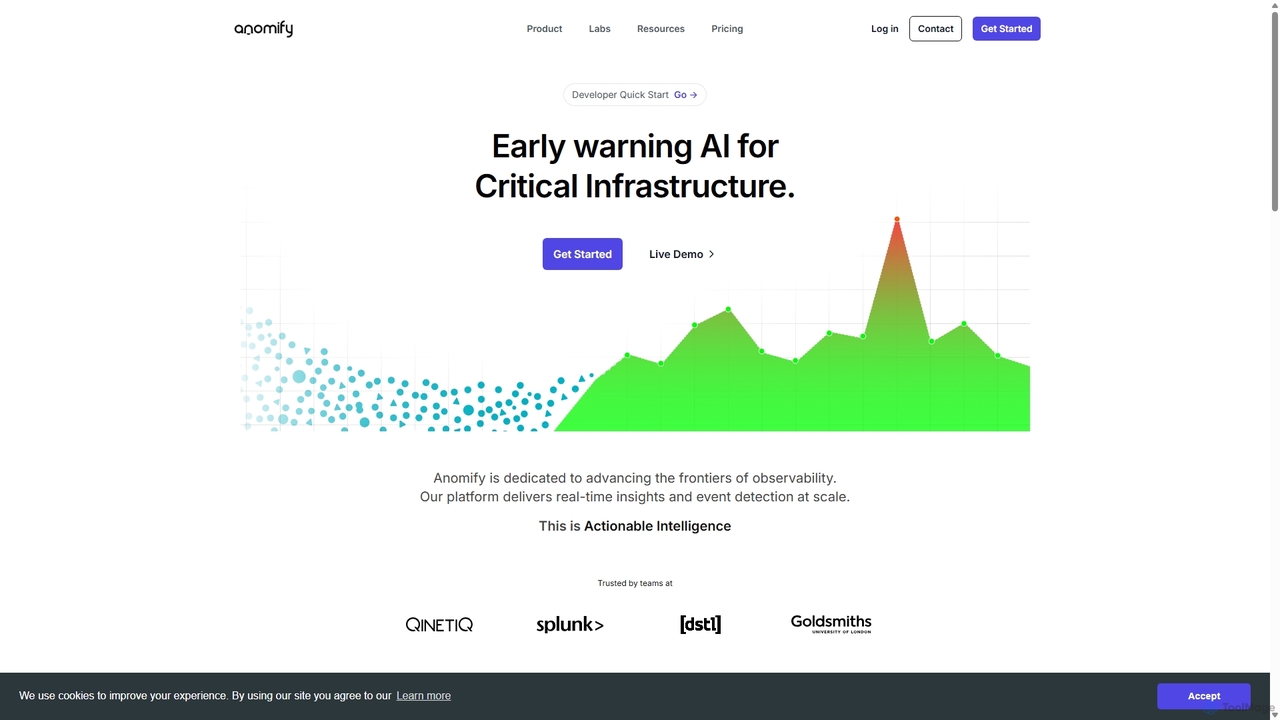
Anomify is an AI-powered early warning platform for critical infrastructure, offering real-time anomaly detection and observability at scale. It leverages multi-stage machine learning to analyze time-series data, significantly reduce false positives, and accelerate root cause analysis. Designed for DevOps, SREs, and IT teams, Anomify transforms monitoring from reactive to proactive, ensuring system performance and reliability.

Anomaly Detection
Visits 12.4KFavorites 178Likes 174

About Alerting

Alerting tools are AI-powered systems designed to automatically detect and notify users about significant events, data changes, or predefined conditions. Leveraging advanced machine learning, these tools continuously monitor various data streams, identify anomalies, and trigger intelligent notifications. They are crucial for proactive management, ensuring immediate awareness of critical updates, potential issues, or emerging opportunities across IT operations, finance, marketing, and more.

Core Features

  • Real-time Monitoring: Continuously track data from systems, applications, and external sources for immediate event detection.
  • Anomaly Detection: Utilize AI to identify unusual patterns or deviations from normal behavior, reducing false positives.
  • Customizable Notifications: Deliver alerts through preferred channels like email, SMS, push notifications, or collaboration platforms with tailored content.
  • Intelligent Triggering: Combine rule-based logic with machine learning models for context-aware and predictive alert generation.
  • Escalation Policies: Define automated sequences for notifying different stakeholders based on the severity and urgency of an alert.

Applicable Scenarios

AI alerting tools are vital for professionals needing immediate insights into dynamic environments. They are used by IT operations teams to monitor infrastructure health, financial analysts for market surveillance, and customer service managers to track critical client issues.

How to Choose

When selecting an AI alerting solution, consider its integration capabilities with your existing data sources and communication tools. Evaluate the sophistication of its AI for anomaly detection and false positive reduction, the flexibility for customizing alert rules and notification channels, and its scalability to handle your data volume and velocity.

Alerting use cases

1

Proactive IT Incident Management

IT operations teams utilize AI alerting tools to receive immediate notifications regarding system outages, performance degradation, or potential security breaches. By continuously monitoring server health, network traffic, and application logs, these tools enable rapid detection and response, minimizing downtime and mitigating risks before they escalate into major incidents.

2

Financial Market Anomaly Detection

Financial traders and analysts employ AI alerting to identify unusual market activities, such as sudden spikes in trading volume, unexpected price movements for specific stocks, or significant news events impacting their portfolios. These real-time alerts provide a competitive edge, allowing for quick decision-making and risk management in volatile markets.

3

Customer Sentiment Shift Notification

Customer success and support teams leverage AI alerting to monitor customer interactions across various channels (e.g., support tickets, social media, reviews). When a key client's sentiment turns negative or a critical issue arises, the system automatically triggers an alert, enabling proactive outreach and intervention to prevent churn and improve satisfaction.

4

Supply Chain Disruption Alerts

Logistics and supply chain managers use AI alerting to track potential disruptions, such as unexpected delays in shipments, sudden inventory shortages at critical nodes, or performance issues with key suppliers. Receiving timely alerts allows them to quickly adjust plans, reroute goods, or find alternative suppliers, ensuring business continuity.

5

Social Media Trend & Brand Mention Monitoring

Marketing and PR teams deploy AI alerting to stay informed about emerging social media trends, viral content, or significant mentions of their brand or competitors. These alerts help them capitalize on timely opportunities for engagement, respond quickly to public sentiment, or manage potential PR crises effectively.

6

Personalized Health Metric Warnings

In healthcare or personal wellness, AI alerting tools can monitor biometric data from wearables or medical devices. Individuals or caregivers receive automated alerts when vital signs (e.g., heart rate, blood sugar levels) deviate from personalized normal ranges or indicate a potential health risk, enabling timely medical attention or lifestyle adjustments.

Alerting FAQ

What are AI Alerting tools?

AI Alerting tools are intelligent systems that use artificial intelligence, particularly machine learning, to monitor data streams and automatically generate notifications when specific conditions, anomalies, or events are detected. Unlike simple threshold-based systems, they can learn normal patterns and identify subtle deviations, providing more relevant and actionable alerts across various domains.

How do AI Alerting tools differ from traditional monitoring systems?

Traditional monitoring systems primarily rely on predefined, static rules and thresholds to trigger alerts. AI Alerting tools, however, leverage machine learning to dynamically learn normal behavior, detect complex anomalies, and reduce false positives. They can adapt to changing data patterns, offer more context-aware notifications, and often predict potential issues before they become critical, providing a more intelligent and proactive approach.

What are the key benefits of using AI for alerting?

The primary benefits include enhanced accuracy in anomaly detection, significantly reduced false positives, and the ability to identify subtle, complex patterns that human operators or traditional systems might miss. AI alerting also enables more proactive problem-solving, improves operational efficiency by focusing attention on critical issues, and allows for highly customized and context-rich notifications, leading to faster response times and better decision-making.

In which industries can AI Alerting tools be most effectively applied?

AI Alerting tools are highly versatile and can be effectively applied across numerous industries. Key sectors include IT operations (for system health and security), finance (for market surveillance and risk management), customer service (for sentiment analysis and critical issue detection), manufacturing (for predictive maintenance), logistics (for supply chain disruptions), and healthcare (for patient monitoring and anomaly detection in medical data).

What should I consider when selecting an AI Alerting solution?

When choosing an AI alerting solution, evaluate its integration capabilities with your existing infrastructure and data sources. Assess the sophistication of its AI models for anomaly detection and its ability to minimize alert fatigue. Consider the flexibility for customizing alert rules, notification channels, and escalation workflows. Finally, review its scalability, performance under load, and the clarity of its reporting and analytics features to ensure it meets your specific operational needs.