Joint Angels
Joint Angels is a free, web-based AI tool that uses your webcam or video uploads for real-time joint …
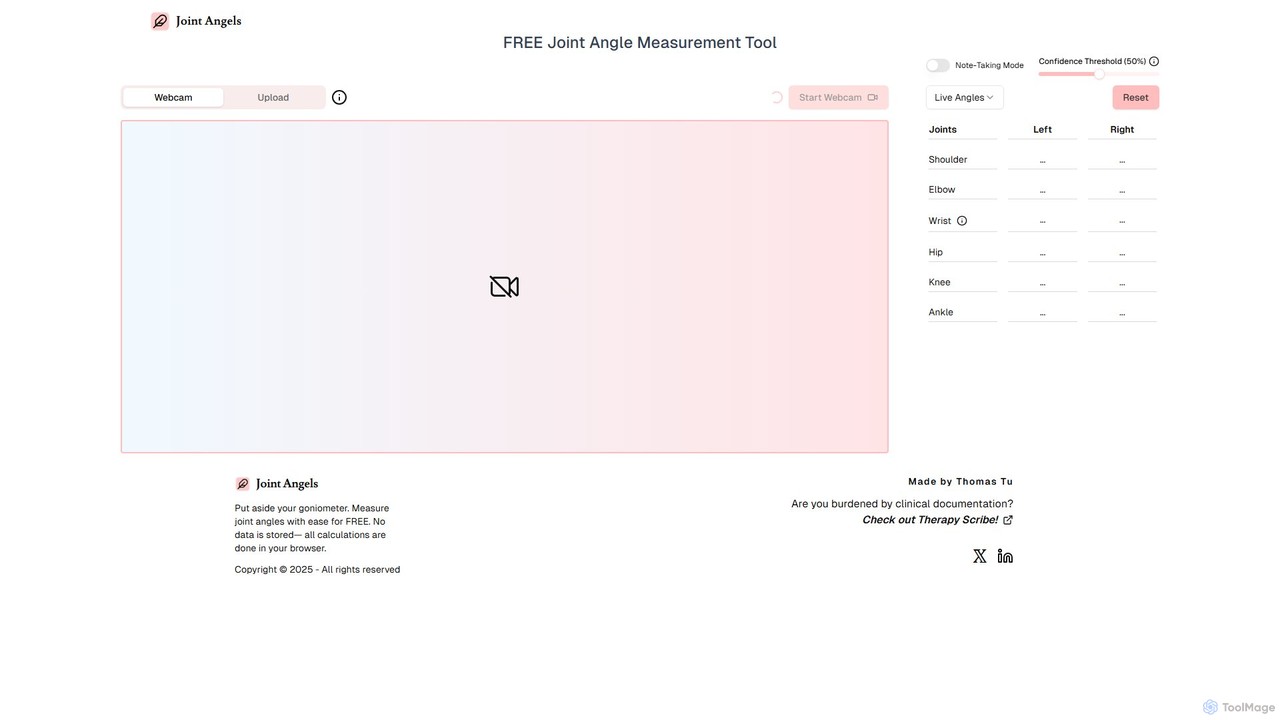
Joint Angels is a free, web-based AI tool that uses your webcam or video uploads for real-time joint angle measurement. It leverages computer vision to provide precise motion analysis, making it ideal for physical therapy, sports coaching, ergonomic assessments, and fitness tracking.
About Analysis Tool
Analysis Tools are AI-powered applications designed to process, interpret, and extract actionable insights from complex datasets. Leveraging advanced machine learning algorithms, natural language processing, and computer vision, these tools identify patterns, trends, and anomalies far beyond human capacity. They empower users to make data-driven decisions, automate reporting, predict future outcomes, and optimize strategies across various domains, significantly enhancing overall productivity by transforming raw data into valuable intelligence.
Core Features
- Automated Data Interpretation: Automatically processes vast amounts of structured and unstructured data to identify key insights and relationships.
- Predictive Modeling: Builds models to forecast future trends, behaviors, and outcomes based on historical data analysis.
- Anomaly Detection: Identifies unusual patterns or outliers in data that may indicate critical issues or opportunities.
- Natural Language Understanding: Extracts meaning and sentiment from text-based data, such as customer reviews or social media posts.
- Interactive Visualization: Presents complex analytical results through intuitive dashboards and charts for easier comprehension.
Applicable Scenarios
AI Analysis Tools are indispensable for professionals across various sectors. Marketing teams use them to analyze campaign performance and customer sentiment, while financial analysts leverage them for market trend prediction and risk assessment. Operations managers apply these tools to optimize supply chains and identify production bottlenecks, transforming raw operational data into actionable improvements.
How to Choose
When selecting an AI Analysis Tool, consider its compatibility with your existing data sources and infrastructure. Evaluate the breadth and depth of its analytical capabilities, ensuring it supports your specific needs like predictive modeling or sentiment analysis. Assess the user interface for ease of use and the level of technical expertise required. Finally, compare pricing models and the quality of customer support to ensure long-term value and scalability.

Analysis ToolUse Cases
Market Trend Forecasting
Marketing strategists and business development teams utilize AI analysis tools to sift through vast amounts of social media data, news articles, and historical sales figures. These tools identify emerging market trends, predict consumer demand shifts, and pinpoint potential competitive threats, enabling proactive strategy adjustments and product development planning.
Customer Behavior Segmentation
E-commerce managers and customer experience professionals employ AI analysis to interpret customer purchase histories, website navigation patterns, and interaction logs. The tools automatically segment customers into distinct groups based on behavior, preferences, and lifetime value, allowing for highly personalized marketing campaigns and improved customer retention strategies.
Financial Risk Assessment
Financial analysts and investment managers leverage AI analysis tools to process real-time market data, company financial statements, and economic indicators. These tools identify subtle risk factors, predict stock price movements, and assess portfolio vulnerabilities, providing critical insights for informed investment decisions and risk mitigation.
Operational Bottleneck Identification
Manufacturing supervisors and logistics coordinators use AI analysis to monitor sensor data from machinery, production line logs, and supply chain metrics. The tools pinpoint inefficiencies, predict equipment failures, and identify bottlenecks in operational workflows, leading to optimized resource allocation and reduced downtime.
Content Performance Optimization
Content creators and digital marketers apply AI analysis to evaluate the engagement metrics of articles, videos, and social media posts. These tools analyze audience demographics, viewing habits, and sentiment to determine which content formats and topics resonate most, guiding future content strategy for maximum reach and impact.
Scientific Research Data Interpretation
Researchers and data scientists in fields like biology or materials science utilize AI analysis to process large, complex experimental datasets. The tools identify hidden correlations, validate hypotheses, and uncover novel insights that would be difficult or impossible to detect manually, accelerating discovery and innovation.