
ToolMage
Sign in

Best 1 Application Tools for Productivity

Popular Application Tools in Productivity include CareerScalar, helping you work more efficiently.

CareerScalar
Freemium

CareerScalar

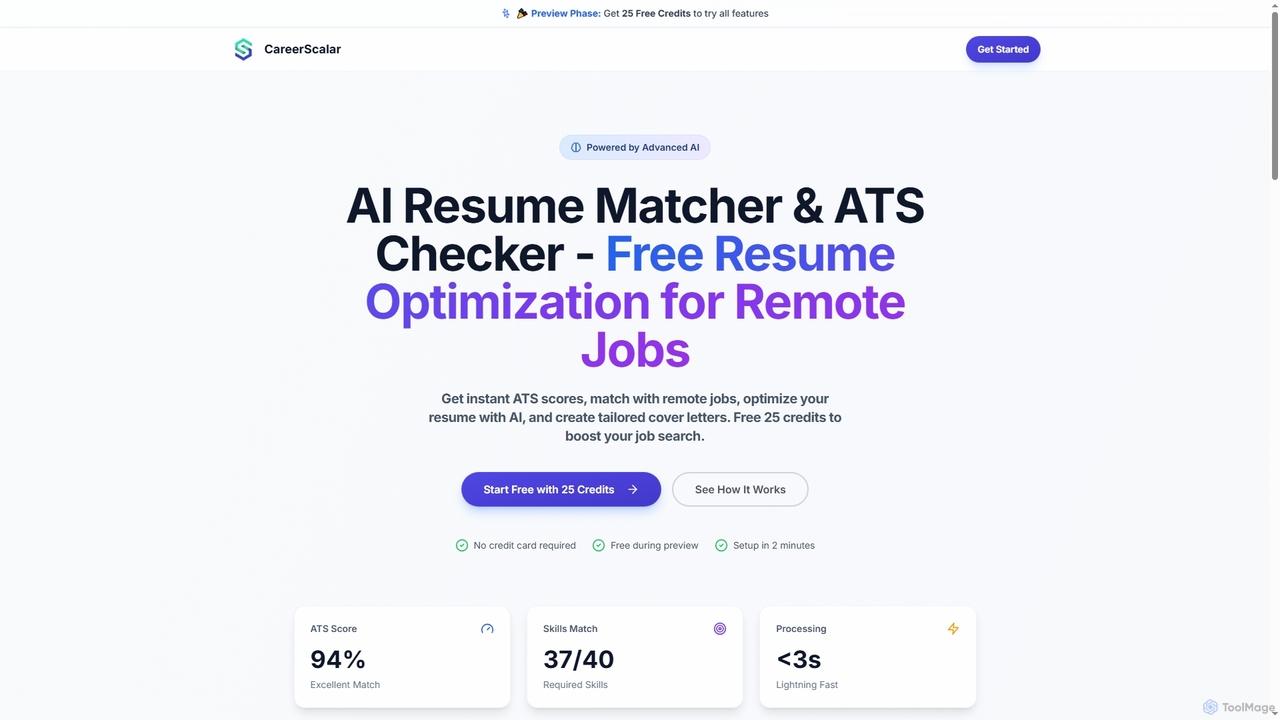
CareerScalar is an advanced AI-powered platform designed to revolutionize your job search. It offers an AI resume matcher, ATS checker, and optimization tools to help job seekers land remote positions faster. Users can get instant ATS scores, tailor resumes with AI, generate cover letters, and find perfectly matched remote jobs, starting with 25 free credits.

Job Matching
Visits 4.3KFavorites 116Likes 117

About Application Tools

Application Tools are AI-powered software solutions designed to perform specific tasks and enhance productivity across various domains. These tools leverage advanced AI models like natural language processing, computer vision, and machine learning to automate complex workflows, generate content, and provide intelligent assistance. They serve as ready-to-use applications that integrate seamlessly into daily operations, transforming how individuals and businesses achieve their goals within the broader productivity landscape.

Core Features

  • Intelligent Automation: Automates repetitive or complex tasks, from data entry to content scheduling, significantly reducing manual effort.
  • Content Generation: Creates high-quality text, images, video, or code based on user prompts, accelerating creative and development processes.
  • Data Analysis & Insights: Processes large datasets to identify patterns, generate reports, and provide actionable insights for informed decision-making.
  • Personalized Assistance: Offers tailored recommendations, summaries, or responses, adapting to individual user needs and preferences.
  • Seamless Integration: Designed to work with existing software ecosystems, enhancing functionality without disrupting current workflows.

Use Cases

AI Application Tools are indispensable for professionals seeking to optimize their output. Content creators use them to draft articles and social media posts, while marketers leverage them for personalized campaign generation. Business analysts employ these tools for automated report creation, and customer service teams deploy AI chatbots for instant support, streamlining operations across the board.

How to Choose

When selecting an AI Application Tool, consider its specific functionality and how well it aligns with your core tasks. Evaluate its integration capabilities with your existing software, ensuring a smooth workflow. Assess the user interface for ease of use and the scalability to meet future demands. Finally, compare pricing models and customer support to find a solution that offers the best value and reliability for your specific needs.

Featured tool rankings

Application Tools use cases

1

Automate Marketing Content Creation

For marketing professionals: Generate diverse marketing copy, social media posts, and ad creatives in minutes. By inputting product descriptions or campaign goals, AI application tools can produce multiple variations of engaging content, saving hours of manual writing and brainstorming, and ensuring consistent brand messaging across platforms.

2

Summarize Meetings and Transcribe Audio

For project managers and team leads: Automatically transcribe meeting audio into text and generate concise summaries, highlighting key decisions, action items, and participants. This eliminates the need for manual note-taking, ensures no critical information is missed, and allows for quick sharing of meeting outcomes, boosting team productivity and accountability.

3

Enhance Customer Support with AI Chatbots

For customer service teams: Deploy AI-powered chatbots to handle routine customer inquiries 24/7, providing instant answers and guiding users through common issues. This frees up human agents to focus on complex problems, significantly improves response times, and enhances overall customer satisfaction by offering immediate, consistent support.

4

Generate Code and Debugging Assistance

For software developers: Utilize AI application tools to generate code snippets, complete functions, or even entire scripts based on natural language descriptions. These tools can also assist in identifying and suggesting fixes for bugs, accelerating the development cycle, reducing errors, and allowing developers to focus on more strategic architectural decisions.

5

Automate Data Analysis and Reporting

For business analysts and data scientists: Leverage AI application tools to process vast amounts of raw data, identify trends, and generate comprehensive reports with visualizations. These tools can automate the entire data pipeline from cleaning to insight generation, enabling faster decision-making and uncovering hidden opportunities without extensive manual analysis.

6

Personalize Learning and Educational Content

For educators and students: Use AI application tools to generate personalized study materials, quizzes, or explanations tailored to individual learning styles and progress. These tools can adapt content difficulty, provide instant feedback, and create engaging interactive lessons, significantly enhancing the learning experience and improving academic outcomes for diverse learners.

Application Tools FAQ

What are AI Application Tools?

AI Application Tools are ready-to-use software solutions that leverage artificial intelligence to perform specific tasks and enhance productivity. Unlike foundational AI models, these tools are designed for end-users to achieve practical outcomes, such as generating content, automating workflows, or providing intelligent assistance. They integrate AI capabilities into everyday business and personal applications, making advanced technology accessible and actionable for a wide range of users.

How to choose the right AI Application Tool?

To choose the right AI Application Tool, first identify your specific needs and the tasks you want to automate or enhance. Consider the tool's core functionalities, ensuring they align with your requirements. Evaluate its ease of use, integration capabilities with your existing software, and scalability for future growth. Additionally, assess the vendor's reputation, customer support, and pricing model to ensure it offers a sustainable and valuable solution for your workflow.

What's the difference between AI Application Tools and general AI models?

AI Application Tools are end-user products built upon general AI models (like large language models or image generation models). While general AI models provide the underlying intelligence and capabilities, application tools package these into user-friendly interfaces with specific functionalities for practical tasks. For example, a large language model is a general AI model, but an AI writing assistant that uses it to draft emails is an application tool. Application tools focus on delivering direct value and solving specific problems for users.

What are the main benefits of using AI Application Tools?

The main benefits of using AI Application Tools include significant improvements in efficiency and productivity through automation of repetitive tasks. They enhance creativity by assisting with content generation and brainstorming, and provide data-driven insights for better decision-making. These tools also lead to cost reduction by optimizing workflows and reducing manual labor, ultimately allowing individuals and businesses to achieve more with fewer resources and greater accuracy.

How will AI Application Tools evolve in the future?

In the future, AI Application Tools are expected to become even more specialized, offering hyper-personalized experiences tailored to individual user habits and preferences. They will feature more seamless integration across diverse platforms and devices, enabling truly unified workflows. We can anticipate advancements in multimodal capabilities, allowing tools to process and generate information across text, image, audio, and video simultaneously, leading to more sophisticated and intuitive user interactions and broader application possibilities.