ToolMage
Sign in

Best 3 Assessment AI tools for Productivity

Popular Assessment AI tools in Productivity include Hallo, Lingali, and Vibeonly, helping you work more efficiently.

Lingali
Freemium

Lingali

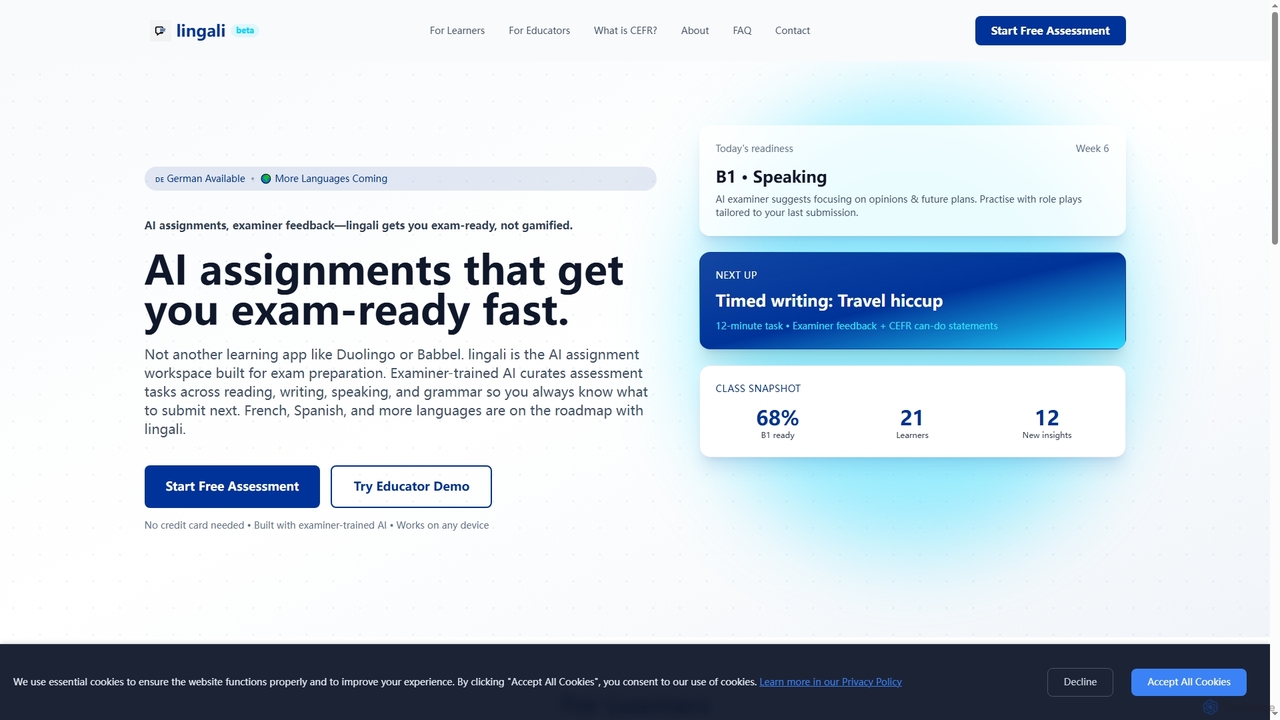
An AI-powered platform for CEFR language assessment, designed to prepare learners for German exams (A1-B2). It provides AI-driven assignments, examiner-trained feedback, and simulated tests for reading, writing, speaking, and grammar, focusing on exam readiness rather than gamified learning.

Exam Preparation
Visits 5.4KFavorites 149Likes 142
Vibeonly

Vibeonly

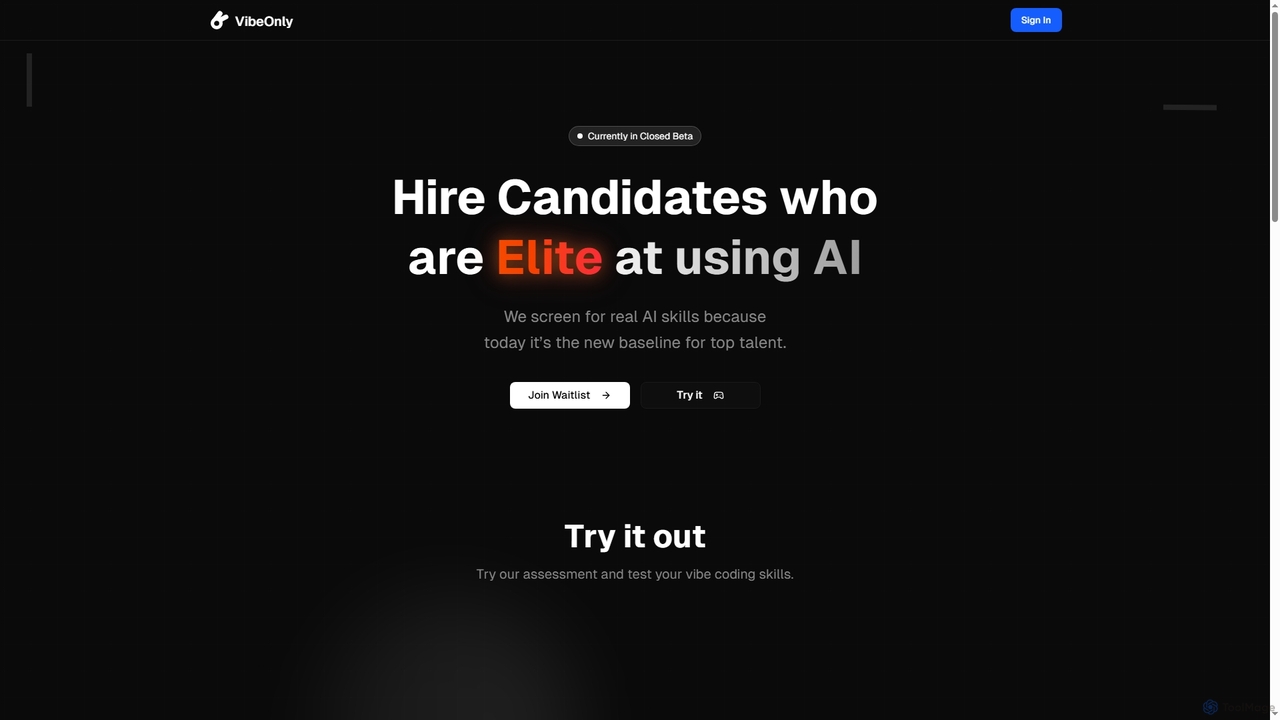
Vibeonly is an AI skill assessment platform for hiring elite, AI-native talent. It evaluates candidates' practical ability to use AI for critical thinking and problem-solving through real-world coding challenges, providing companies with an "AI Fluency Score" to identify top performers.

Testing
Visits 5.4KFavorites 111Likes 121
Hallo
Freemium

Hallo

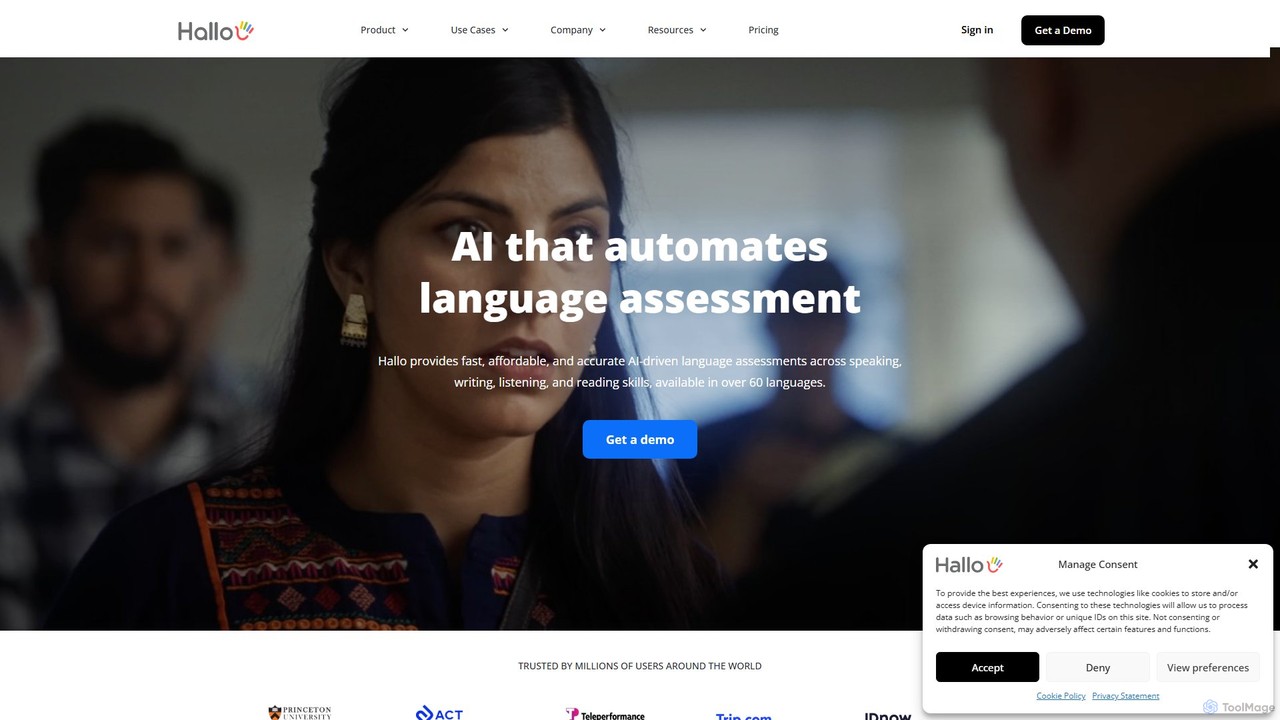
Hallo is an AI-powered platform for fast, accurate, and affordable language assessments. It evaluates speaking, writing, listening, and reading skills in over 60 languages, designed for global hiring, talent retention, and educational placement.

Language Learning
Visits 184.3KFavorites 128Likes 121

About Assessment

AI Assessment tools are a specialized category of productivity software that uses artificial intelligence to create, administer, and analyze evaluations. These tools leverage Natural Language Processing (NLP) and machine learning algorithms to automatically generate questions, grade complex responses, and provide data-driven insights. Their primary value lies in delivering objective, scalable, and efficient assessments, significantly reducing the manual effort involved in evaluating skills and knowledge. As part of the productivity ecosystem, they streamline workflows for educators, trainers, and hiring managers.

Core Features

  • Automated Question Generation: Creates diverse and relevant questions (multiple-choice, open-ended, scenario-based) from source materials like documents or videos.
  • Intelligent Scoring and Feedback: Grades not just simple answers but also complex text like essays or code, providing instant, constructive feedback.
  • Performance Analytics: Delivers detailed dashboards and reports on individual and group performance, highlighting strengths and knowledge gaps.
  • Adaptive Testing: Adjusts the difficulty of questions in real-time based on the test-taker's responses for a more accurate evaluation.
  • AI-Powered Proctoring: Monitors test sessions to ensure integrity and prevent cheating through methods like webcam and browser tracking.

Use Cases

These tools are widely used in corporate training to measure employee competency, in human resources for pre-employment skill screening, and in educational institutions to automate quiz creation and grading. They are essential for any scenario requiring standardized, large-scale evaluation of skills or knowledge.

How to Choose

When selecting an AI Assessment tool, consider the specific subject matter it supports (e.g., coding, languages, soft skills). Evaluate the range of question types it can generate and grade. Check for integration capabilities with your existing Learning Management Systems (LMS) or HR software, and assess the depth of its analytical reporting to ensure it meets your insight requirements.

Assessment use cases

1

Corporate Skill Gap Analysis

An HR manager for a large tech company needs to assess the current proficiency of their sales team on a new product suite. They use an AI assessment tool to upload training materials and automatically generate a series of scenario-based questions. The tool administers the test online, grades the responses, and produces a dashboard that visualizes team-wide strengths and weaknesses. This data allows the manager to identify specific knowledge gaps, such as handling objections about pricing, and organize targeted follow-up training sessions, ensuring a higher return on their training investment.

2

Automating Technical Recruitment Screening

A tech recruiter is tasked with screening hundreds of applications for a senior software engineer role. To efficiently filter candidates, they use an AI assessment platform that provides standardized coding challenges. Candidates are invited to solve a problem in their preferred programming language. The AI not only checks the code for correctness but also analyzes its efficiency (time and space complexity) and adherence to coding best practices. The recruiter receives a ranked list of candidates with detailed performance reports, allowing them to focus interview time on the most promising applicants, saving dozens of hours of manual code review.

3

Creating Educational Quizzes Instantly

A high school history teacher wants to create a weekly quiz for their students based on lecture notes and textbook chapters. Instead of spending hours manually writing questions, the teacher uploads a PDF of the material to an AI assessment tool. Within minutes, the AI generates a 25-question quiz featuring a mix of multiple-choice, true/false, and short-answer questions. The teacher can review, edit, or add questions before deploying the quiz to the students via a link. This process reduces preparation time by over 80%, allowing the teacher to focus more on instruction and student interaction.

4

Evaluating Language Proficiency with AI

A language learning platform needs a scalable way to assess the speaking and writing skills of its users. It integrates an AI assessment tool via API. When a user completes a module, they are prompted to answer an open-ended question in writing and record a short spoken response. The AI analyzes the written text for grammatical accuracy, vocabulary richness, and coherence. For the spoken response, it evaluates pronunciation, fluency, and intonation. The user receives an instant, detailed report with a proficiency score and specific areas for improvement, providing a personalized and objective learning experience.

5

Assessing Customer Support Agent Competency

A call center manager wants to ensure their agents are knowledgeable about a complex new billing system. They use an AI assessment tool to create a simulation where agents must respond to mock customer emails containing various billing inquiries. The AI evaluates the agents' written responses for accuracy, completeness, tone, and adherence to company communication guidelines. The results provide the manager with objective data on which agents require more training and which specific topics are most challenging for the team, enabling a more effective and data-driven coaching process.

6

Pre-employment Soft Skills Assessment

A consulting firm needs to assess problem-solving and communication skills in its candidates, which are difficult to gauge from a resume. They incorporate an AI assessment into their hiring process. Candidates are presented with a realistic business case study and asked to provide a written analysis and recommendation. The AI's NLP capabilities analyze the responses not just for keywords, but for logical structure, clarity of argument, and persuasive language. This provides recruiters with a standardized measure of soft skills, helping them identify candidates who can think critically and communicate effectively under pressure.

Assessment FAQ

What are AI Assessment tools?

AI Assessment tools are applications that use artificial intelligence to automate the process of creating, delivering, and analyzing tests and evaluations. Unlike simple quiz makers, they leverage technologies like machine learning and Natural Language Processing (NLP) to perform advanced tasks. Key features include generating questions from documents, automatically grading complex open-ended answers, and providing deep analytical insights into performance. They are primarily used to objectively measure knowledge, skills, and abilities in educational, corporate, and recruitment settings.

How to choose the right AI Assessment tool?

Choosing the right tool depends on your specific needs. Consider the following factors:

  • Content & Subject Matter: Does the tool specialize in your area, such as technical coding, language proficiency, or general knowledge?
  • Question & Grading Capability: Can it generate the types of questions you need (e.g., scenario-based, multiple-choice) and accurately grade complex, open-ended responses?
  • Integration: Can it easily connect with your existing systems, like a Learning Management System (LMS) or an Applicant Tracking System (ATS)?
  • Analytics & Reporting: Does it provide clear, actionable insights into performance, or just a simple score?
  • User Experience: Is the platform intuitive for both administrators creating the assessments and for the end-users taking them?
What's the difference between AI Assessment and traditional survey tools?

The core difference lies in their purpose. Traditional survey tools (like Google Forms or SurveyMonkey) are designed to collect opinions, feedback, or self-reported data; there are no inherently 'right' or 'wrong' answers. In contrast, AI Assessment tools are designed to evaluate knowledge or skills against a correct standard. They determine a user's competency by grading responses, analyzing performance, and providing objective scores. While a survey asks 'What do you think?', an assessment asks 'What do you know?' or 'What can you do?'.

What are the main benefits of using AI for assessments?

Using AI for assessments offers several key advantages over manual methods. The primary benefits include:

  • Objectivity: AI removes unconscious human bias from the grading process, ensuring every test-taker is evaluated on the exact same criteria.
  • Efficiency: It drastically reduces the time spent on creating questions, administering tests, and grading responses, freeing up educators and managers for higher-value tasks.
  • Scalability: AI can assess thousands of individuals simultaneously without a drop in quality, making it ideal for large-scale training or recruitment.
  • Data-Driven Insights: It provides deep analytics on performance trends, identifying common misconceptions or skill gaps across a group that are difficult to spot manually.
Who are AI Assessment tools for?

AI Assessment tools are designed for a range of professionals who need to measure knowledge or skills efficiently and at scale. Key user groups include:

  • Corporate Trainers & L&D Professionals: To measure the effectiveness of training programs and identify skill gaps within teams.
  • HR Managers & Recruiters: For pre-employment screening to objectively filter candidates based on technical or soft skills.
  • Educators & Academic Institutions: To automate the creation and grading of quizzes, exams, and assignments, saving significant time.
  • Certification Bodies: To develop and administer standardized tests for professional certifications in a secure and scalable manner.