Productivity Best in category 1 results Assessments AI Tool

Popular AI tools in the Assessments field of Productivity include InterviewQueue, etc., helping you quickly improve efficiency.

InterviewQueue

InterviewQueue

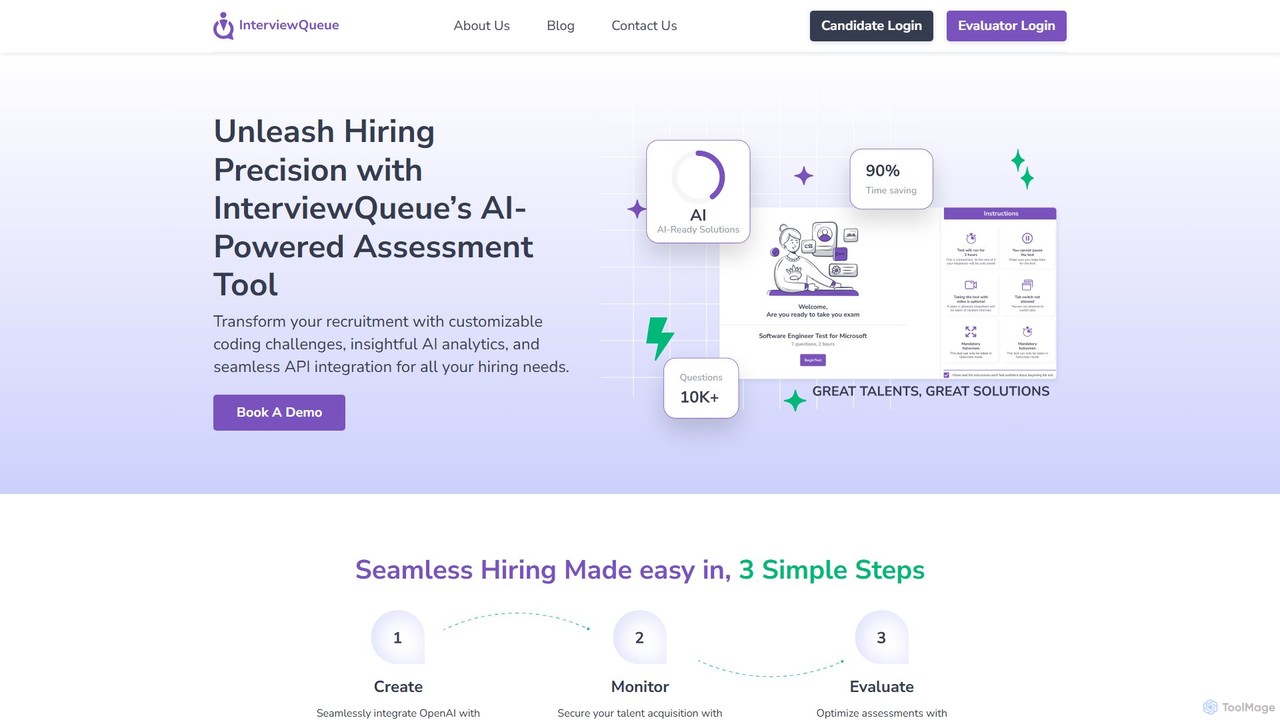
InterviewQueue is an AI-powered assessment platform designed to streamline the technical hiring process. It enables companies to create …

2.9K

About Assessments

AI Assessment tools are a specialized category of productivity software that use artificial intelligence to create, administer, and analyze evaluations. These platforms leverage machine learning and natural language processing (NLP) to automate tasks like question generation, grading complex responses, and identifying knowledge gaps. The primary value lies in delivering objective, scalable, and data-driven insights into skills, knowledge, and performance. This enables organizations to make more informed decisions in hiring, training, and education while significantly reducing manual effort.

Core Features

  • Automated Question Generation: Creates a variety of question types (multiple-choice, short answer, essay) from existing content like documents or videos.
  • Adaptive Testing: Adjusts the difficulty of questions in real-time based on the test-taker's performance, providing a more accurate skill measurement.
  • Advanced Performance Analytics: Offers detailed dashboards on individual and group performance, identifying trends, strengths, and areas for improvement.
  • AI-Powered Grading: Automatically scores not just objective questions but also complex open-ended responses, essays, and even code submissions.
  • Remote Proctoring & Security: Utilizes AI to monitor test-takers via webcam for signs of cheating, ensuring assessment integrity.

Applicable Scenarios

These tools are widely used in corporate human resources for pre-employment screening and employee skill development. In the education sector, they assist teachers in creating personalized learning paths and automating grading. Certification bodies also use them to administer secure, large-scale professional examinations remotely.

Selection Criteria

When choosing an AI Assessment tool, consider the types of assessments it supports (e.g., coding, language, soft skills). Evaluate the depth of its analytics and reporting capabilities. Check for integration options with existing Learning Management Systems (LMS) or Human Resource Information Systems (HRIS). Finally, assess the robustness of its security and anti-cheating features for high-stakes testing.

AssessmentsUse Cases

1

Automating Technical Skill Screening for Recruitment

A tech recruiter needs to screen hundreds of applications for a software developer role. Instead of manual resume reviews and initial phone screens, they use an AI Assessment tool. The tool automatically generates relevant coding challenges based on the job description. Candidates complete the tests online, and the AI platform auto-grades the code for correctness, efficiency, and style. The recruiter receives a ranked list of candidates with detailed performance reports, reducing screening time by over 70% and focusing interviews on the most qualified individuals.

2

Creating Personalized Learning Paths in Education

A high school teacher wants to address the diverse learning needs in a classroom of 30 students. Using an AI Assessment tool, the teacher administers a diagnostic test at the beginning of a new unit. The AI analyzes each student's results to identify specific knowledge gaps and strengths. Based on this analysis, the platform automatically suggests personalized learning materials, such as video tutorials for struggling students and advanced reading for those who have mastered the concepts. This allows the teacher to move from a one-size-fits-all approach to targeted, individual instruction, improving overall student outcomes.

3

Measuring Corporate Training Effectiveness

An L&D manager rolls out a new compliance training program for 500 employees. To measure its effectiveness, they use an AI Assessment tool to create a post-training evaluation. The tool generates scenario-based questions that test practical application, not just memorization. After employees complete the assessment, the AI provides a detailed analytics dashboard showing overall comprehension rates, identifying specific topics where employees struggled, and flagging departments that may need follow-up training. This data-driven feedback loop helps the L&D team prove training ROI and continuously improve their programs.

4

Administering Secure Remote Certification Exams

A professional certification body needs to offer its exams globally without requiring physical test centers. They adopt an AI Assessment platform with integrated remote proctoring. The platform locks down the candidate's browser, uses the webcam to verify identity, and monitors for suspicious behavior like looking away from the screen or having another person in the room. The AI flags potential integrity violations for human review. This allows the organization to scale its certification program securely, reduce logistical costs, and offer greater flexibility to candidates worldwide.

5

Automated Language Proficiency Assessment

A global company needs to assess the English proficiency of job applicants from various countries. They use an AI Assessment tool specialized in language skills. The tool evaluates candidates on four key areas: reading, writing, listening, and speaking. For the speaking section, the AI analyzes pronunciation, fluency, grammar, and vocabulary in real-time. It provides a standardized, objective score for each candidate, eliminating the bias and time constraints of human interviews. This process allows the company to efficiently filter candidates and ensure they meet the required communication standards for the role.

6

Identifying Skill Gaps for Employee Development

A manager wants to create a development plan for their team. They use an AI Assessment tool to conduct a 360-degree skill evaluation, assessing both technical and soft skills. The AI platform aggregates the results and generates a team-wide skill matrix, highlighting collective strengths and critical gaps. For each team member, it produces a personalized report with recommended training modules and career path suggestions. This objective, data-backed approach helps the manager have more productive development conversations and invest training budgets where they will have the most impact.

AssessmentsFrequently Asked Questions