TranscribeAndSplit
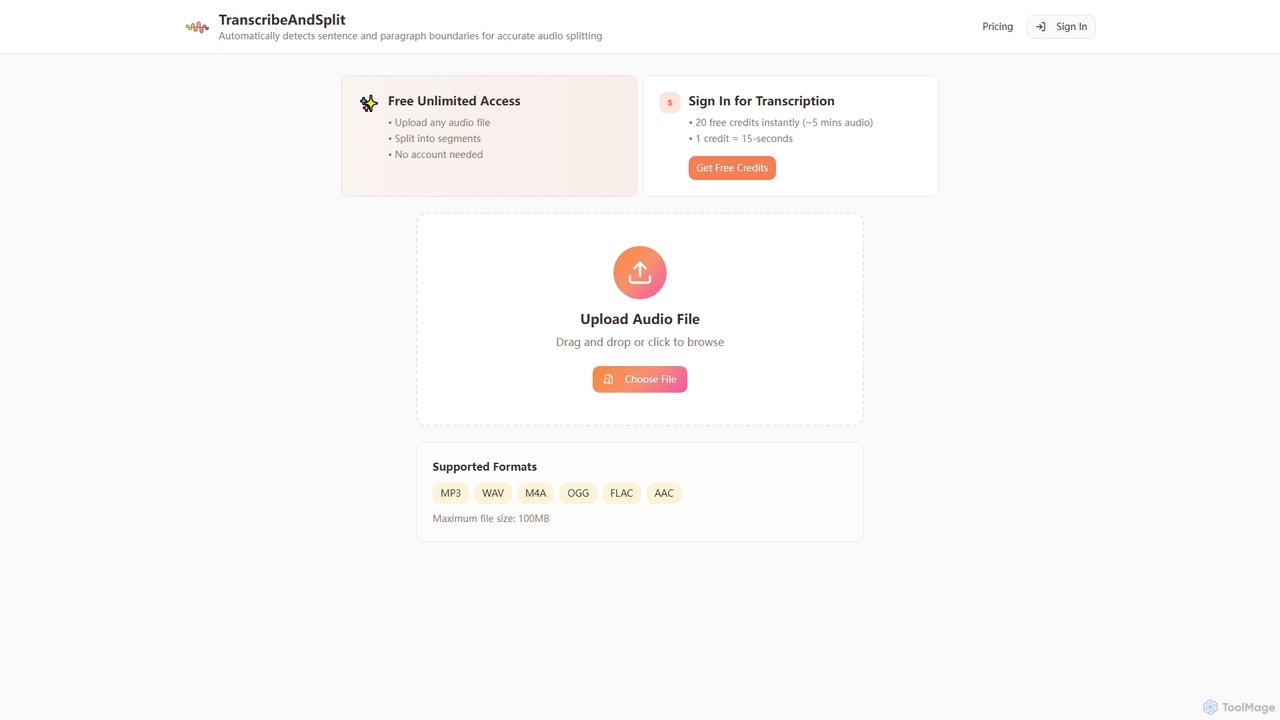
TranscribeAndSplit is an AI-powered online tool designed to effortlessly split audio files by sentence or paragraph boundaries and …
TranscribeAndSplit is an AI-powered online tool designed to effortlessly split audio files by sentence or paragraph boundaries and provide transcription services. It offers free unlimited access for audio splitting and generous free credits for transcription, supporting various popular audio formats for efficient content management.
About Audio Management
AI Audio Management tools are a category of AI-powered applications designed to streamline and enhance various audio-related tasks. Leveraging advanced artificial intelligence, including speech recognition, natural language processing, and machine learning, these tools can automatically transcribe, edit, analyze, and generate audio content. They significantly boost productivity for professionals dealing with large volumes of spoken information, offering solutions for everything from content creation to research and accessibility.
Core Features
- AI Transcription: Converts spoken language from audio or video files into accurate, editable text, often with speaker identification.
- Noise Reduction & Enhancement: Utilizes AI algorithms to automatically remove background noise, echo, and improve overall audio clarity and quality.
- Audio Summarization: Condenses lengthy audio recordings into concise summaries, highlighting key points and actionable insights.
- Text-to-Speech (TTS) Generation: Transforms written text into natural-sounding spoken audio, with customizable voices and emotional tones.
- Audio Translation: Automatically translates spoken content from one language to another, facilitating global communication and content localization.
Applicable Scenarios
These tools are invaluable for content creators, journalists, researchers, and businesses that regularly process or produce audio. They are used in podcast production, video post-production, academic research involving interviews, and corporate communications for meeting documentation and training material creation.
How to Choose
When selecting an AI Audio Management tool, consider transcription accuracy, supported languages and accents, the range of audio enhancement features, integration capabilities with existing workflows (e.g., video editors, CRM), and pricing models. Evaluate the ease of use and the quality of generated voices for TTS applications.

Audio ManagementUse Cases
Automating Meeting Minutes and Summaries
For corporate professionals and team leaders, AI audio management tools automatically transcribe meeting recordings, identify speakers, and generate concise summaries of discussions and action items. This eliminates manual note-taking, ensuring accurate records and allowing participants to focus entirely on the conversation, saving hours of post-meeting work.
Enhancing Podcast and Video Production Quality
Podcast hosts and video editors use these tools to automatically clean up audio tracks by removing background noise, echo, and hum, and to normalize volume levels across different speakers. This significantly improves the listening experience for audiences, reduces post-production time, and helps achieve professional-grade audio without extensive manual editing.
Streamlining Academic Research and Interview Analysis
Researchers and students can upload lengthy interview recordings or lecture audio to be accurately transcribed into text. AI tools can then help identify key themes, sentiments, and frequently mentioned keywords, making the qualitative data analysis process much faster and more efficient than manual transcription and review.
Creating Multilingual Content for Global Audiences
Content creators and marketing teams leverage AI audio management for translating spoken content and generating localized voiceovers. Tools can transcribe original audio, translate the text, and then use text-to-speech to create natural-sounding audio in multiple languages, expanding reach to international markets without hiring numerous voice actors.
Improving Accessibility for Digital Media
Media producers and educators utilize AI tools to automatically generate accurate captions and subtitles for videos and online courses. This not only makes content accessible to hearing-impaired individuals but also benefits viewers in noisy environments or those who prefer to consume content without sound, ensuring broader audience engagement and compliance with accessibility standards.
Organizing and Searching Large Audio Archives
Organizations with extensive audio libraries, such as broadcasters or legal firms, use AI audio management to transcribe and index their recordings. This allows for quick, keyword-based searching within audio files, making it easy to locate specific information, track discussions, or retrieve relevant clips without listening to hours of content.