nonfinito
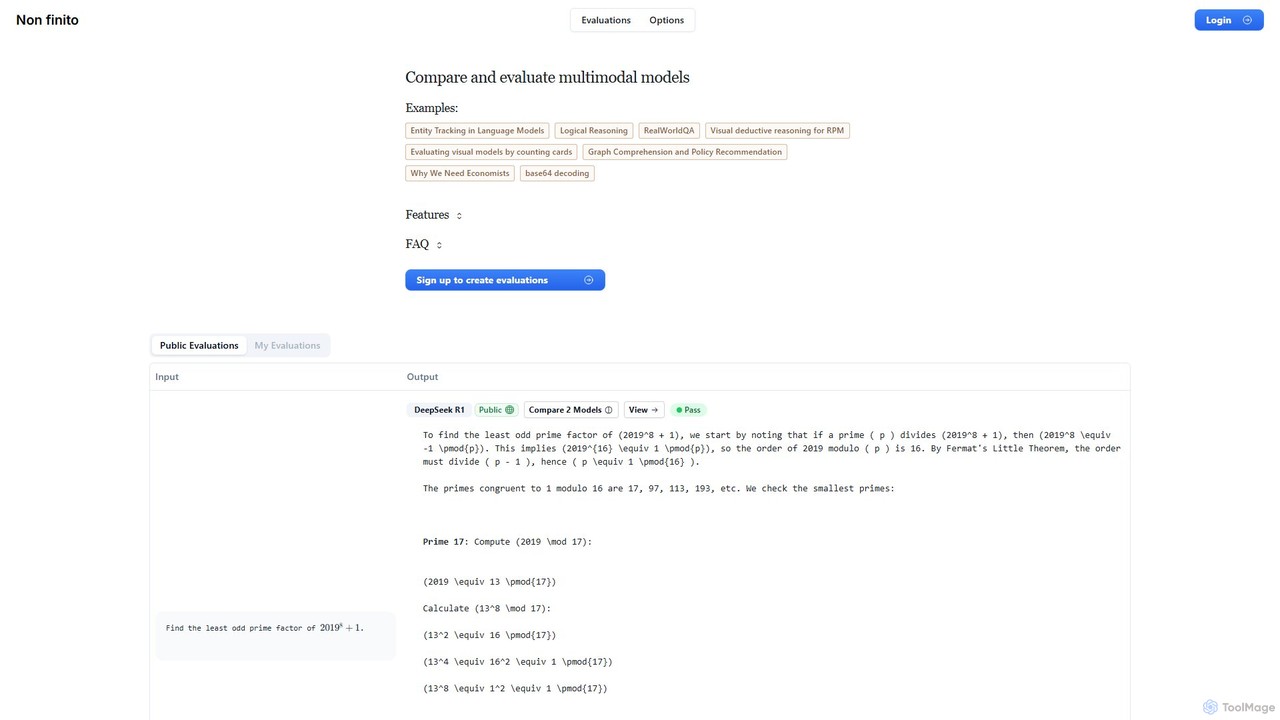
nonfinito is a comprehensive platform for evaluating and comparing multimodal AI models. It enables developers, researchers, and businesses …
nonfinito is a comprehensive platform for evaluating and comparing multimodal AI models. It enables developers, researchers, and businesses to test various LLMs side-by-side on custom prompts, assess their performance with pass/fail ratings, and analyze raw outputs. Create public or private benchmarks to find the best model for any task.
About Benchmarking
AI Benchmarking tools are specialized platforms for systematically evaluating and comparing the performance of artificial intelligence models and systems. They operate by running standardized tests or custom prompts across different models to measure key metrics like accuracy, speed, cost, and output quality. This enables developers, researchers, and businesses to make data-driven decisions when selecting, fine-tuning, or deploying AI solutions. As a key part of the Productivity ecosystem, these tools ensure that the chosen AI components are the most effective and efficient for a given task, directly optimizing workflows and results.
Core Features
- Model Performance Metrics: Measure objective criteria such as accuracy, latency, throughput, and other relevant scores (e.g., BLEU, ROUGE).
- Comparative Leaderboards: Provide side-by-side comparisons of multiple AI models on the same tasks for clear evaluation.
- Standardized Datasets: Utilize industry-recognized benchmarks (e.g., MMLU, HumanEval) for objective and reproducible evaluation.
- Cost-Performance Analysis: Calculate and compare API costs against the quality of outputs from different models to determine ROI.
- Custom Test Creation: Allow users to build and run proprietary tests using their specific data, prompts, and evaluation criteria.
Use Cases
These tools are widely used by AI developers for model selection, data scientists for validating fine-tuned models, and product managers for assessing the ROI of different AI integrations. In enterprise settings, they are crucial for regression testing and ensuring consistent AI performance over time after model updates.
How to Choose
When selecting an AI Benchmarking tool, consider the range of supported models (e.g., LLMs, image models), the availability of relevant industry benchmarks, and the flexibility to create custom evaluation suites. Also, evaluate its integration capabilities with your existing development workflow and the clarity of its reporting and analytics dashboards.

BenchmarkingUse Cases
Selecting the Best LLM for Customer Support
A tech company needs to build an AI chatbot to handle customer queries. They use a benchmarking tool to test three leading LLMs (e.g., GPT-4, Claude 3, Gemini Pro) on a dataset of 1,000 real customer support tickets. The tool automatically measures response accuracy, politeness scores, and API latency for each model. The resulting leaderboard clearly shows that one model provides the best balance of quality and speed for their specific needs, enabling a confident, data-backed decision for their development team.
Evaluating Fine-Tuned Model Improvements
A data science team fine-tunes an open-source model for legal document analysis. To prove its value, they use a benchmarking platform to compare the fine-tuned version against the original model and a proprietary one. By running a custom test suite of 200 legal queries, they generate a report showing a 15% increase in accuracy on contract clause identification. This quantitative result justifies the investment in fine-tuning and provides clear evidence of improved performance to stakeholders.
Optimizing Prompts for Marketing Copy
A marketing team needs to generate high-quality ad copy at scale. They use a benchmarking tool to A/B test 20 different prompt variations across multiple AI models. The tool automates the process and scores the outputs based on predefined quality criteria, such as clarity and call-to-action strength. This data-driven approach helps them identify the top-performing prompt-model combination, which can then be integrated into their content workflow to consistently produce more effective campaign materials.
AI System Regression Testing
An enterprise updates the core AI model in its internal knowledge management system. Before deploying, the QA team uses a benchmarking tool to run a predefined set of 500 tests that cover key functionalities. The tool compares the new model's results against the previous version's baseline, flagging any significant drops in performance. This ensures that updates do not inadvertently introduce regressions, maintaining system reliability and user trust.
Controlling AI API Costs
A startup's application relies heavily on a text-to-image API, and costs are rising. They use a benchmarking tool to evaluate three cheaper alternative models. They test all models on 100 representative prompts, comparing output image quality, style adherence, and cost-per-image. The analysis reveals a model that is 40% cheaper while meeting 90% of their quality requirements. This data allows them to make a strategic switch, significantly reducing operational costs without a major compromise on product quality.
Academic Research on Model Capabilities
University researchers are studying the reasoning abilities of emerging LLMs. They leverage a benchmarking platform to systematically run the ARC (AI2 Reasoning Challenge) benchmark across five different open-source models. The platform automates the execution, collects the results, and provides visualization tools for analysis. This significantly accelerates their research process, allowing them to focus on interpreting the data and publishing their comparative findings rather than on the manual setup and execution of tests.