Third
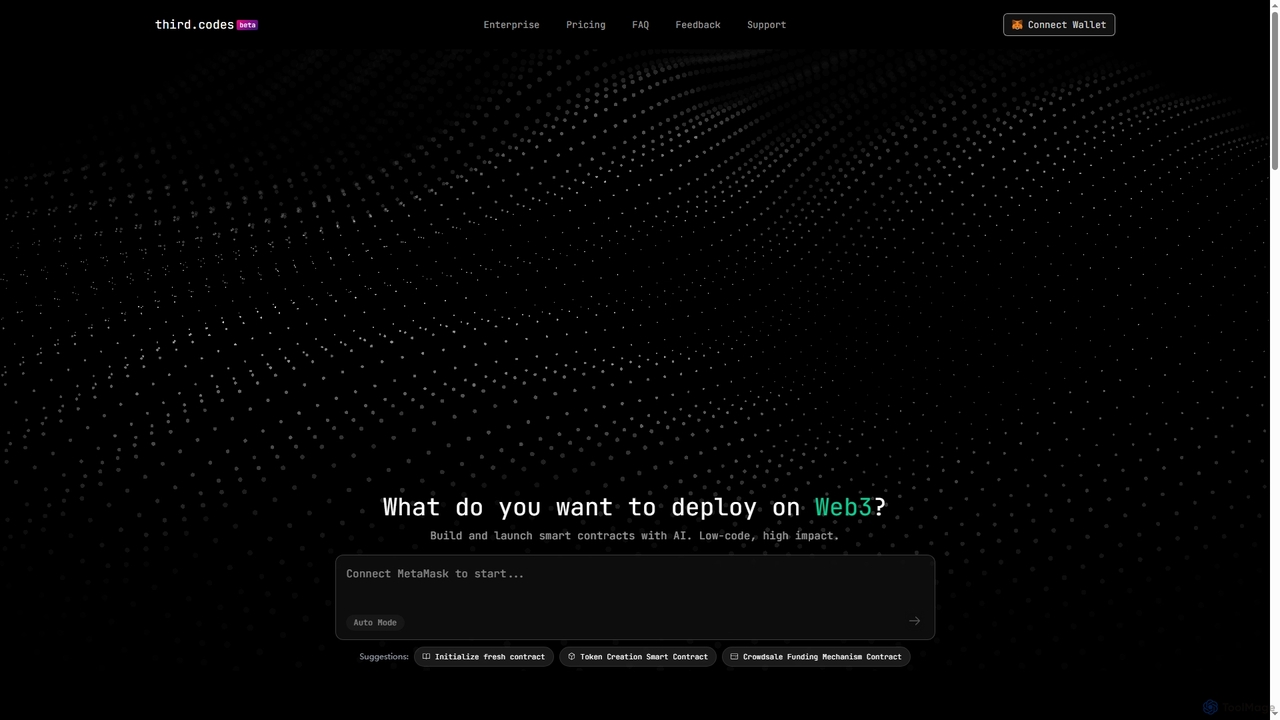
Third is an AI-powered platform for instantly generating, debugging, and deploying Solidity smart contracts across all EVM-compatible blockchains. …
Third is an AI-powered platform for instantly generating, debugging, and deploying Solidity smart contracts across all EVM-compatible blockchains. It simplifies Web3 development, allowing users to create complex contracts like ERC20 tokens, NFTs, DAOs, and DEXs from simple prompts, with one-click deployment.
About Code Deployment
Code Deployment tools are AI-powered solutions designed to automate and streamline the entire process of releasing software applications, from initial development stages to live production environments. These sophisticated tools leverage intelligent automation, machine learning, and predictive analytics to manage complex deployment pipelines, ensuring consistent, reliable, and highly efficient delivery of code across various platforms. As a critical sub-category within productivity tools, they fundamentally transform software development workflows by significantly reducing manual errors, accelerating release cycles, and enabling development teams to focus more on innovation and less on repetitive, time-consuming operational tasks. This automation is key to achieving faster time-to-market and maintaining high software quality.
Core Features
- Automated Deployment Pipelines: Orchestrate and execute a series of deployment steps automatically, covering everything from code compilation and testing to final release.
- Version Control Integration: Seamlessly connect with popular version control systems like Git, allowing deployments to be triggered by code commits and ensuring traceability.
- Environment Management: Define, configure, and manage distinct deployment environments (development, staging, production) with specific settings and dependencies.
- Rollback Capabilities: Provide robust mechanisms to quickly and safely revert to previous stable application versions in the event of a failed deployment or critical issue.
- Monitoring & Logging: Offer real-time visibility into deployment status, performance metrics, and detailed logs for effective troubleshooting and auditing.
Applicable Scenarios
These tools are indispensable for organizations practicing Continuous Integration/Continuous Deployment (CI/CD), enabling rapid, frequent, and reliable software updates without manual intervention. They are also vital for deploying and managing complex microservices architectures across distributed systems, ensuring each service is updated independently and efficiently. Furthermore, Code Deployment solutions are crucial for cloud-native applications and serverless functions, where agility, scalability, and automated infrastructure provisioning are paramount for modern development practices.
How to Choose
When selecting a Code Deployment tool, it's essential to consider its integration capabilities with your existing CI/CD tools, version control systems, and infrastructure providers. Evaluate its comprehensive support for your target deployment environments, whether they are public cloud platforms, on-premise servers, hybrid setups, or serverless functions. Assess its scalability to handle growing application complexity and user traffic, robust security features for protecting sensitive code and data, and the ease of defining, managing, and visualizing complex deployment workflows. The tool should align with your team's technical expertise, operational needs, and long-term strategic goals for software delivery.
Code DeploymentUse Cases
Automating Web Application Releases to Production
For web development teams, Code Deployment tools automate the entire release process of new features or bug fixes for web applications. Developers commit code to a version control system, triggering an automated pipeline that builds, tests, and deploys the application to staging for review, then to production. This ensures rapid, error-free updates, reducing downtime and manual intervention, allowing teams to deliver value to users faster and more reliably.
Deploying Microservices to Kubernetes Clusters
DevOps engineers managing microservices architectures use Code Deployment tools to orchestrate the deployment of individual services to Kubernetes clusters. The tools can automatically build Docker images, push them to a container registry, update Kubernetes manifests, and roll out new versions with zero downtime. This enables independent scaling and updating of services, improving system resilience and development agility for complex distributed applications.
Managing Multi-Environment Deployments for SaaS Products
SaaS companies often maintain multiple environments (development, testing, staging, production) for their products. Code Deployment tools allow administrators to define environment-specific configurations and securely deploy different versions of the application to each. This ensures consistent testing across environments and controlled releases, preventing configuration drift and ensuring that only thoroughly validated code reaches end-users, enhancing product stability.
Implementing CI/CD for Mobile Application Updates
Mobile app developers leverage Code Deployment tools to establish robust CI/CD pipelines for iOS and Android applications. Upon code commit, the tools automatically build the app, run unit and integration tests, and then distribute beta versions to testers or submit final builds to app stores. This automation significantly speeds up the release cycle for mobile updates, ensuring quality and consistency across various devices and operating systems.
Automating Infrastructure as Code (IaC) Deployment
Cloud architects and infrastructure engineers utilize Code Deployment tools to automate the provisioning and management of infrastructure using Infrastructure as Code (IaC) principles (e.g., Terraform, CloudFormation). The tools can automatically apply infrastructure changes based on version-controlled IaC templates, ensuring that environments are consistently configured, auditable, and reproducible. This reduces manual configuration errors and accelerates environment setup for new projects.
Streamlining Serverless Function Deployment and Management
Developers working with serverless architectures (e.g., AWS Lambda, Azure Functions) use Code Deployment tools to automate the packaging, deployment, and versioning of their functions. These tools handle dependency management, code uploads, and configuration updates across different regions or stages. This streamlines the serverless development lifecycle, enabling rapid iteration, efficient resource utilization, and simplified management of event-driven applications without managing underlying servers.