Productivity Best in category 1 results Custom Tools AI Tool

Popular AI tools in the Custom Tools field of Productivity include Shinkai, etc., helping you quickly improve efficiency.

Free
Shinkai

Shinkai

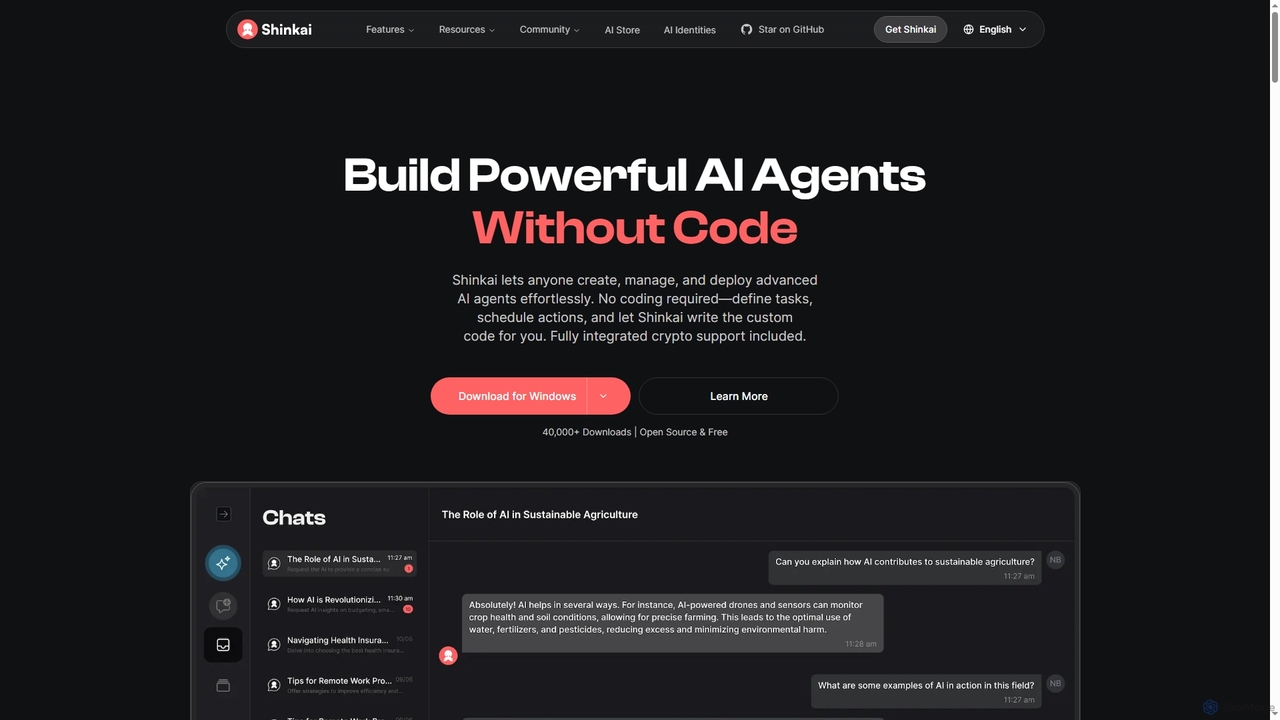
Shinkai is an open-source, no-code platform that empowers users to create, manage, and deploy powerful AI agents locally. …

8.9K

About Custom Tools

Custom Tools are AI-powered solutions specifically designed and configured to meet unique business needs or individual workflows, going beyond the capabilities of off-the-shelf applications. These tools leverage advanced AI models, often fine-tuned with proprietary data, to perform highly specialized tasks or integrate seamlessly into existing complex systems. They provide unparalleled flexibility and precision, enabling organizations to automate niche processes, gain bespoke insights, and achieve competitive advantages tailored to their specific operational context.

Core Features

  • Tailored AI Models: Development or fine-tuning of AI models (e.g., NLP, computer vision) using specific datasets for highly accurate and relevant results.
  • Workflow Integration: Seamless embedding of AI functionalities into existing enterprise software, legacy systems, or custom applications for smooth data flow.
  • Data Specificity: Ability to process, analyze, and generate outputs based on proprietary, industry-specific, or highly sensitive data, maintaining privacy and relevance.
  • Scalable Customization: Frameworks that allow for iterative adjustments and scaling of AI capabilities as business requirements evolve.
  • API & SDK Access: Provision of robust APIs and SDKs for developers to build, extend, and integrate custom AI functionalities into their own platforms.

Applicable Scenarios

Businesses often deploy custom AI tools for highly specific tasks like automating complex legal document review, predicting niche market trends using proprietary data, or developing unique customer service chatbots trained on specific product catalogs and company policies. These tools are invaluable where generic AI solutions fall short due to data sensitivity, unique operational logic, or the need for deep integration.

Selection Criteria

Selecting a custom AI tool involves evaluating the specific problem it aims to solve, the availability and quality of proprietary data for training, the required level of integration with existing systems, and the long-term scalability needs. Consider the expertise of the development team, the flexibility of the underlying AI framework, and the total cost of ownership including maintenance and future adaptations.

Custom ToolsUse Cases

1

Automating Niche Industry Compliance Checks

For legal firms or financial institutions, custom AI tools can be trained on vast amounts of industry-specific regulations, internal policies, and historical compliance data. This enables the AI to automatically review contracts, reports, or transactions for adherence to complex, evolving compliance standards, flagging potential violations with high accuracy and significantly reducing manual review time and human error.

2

Personalized Product Recommendation Engine

E-commerce businesses with unique product catalogs or customer behavior patterns can deploy custom AI to build highly personalized recommendation engines. By analyzing proprietary purchase history, browsing data, and even external market signals, the AI can suggest products with greater precision than generic solutions, leading to increased conversion rates and customer satisfaction.

3

Advanced Fraud Detection for Unique Patterns

Financial services or insurance companies facing specific, evolving fraud patterns that generic AI models struggle to identify can benefit from custom tools. These AI systems are trained on an organization's unique historical fraud data and transaction anomalies, allowing them to detect subtle, previously unseen fraudulent activities tailored to their specific risk profile.

4

Optimizing Supply Chain Logistics with Proprietary Data

Manufacturing or logistics companies can use custom AI to optimize their complex supply chains. By integrating with internal inventory systems, real-time sensor data, and historical delivery records, the AI can predict demand fluctuations, optimize routing, and manage inventory levels more efficiently, leading to reduced operational costs and improved delivery times specific to their network.

5

Bespoke Content Generation for Brand Voice

Marketing agencies or large enterprises requiring content that strictly adheres to a unique brand voice, style guide, and specific industry terminology can utilize custom AI content generators. These tools are fine-tuned on extensive archives of approved brand content, ensuring all generated marketing copy, articles, or social media posts maintain consistency and authenticity.

6

Predictive Maintenance for Specialized Industrial Equipment

Industries operating highly specialized machinery, such as aerospace or heavy manufacturing, can implement custom AI for predictive maintenance. The AI analyzes sensor data from specific equipment models, historical failure logs, and operational parameters to accurately predict potential breakdowns before they occur, minimizing downtime and extending equipment lifespan.

Custom ToolsFrequently Asked Questions