Freemium
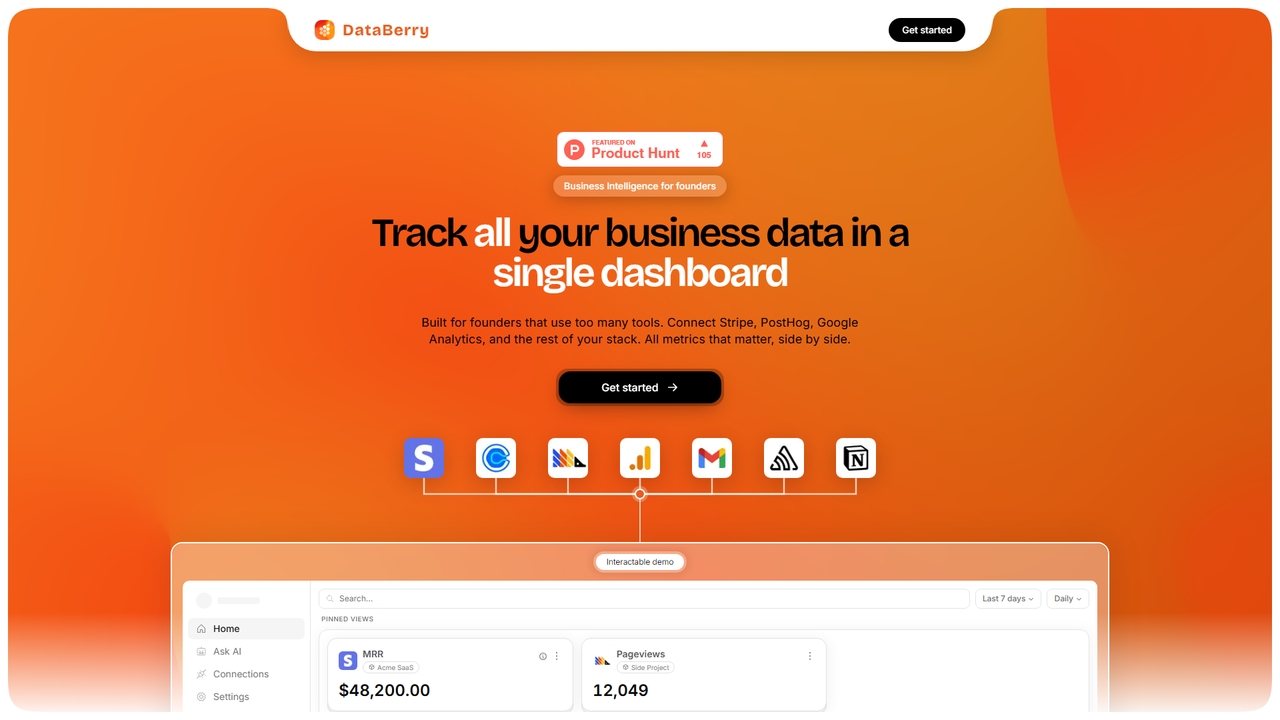
Popular Data Aggregation AI tools in Productivity include Pluggy and Databerry, helping you work more efficiently.

Pluggy is an Open Finance API platform that allows developers to connect to users' financial accounts. It provides a single API to access aggregated financial data, including transactions, balances, and investments, and to initiate instant payments via PIX.
ApiData Aggregation tools are AI-powered solutions designed to collect, process, and consolidate disparate data from various sources into a unified, coherent format. These tools leverage advanced algorithms to automate the extraction, transformation, and loading (ETL) of data, making it readily available for analysis and reporting. By centralizing information, they empower businesses to gain comprehensive insights, streamline operations, and make more informed decisions across different departments, significantly boosting overall productivity.
Data Aggregation tools are essential for organizations seeking to overcome data silos and leverage their information assets effectively. They are widely used in business intelligence, marketing analytics, financial reporting, and operational management to create a single source of truth for critical data, enabling cross-functional analysis and strategic planning.
When selecting a Data Aggregation tool, consider its compatibility with your existing data sources and systems, the robustness of its data cleaning and transformation capabilities, and its scalability to handle growing data volumes. Evaluate the ease of use, customization options for reporting, and the level of security and compliance offered to protect sensitive information.
A marketing analyst uses AI data aggregation tools to automatically collect competitor pricing, product reviews, social media mentions, and industry news from various online sources. This consolidated view helps identify market trends, assess competitive positioning, and inform strategic marketing campaigns, saving hours of manual research and providing real-time insights.
A customer experience manager employs data aggregation to pull customer reviews from e-commerce platforms, support tickets from helpdesk software, and sentiment from social media. The tool unifies this feedback, identifies common pain points or popular features, and generates actionable reports to improve product development and service quality.
A finance department utilizes data aggregation to combine financial data from multiple ERP systems, accounting software, and external market data feeds. This enables the creation of comprehensive, real-time financial dashboards and reports, facilitating accurate forecasting, budget analysis, and compliance reporting across different business units.
An e-commerce retailer aggregates product specifications, inventory levels, supplier data, and customer purchase history from various internal and external databases. This unified product catalog ensures consistent information across all sales channels, optimizes inventory management, and supports personalized product recommendations, enhancing the shopping experience.
A sales team uses data aggregation to enrich leads by combining information from CRM systems, marketing automation platforms, public company databases, and social profiles. The tool consolidates contact details, company size, industry, and engagement history, allowing sales representatives to prioritize high-potential leads and tailor their outreach strategies effectively.
A supply chain manager aggregates data from logistics providers, inventory management systems, supplier performance databases, and IoT sensors on shipments. This provides a holistic view of the entire supply chain, enabling proactive identification of bottlenecks, optimization of routes, and improved inventory forecasting, leading to reduced costs and enhanced efficiency.
Data Aggregation tools are software solutions that automatically collect, process, and consolidate data from multiple disparate sources into a single, unified dataset. They are crucial for breaking down data silos, transforming raw information into a structured format, and making it accessible for comprehensive analysis, reporting, and business intelligence. These tools often leverage AI to handle complex data types and automate the entire aggregation process.
AI significantly enhances Data Aggregation by automating complex tasks that would otherwise require extensive manual effort. AI-powered algorithms can intelligently identify and extract relevant information from unstructured data (like text or images), perform advanced data cleaning and normalization, and detect patterns or anomalies. This leads to higher accuracy, faster processing, and the ability to handle larger volumes and varieties of data, providing deeper insights.
The primary benefits of using Data Aggregation tools include improved data accuracy and consistency, significant time savings through automation, and the ability to gain a holistic view of business operations. They facilitate better decision-making by providing a single source of truth, reduce manual errors, and enable more efficient reporting and analytics. Ultimately, these tools help organizations unlock the full potential of their data assets.
To choose the right Data Aggregation tool, first assess your specific data sources and integration needs, ensuring the tool supports them. Evaluate its data quality features, including cleaning, transformation, and validation capabilities. Consider scalability for future data growth, ease of use for your team, and the level of security and compliance it offers. Finally, compare pricing models and customer support to find a solution that aligns with your budget and operational requirements.
While often used interchangeably, Data Aggregation and Data Integration have distinct focuses. Data Aggregation primarily involves collecting and consolidating data from various sources into a unified format for analysis and reporting, creating a single, summarized view. Data Integration, on the other hand, focuses on connecting different systems and applications to ensure data flows seamlessly between them, often for operational purposes. Aggregation is a specific type of integration, focused on analytical consolidation rather than just connectivity.