rocketstatements
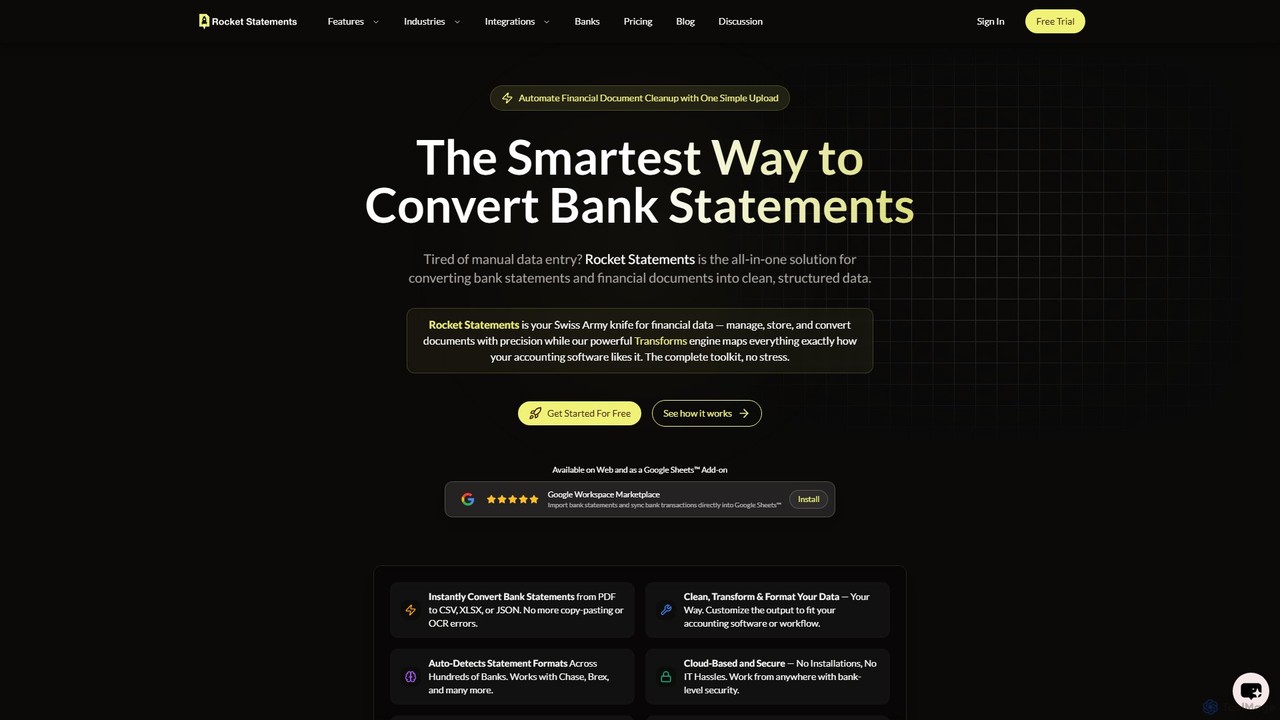
An AI-powered platform that instantly converts bank statements from PDF and image formats into clean, structured data like …
An AI-powered platform that instantly converts bank statements from PDF and image formats into clean, structured data like Excel, CSV, and JSON. Designed for accountants and businesses to automate financial data entry and cleanup, integrating seamlessly with accounting software.
About Data Conversion
AI Data Conversion tools are specialized applications that automate the process of transforming data from one format to another. Leveraging machine learning models, these tools intelligently recognize, parse, and restructure complex and unstructured data, such as PDFs, images, and audio files. Their primary value lies in bridging compatibility gaps between different systems, digitizing physical documents, and preparing data for analysis or migration. This goes beyond simple file type changes by understanding the context and structure of the information itself.
Core Features
- Intelligent Format Recognition: Automatically identifies input data structures and maps them to desired output formats.
- Unstructured Data Processing: Extracts text and structured information from images (OCR), PDFs, and audio files.
- Schema Transformation: Converts data between complex schemas like XML, JSON, and database tables.
- Batch Conversion: Processes large volumes of files or data records in a single automated operation.
- Data Validation & Cleansing: Identifies and helps correct errors or inconsistencies during the conversion process.
Use Cases
These tools are widely used in finance for digitizing invoices, in healthcare for processing patient records, and in IT for migrating legacy system data. Developers also use them to normalize data from various APIs, while content creators convert media files for repurposing.
How to Choose
When selecting a tool, consider the specific input and output formats you need. Evaluate its accuracy for unstructured data (e.g., OCR precision). Also, check for API access for integration, security protocols for sensitive data, and the tool's ability to scale with your data volume.
Data ConversionUse Cases
Automated Invoice and Receipt Digitization
An accounting department receives hundreds of invoices and receipts weekly in various formats, including scanned PDFs and photos. Using an AI Data Conversion tool with advanced OCR, they automate the entire process. The tool automatically extracts key information like vendor name, invoice number, date, and line items, then converts this unstructured data into a structured CSV or JSON file. This file is then directly imported into their accounting software, eliminating manual data entry, reducing errors, and saving dozens of hours per week.
Legacy System Data Migration
An IT team is tasked with migrating decades of customer data from a mainframe system using a proprietary format to a modern cloud-based SQL database. A manual conversion would be error-prone and time-consuming. They use an AI Data Conversion tool that can be trained to understand the legacy data structure. The tool intelligently maps old data fields to the new database schema, handles character encoding issues, and validates data integrity during the transfer. This accelerates the migration project from months to weeks and ensures high data fidelity.
Multimedia Content Transcription and Repurposing
A content marketing agency produces weekly podcasts and video interviews. To maximize their reach, they need to repurpose this content into blog posts, social media snippets, and newsletters. An AI Data Conversion tool with speech-to-text capabilities automatically transcribes the audio from these files into accurate, time-stamped text. This text can then be easily edited, summarized by another AI tool, and converted into various document formats (like .docx or .md) for different platforms, drastically reducing the manual effort required for content creation.
Normalizing Data from Multiple API Sources
A software developer is building a dashboard that aggregates data from three different service providers via their APIs. Each API returns data in a different format (one in XML, two in different JSON structures). Instead of writing complex custom parsers for each, the developer uses an AI Data Conversion tool. They define a single, standardized JSON schema for their application. The tool then automatically ingests data from each API endpoint and transforms it into the unified format, simplifying the development process and making the application easier to maintain.
Converting Research Data for Analysis
A scientific researcher collects data from various laboratory instruments, each outputting data in a proprietary binary or text format. To perform a comprehensive analysis, all this data needs to be in a standardized format like CSV or Parquet. The researcher uses an AI Data Conversion tool that supports custom format definitions. They configure the tool to parse the specific layouts of their instrument files. The tool then batch-converts thousands of files, structuring the raw data into clean, tabular formats ready for import into statistical software like R or Python libraries like Pandas.
Extracting Product Data for E-commerce
An e-commerce manager needs to add hundreds of new products from a supplier. The supplier provides product information in poorly structured PDF catalogs. Manually copying this data is tedious. The manager uses an AI Data Conversion tool to process these PDFs. The tool identifies and extracts product names, SKUs, descriptions, and prices, even when the layout varies between pages. It then converts this extracted information into a structured CSV file, perfectly formatted for a bulk upload to their e-commerce platform like Shopify or Magento, saving days of manual work.