AI Placeholder
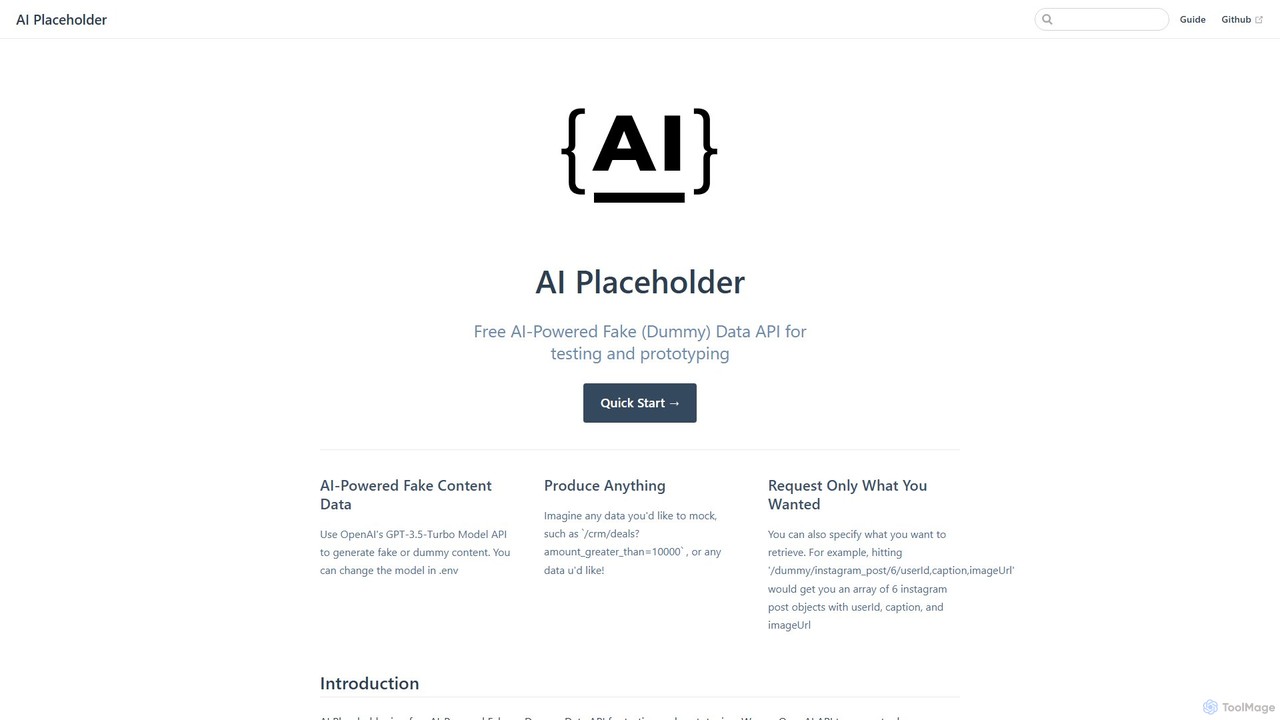
AI Placeholder is a free, open-source API that leverages OpenAI's GPT-3.5-Turbo to generate realistic fake or dummy data …
AI Placeholder is a free, open-source API that leverages OpenAI's GPT-3.5-Turbo to generate realistic fake or dummy data for testing and prototyping. Developers can create highly customized datasets on-the-fly, from simple user lists to complex CRM deal data, simply by structuring an API request. It offers both a hosted version for immediate use and the option to self-host for greater control.
About Data Generation
Data Generation tools are a class of AI applications designed to programmatically create synthetic, structured, or mock data. These tools leverage generative models, statistical algorithms, and user-defined rules to produce high-quality datasets that mimic the characteristics of real-world information. Their primary value lies in accelerating software testing, training machine learning models without sensitive data, and protecting user privacy. By providing on-demand access to realistic data, they remove critical bottlenecks in development and research workflows.
Core Features
- Synthetic Data Creation: Generates statistically accurate tabular, text, or image data based on real data patterns or custom schemas.
- Data Anonymization: Creates privacy-preserving datasets by replacing personally identifiable information (PII) with realistic synthetic values.
- Test Data Management: Produces specific data volumes and formats required for database load testing, API validation, and quality assurance.
- Customizable Schemas: Allows users to define data types, relationships, and constraints to generate highly specific and structured datasets.
- Data Augmentation: Expands existing small datasets by creating new, varied data points to improve the robustness of machine learning models.
Use Cases
These tools are widely used by software development teams for creating comprehensive test environments and by data scientists for training AI models when real data is scarce, imbalanced, or protected by privacy regulations. For instance, financial institutions use them to generate synthetic transaction data for fraud detection model development, while healthcare researchers create anonymized patient data for analysis without compromising confidentiality.
How to Choose
When selecting a Data Generation tool, consider the required data types (e.g., tabular, text, time-series). Evaluate the fidelity of the generated data—how well it captures the statistical properties of real data. Assess its scalability for producing large volumes of information and its integration capabilities with your existing databases and APIs. Finally, for sensitive applications, verify the tool's support for formal privacy guarantees like Differential Privacy.

Data GenerationUse Cases
Generating Test Data for Software Development
A Quality Assurance (QA) engineer is tasked with testing a new e-commerce application's database performance under heavy load. Instead of using sensitive real customer data, they use a data generation tool to create one million realistic but entirely fake user profiles. This includes generating consistent names, email addresses, shipping addresses, and order histories that conform to the database schema. The resulting dataset allows for comprehensive stress testing and bug identification in a secure, privacy-compliant environment, significantly accelerating the QA cycle before launch.
Training a Machine Learning Model with Synthetic Data
A data scientist is building a fraud detection model but has an imbalanced dataset with very few examples of fraudulent transactions. This scarcity makes it difficult to train an accurate model. By using an AI data generation tool, they can analyze the patterns of the few real fraud cases and generate thousands of new, diverse, and realistic synthetic fraud examples. This process, known as data augmentation, creates a balanced training set, enabling the machine learning model to learn the characteristics of fraud more effectively and significantly improving its detection accuracy in real-world scenarios.
Creating Anonymized Datasets for Research
A healthcare research institution needs to share patient data with external partners for a collaborative study, but is bound by strict privacy regulations like HIPAA. To overcome this, they use a data generation tool to create a synthetic dataset. The tool analyzes the original, private patient data to learn its statistical properties, distributions, and correlations. It then generates an entirely new dataset that mirrors these statistical characteristics but contains no real patient information. This allows researchers to share valuable insights and collaborate freely without risking patient confidentiality, ensuring full legal and ethical compliance.
Populating Product Demos and Prototypes
A product manager is preparing a presentation of a new analytics dashboard for potential investors. An empty dashboard with no data fails to demonstrate the product's value. Using a data generation tool, the manager quickly creates thousands of rows of realistic-looking sales data, user engagement metrics, and inventory levels. This mock data is used to populate the dashboard's charts and tables, creating a compelling and dynamic demonstration. It allows stakeholders to immediately grasp the product's capabilities and visualize how it would work with their own data, making the pitch far more effective.
Generating Realistic Mock API Responses
A frontend development team is building a mobile app that relies on a backend API, but the API is not yet complete. To avoid delays, the team uses a data generation tool to create a mock API server. They define the expected JSON structure for various endpoints, such as user profiles or product lists. The tool then populates this structure with large amounts of realistic, varied data. This allows the frontend team to build and test the user interface against a functional, data-rich mock API, ensuring development can proceed in parallel and integration issues are identified early.
Creating Diverse Datasets to Mitigate AI Bias
An AI ethics team discovers that their company's hiring algorithm, trained on historical data, shows bias against certain demographic groups. To correct this, they use a data generation tool to create a new, balanced training dataset. The tool is configured to generate synthetic candidate profiles that increase the representation of underrepresented groups while maintaining realistic skill and experience distributions. By retraining the algorithm on this augmented and debiased dataset, the team can significantly reduce algorithmic bias and promote fairer hiring outcomes, aligning the AI's performance with the company's diversity and inclusion goals.