Beam
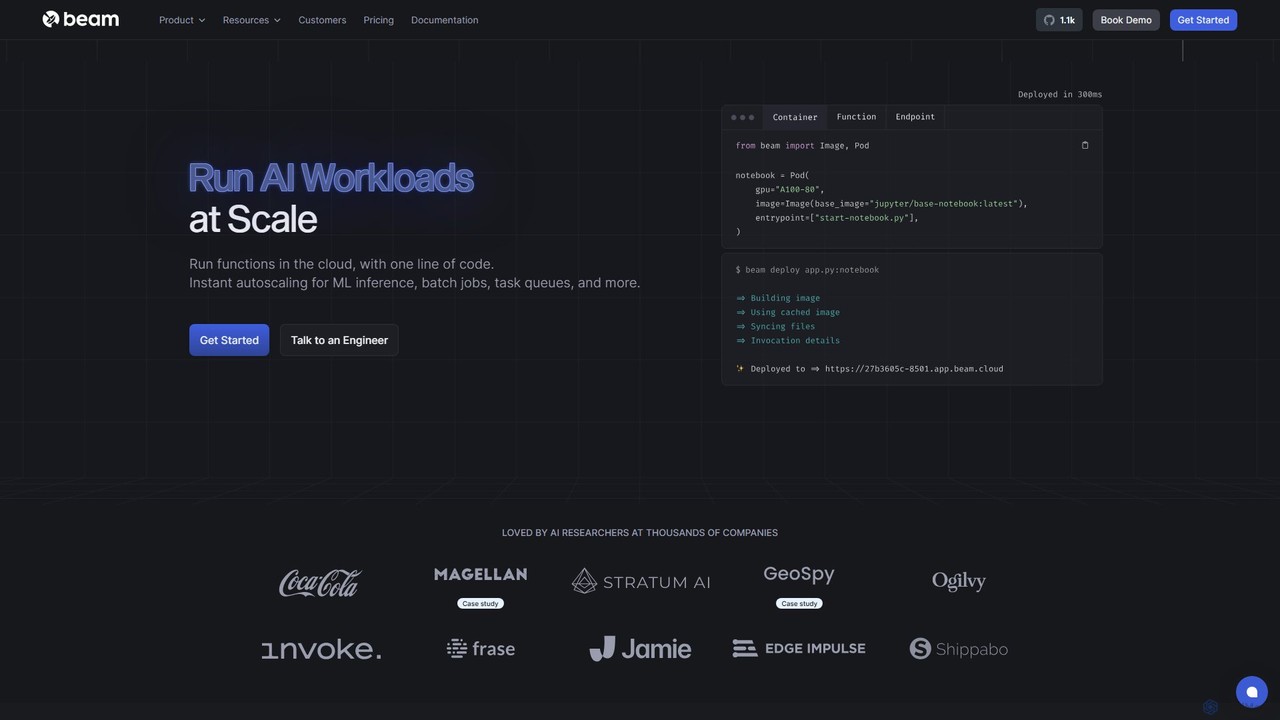
Beam is a serverless cloud platform designed for developers to run, scale, and deploy AI/ML models and applications …
Beam is a serverless cloud platform designed for developers to run, scale, and deploy AI/ML models and applications on GPUs with ease. It offers instant autoscaling, pay-per-second billing, and a streamlined workflow, allowing you to go from code to a scalable API in minutes without managing complex infrastructure.
About Deployment
Deployment AI tools are specialized platforms and services designed to streamline the process of taking trained AI models from development to production environments. These tools automate critical MLOps tasks, ensuring models are efficiently served, monitored, and scaled to meet real-world demands. They provide the infrastructure and workflows necessary for reliable AI application delivery, significantly enhancing the operational efficiency of AI initiatives within the broader productivity ecosystem.
Core Features
- Model Serving: Efficiently hosts and exposes trained AI models as APIs for real-time inference.
- Version Control: Manages different iterations of models and their associated code and data.
- Performance Monitoring: Tracks model performance, data drift, and resource utilization in production.
- Scalability: Automatically scales inference resources up or down based on demand.
- CI/CD for ML: Integrates machine learning models into continuous integration and delivery pipelines.
Applicable Scenarios
Data science teams and MLOps engineers leverage deployment tools to automate the release cycle of machine learning models, ensuring consistent performance and availability. They are crucial for companies building AI-powered products, from recommendation engines to intelligent automation systems, needing robust infrastructure for model lifecycle management.
How to Choose
When selecting deployment tools, consider their compatibility with existing ML frameworks, scalability options for varying inference loads, monitoring capabilities for model health, and ease of integration with your current infrastructure. Evaluate also the level of automation offered for CI/CD and the cost-effectiveness of their resource management.
DeploymentUse Cases
Automating AI Model Release Pipelines
MLOps engineers use deployment platforms to establish CI/CD pipelines for machine learning models. This automates testing, versioning, and releasing new model iterations, ensuring rapid and reliable updates to AI-powered applications without manual intervention, significantly reducing time-to-market for new features.
Real-time Inference for Customer Service Bots
Companies deploy natural language processing (NLP) models using these tools to power real-time customer service chatbots. The deployment infrastructure ensures low-latency responses and high availability, allowing thousands of customer queries to be processed simultaneously and accurately, improving customer satisfaction and operational efficiency.
Scaling Computer Vision Models for Industrial Inspection
Manufacturers utilize deployment solutions to serve computer vision models for automated quality control on production lines. These tools enable dynamic scaling of inference resources to handle varying volumes of image data, ensuring consistent inspection speeds and accuracy as production demands fluctuate, minimizing defects and waste.
Managing A/B Testing for Recommendation Engines
E-commerce platforms employ deployment tools to simultaneously serve multiple versions of recommendation models for A/B testing. This allows them to compare model performance in real-time, gather user feedback, and seamlessly roll out the most effective model to all users, optimizing personalization and driving higher conversion rates.
Monitoring and Retraining Fraud Detection Models
Financial institutions deploy fraud detection models and use integrated monitoring features to track model drift and performance degradation. When anomalies are detected, these tools facilitate automated alerts and trigger retraining workflows, ensuring the model remains accurate against evolving fraud patterns and minimizing financial losses.
Edge Deployment for IoT Devices
Developers use specialized deployment tools to push optimized AI models to edge devices like smart cameras or industrial sensors. This enables on-device inference, reducing latency and bandwidth usage, which is critical for applications requiring immediate decision-making without constant cloud connectivity, enhancing reliability in remote environments.