
ToolMage
Sign in

Best 1 Document Summarization AI tools for Productivity

Popular Document Summarization AI tools in Productivity include brighterway, helping you work more efficiently.

brighterway
Paid

brighterway

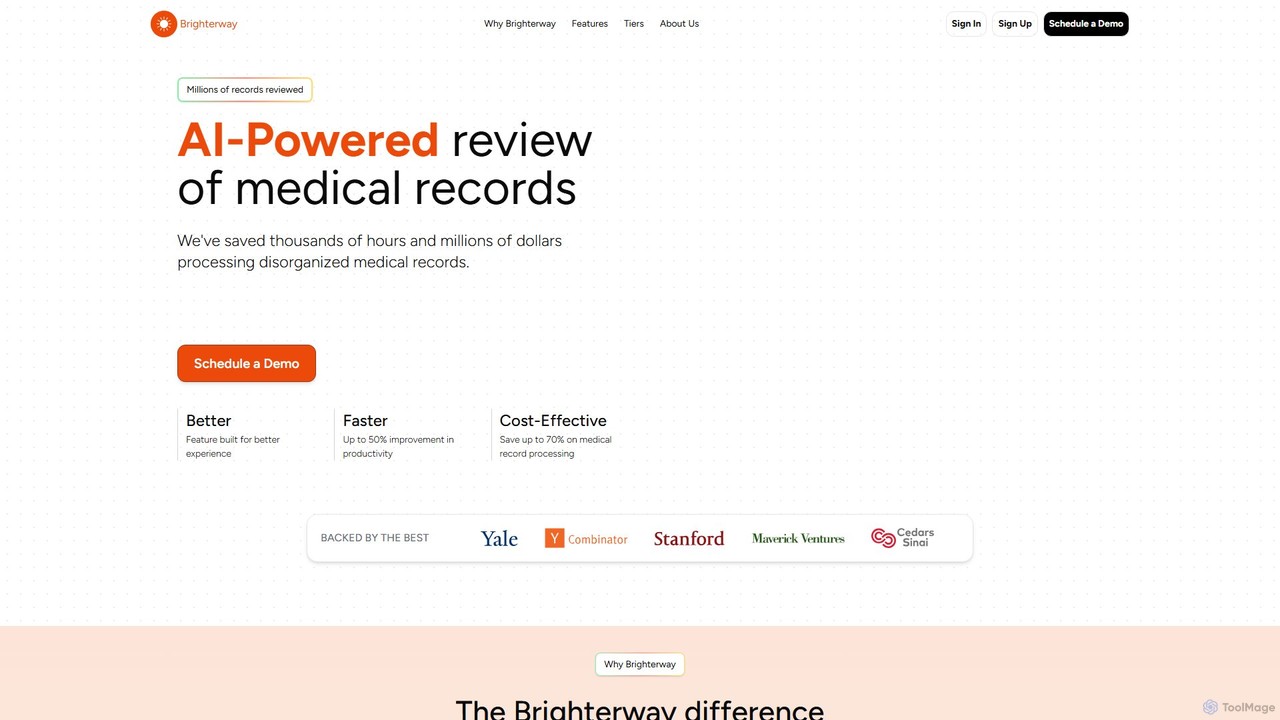
Brighterway is an AI-powered platform designed for the medical and legal industries to streamline the review of complex medical records. It automates the sorting and summarization of disorganized documents, significantly improving productivity and reducing costs. The platform is fine-tuned by MDs and AI researchers to ensure clinical accuracy and relevance, offering customizable solutions and expert support to enhance decision-making.

Data Processing
Visits 7.1KFavorites 135Likes 161

About Document Summarization

Document Summarization tools are AI-powered applications that condense lengthy texts into concise, coherent summaries. These tools leverage natural language processing (NLP) and machine learning to identify key information, extracting or generating shorter versions while preserving the original meaning. They significantly enhance productivity by enabling users to quickly grasp essential content from reports, articles, and documents, making information consumption more efficient within the broader Productivity category.

Core Features

  • Extractive Summarization: Identifies and extracts the most important sentences or phrases directly from the original text.
  • Abstractive Summarization: Generates new sentences and phrases to form a summary, often rephrasing content for better flow and conciseness.
  • Customizable Length: Allows users to specify the desired summary length, from a few sentences to a percentage of the original text.
  • Keyphrase Extraction: Automatically identifies and lists the most relevant keywords and phrases within the document.
  • Multi-document Summarization: Combines information from multiple related documents to create a single, comprehensive summary.

Applicable Scenarios

Researchers can quickly review numerous scientific papers and articles to identify relevant studies and key findings. Business analysts and executives can summarize market research reports and financial statements to extract critical insights for strategic decision-making. Content creators and journalists can condense lengthy interviews or source materials into digestible summaries for articles or news reports.

How to Choose

When selecting a document summarization tool, consider the accuracy and coherence of its summaries, especially for complex texts. Evaluate its support for various document formats (PDF, Word, web pages) and integration capabilities with existing workflows or platforms. Look for customization options like summary length control and the ability to focus on specific topics. Finally, assess the security and privacy features, particularly for sensitive corporate or personal data.

Document Summarization use cases

1

Quickly Digesting Research Papers

Academic researchers and students often face an overwhelming volume of scientific literature. Document summarization tools allow them to input lengthy research papers and instantly receive condensed versions, highlighting the abstract, methodology, key findings, and conclusions. This enables them to rapidly assess the relevance of a paper to their work, saving hours of reading time and accelerating literature reviews for dissertations or grant proposals.

2

Summarizing Legal Documents

Legal professionals, including lawyers and paralegals, frequently deal with extensive contracts, case files, and discovery documents. Using AI summarization, they can quickly generate summaries of these complex texts, identifying critical clauses, key arguments, and relevant precedents. This streamlines the review process, helps in preparing for court cases, and ensures no crucial information is overlooked, significantly reducing manual effort.

3

Extracting Key Information from News Articles

Journalists, media analysts, and PR professionals need to stay updated on current events across numerous news sources. Document summarization tools can process multiple articles on a given topic, providing concise summaries that capture the main points, involved parties, and developments. This facilitates rapid news consumption, trend identification, and the efficient creation of daily news briefings or media reports.

4

Condensing Meeting Transcripts

Teams often conduct long meetings that generate extensive transcripts. Project managers and team leads can feed these transcripts into a summarization tool to automatically generate concise meeting minutes, highlighting action items, decisions made, and key discussion points. This ensures everyone is aligned, follow-ups are clear, and valuable time is saved from manual note-taking and distribution.

5

Summarizing Customer Feedback and Reviews

Product managers and customer service teams receive vast amounts of customer feedback, reviews, and support tickets. Document summarization tools can process this unstructured data to identify common themes, recurring issues, and sentiment trends. This helps in quickly understanding customer pain points, prioritizing product improvements, and enhancing overall customer satisfaction without manually sifting through thousands of entries.

6

Creating Executive Briefs from Reports

Business executives and managers require quick, high-level overviews of detailed internal reports, such as quarterly performance reviews, project status updates, or market analysis. Summarization tools enable them to transform lengthy reports into executive briefs, focusing on critical metrics, strategic implications, and recommendations. This supports informed decision-making by providing essential information efficiently.

Document Summarization FAQ

What are Document Summarization tools?

Document Summarization tools are AI-powered applications that automatically condense long texts into shorter, coherent summaries. They leverage natural language processing (NLP) to either extract key sentences (extractive summarization) or generate new, concise sentences (abstractive summarization) that capture the main ideas. These tools are invaluable for quickly understanding large volumes of information and boosting productivity across various professional and academic fields.

How do AI Document Summarization tools work?

AI Document Summarization tools typically work by analyzing the input text using advanced NLP algorithms. Extractive summarizers identify and rank sentences based on their importance (e.g., keyword frequency, position, sentence structure) and then stitch the top-ranked sentences together. Abstractive summarizers use deep learning models, often sequence-to-sequence neural networks, to understand the text's meaning and generate entirely new sentences that convey the core information in a more condensed form, similar to how a human would paraphrase.

What's the difference between extractive and abstractive summarization?

The main difference lies in how the summary is generated. Extractive summarization directly pulls important sentences or phrases from the original document, ensuring factual accuracy but sometimes lacking flow. Abstractive summarization, on the other hand, generates new sentences that paraphrase and condense the original content, offering more coherent and human-like summaries but potentially introducing inaccuracies if the AI misunderstands the context. Most advanced tools offer a blend or allow users to choose.

Who can benefit most from using Document Summarization tools?

A wide range of professionals can benefit significantly. This includes researchers and students for literature reviews, legal professionals for contract analysis, journalists and content creators for condensing source material, business analysts for market reports, and project managers for meeting minutes. Anyone dealing with large volumes of text and needing to quickly extract key information will find these tools highly valuable for improving efficiency and decision-making.

How do Document Summarization tools compare to manual summarization?

Document Summarization tools offer significant advantages in speed and scale, capable of processing vast amounts of text in seconds, which is impossible manually. They also provide consistency in summary style and length. However, manual summarization allows for nuanced understanding, critical interpretation, and the ability to incorporate external knowledge or specific contextual requirements that AI might miss. AI tools are best for initial drafts, large-scale processing, or when speed is paramount, while human review adds depth and precision.