
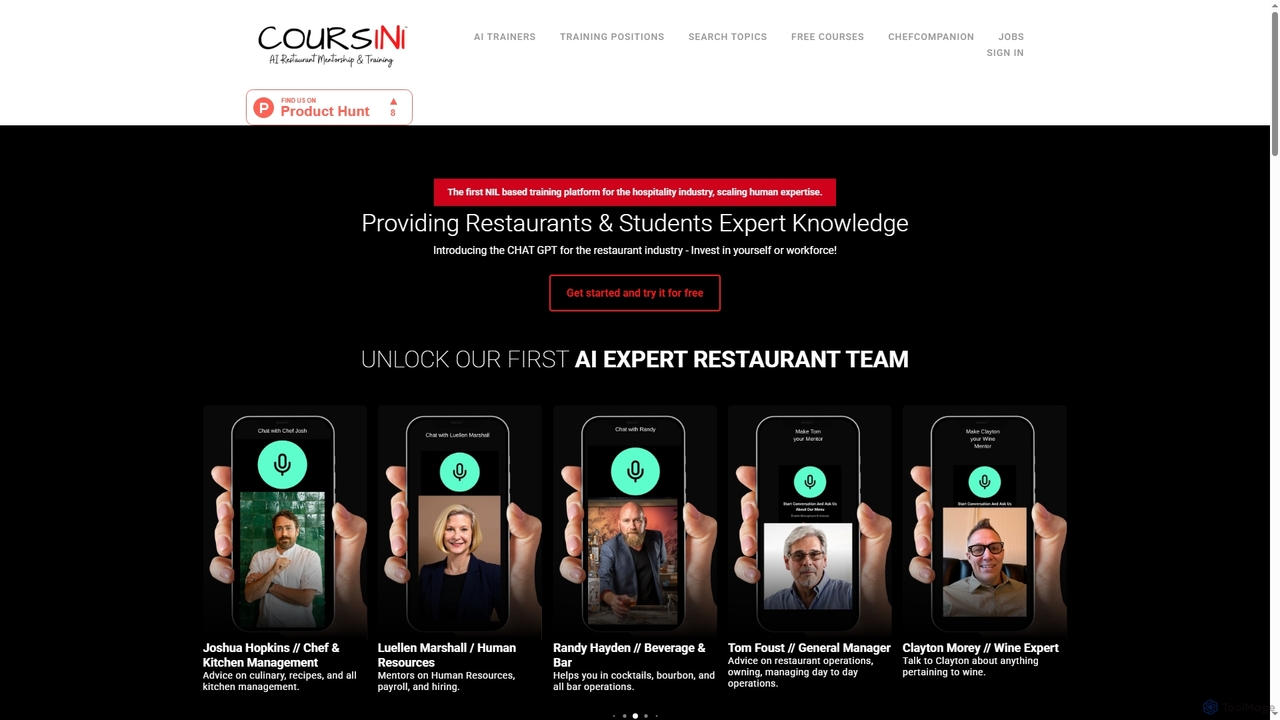
Coursini Concierge
Coursini Concierge is an AI-powered conversational platform for the hospitality industry, offering instant, on-demand expert advice and training. …
Coursini Concierge is an AI-powered conversational platform for the hospitality industry, offering instant, on-demand expert advice and training. It connects users with virtual AI agents specializing in various restaurant roles, providing immediate answers and guidance in multiple languages, akin to having a personal industry mentor available 24/7.
About Expert Systems
Expert Systems are AI tools designed to emulate the decision-making ability of a human expert within a specific domain. They operate using a knowledge base of facts and rules, combined with an inference engine that applies logic to solve complex problems. These systems are highly valued for their ability to provide consistent, transparent, and explainable advice, automating complex analysis and diagnostic tasks. Unlike some other productivity AI that learns from data, expert systems rely on explicitly programmed human knowledge, making them ideal for regulated industries where auditability is key.
Core Features
- Knowledge Base: A structured repository for storing domain-specific facts, rules, and heuristics from human experts.
- Inference Engine: The reasoning component that applies logical rules to the knowledge base to derive conclusions or solutions.
- Explanation Facility: The ability to justify its reasoning process, showing the user the specific rules used to reach a conclusion.
- Knowledge Acquisition Tools: Interfaces that help domain experts input, validate, and maintain the system's knowledge base.
Use Cases
Expert systems are widely used in fields requiring specialized knowledge, such as medical diagnosis, financial services for loan underwriting and fraud detection, and industrial settings for equipment troubleshooting. They also power sophisticated customer support helpdesks and compliance verification systems where consistent application of rules is critical.
How to Choose
When selecting an expert system, evaluate the ease of knowledge base creation and maintenance. Consider the power and flexibility of its inference engine (e.g., support for forward/backward chaining). Assess its integration capabilities with existing databases and enterprise software, and critically, review the clarity and depth of its explanation and auditing features for compliance purposes.
Expert SystemsUse Cases
Medical Preliminary Diagnosis Support
A clinical physician uses an expert system to support diagnostic processes. The physician inputs a patient's symptoms, medical history, and lab results into the system's interface. The inference engine processes this data against a vast medical knowledge base containing information on thousands of diseases and symptoms. The system then generates a ranked list of potential diagnoses, along with the specific rules and evidence that support each possibility. This acts as a powerful productivity tool, helping to reduce diagnostic errors and ensure all possibilities are considered, ultimately augmenting the doctor's judgment.
Automated Loan Application Underwriting
A financial institution uses an expert system to streamline its loan approval process. When a loan officer submits an application, the system automatically pulls applicant data, such as credit score, income, and debt-to-income ratio. The inference engine then applies a complex set of pre-defined underwriting rules and regulatory policies from its knowledge base. It instantly assesses risk and determines eligibility, providing a clear 'approve', 'deny', or 'refer to human underwriter' decision. The system also generates an audit trail, explaining exactly which rules led to the decision, ensuring compliance and consistency.
Industrial Equipment Fault Diagnosis
A maintenance technician in a manufacturing plant uses a mobile expert system to troubleshoot a malfunctioning machine. Instead of consulting bulky manuals, the technician inputs observable symptoms and error codes from the machine's control panel. The system's inference engine processes this information against a knowledge base containing the machine's schematics, common failure modes, and repair procedures. It guides the technician through a logical sequence of diagnostic tests, asking for specific readings or observations, and ultimately pinpoints the faulty component and suggests the correct repair action, reducing downtime and repair costs.
IT Helpdesk and Technical Support Automation
A large corporation implements an expert system to power its internal IT helpdesk. When an employee reports an issue, like a network connectivity problem, the system initiates a guided diagnostic conversation. It asks a series of targeted questions based on a knowledge base of common IT problems and solutions. Based on the employee's answers, the inference engine narrows down the potential causes and provides step-by-step self-help instructions. If the issue persists, it's escalated to a human agent with a full transcript of the diagnostic steps already taken, significantly speeding up resolution time.
Regulatory Compliance Verification
A compliance officer in a pharmaceutical company uses an expert system to verify that a new drug's marketing materials adhere to strict government regulations. The officer inputs the text and claims from a promotional brochure. The system's knowledge base contains all relevant advertising codes, legal precedents, and internal policies. The inference engine checks each claim against these rules, flagging any potentially non-compliant language, unsupported medical claims, or missing disclaimers. The system provides a detailed report with explanations, allowing the officer to quickly identify and rectify issues before publication, mitigating legal risks.
Insurance Claim Assessment
An insurance adjuster uses an expert system to perform an initial assessment of a complex property damage claim. The adjuster inputs details about the incident, policy coverage, and estimated repair costs. The system's inference engine cross-references this information with a knowledge base of insurance policies, legal requirements, and historical claim data. It then provides a preliminary assessment of claim validity, identifies potential fraud indicators based on rule violations, and calculates a suggested settlement range. This automates the routine aspects of assessment, allowing the adjuster to focus their expertise on the more nuanced and complex parts of the claim.