ToolMage
Sign in

Best 1 Facilitation AI tools for Productivity

Popular Facilitation AI tools in Productivity include Metodic, helping you work more efficiently.

Metodic
Freemium

Metodic

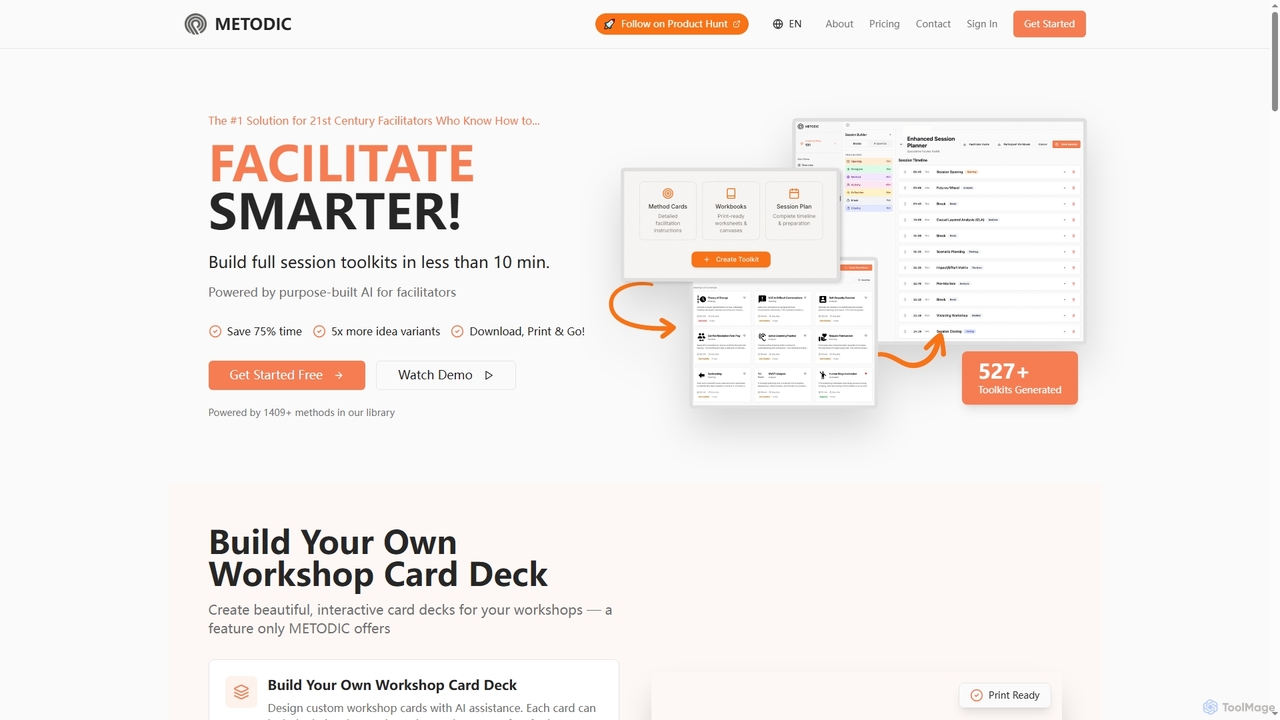
Metodic is an AI-powered platform designed for facilitators to rapidly generate comprehensive session toolkits, method card decks, and session plans. It helps professionals save up to 75% of preparation time, offering tailored content, proven methods, and print-ready materials for engaging workshops and meetings.

Workshop Planning
Visits 8.1KFavorites 152Likes 161

About Facilitation

AI-powered Facilitation tools are designed to enhance group collaboration, meetings, and decision-making processes by leveraging artificial intelligence. These tools utilize advanced natural language processing, sentiment analysis, and organizational algorithms to streamline interactions, capture insights, and guide discussions. They significantly boost team productivity and engagement by automating administrative tasks and providing real-time support for more effective group outcomes, positioning them as a specialized subset within the broader productivity category.

Core Features

  • Intelligent Agenda Management: AI assists in creating, structuring, and managing meeting agendas, suggesting topics and time allocations based on objectives.
  • Real-time Discussion Analysis: Monitors conversation flow, identifies key themes, sentiment, and participation levels to ensure balanced and productive dialogue.
  • Automated Note-taking & Summarization: Automatically transcribes discussions, extracts action items, decisions, and generates concise summaries post-meeting.
  • Brainstorming & Idea Generation Support: Provides prompts, organizes ideas, and identifies patterns during brainstorming sessions to foster creativity.
  • Decision-making Frameworks: Guides groups through structured decision-making processes, helping to weigh options and reach consensus efficiently.

Use Cases

These tools are invaluable for project managers, team leads, and consultants who regularly organize and run meetings, workshops, or collaborative sessions. They are particularly useful in remote or hybrid work environments where effective communication and structured interaction are crucial. From daily stand-ups to strategic planning sessions, AI facilitation ensures every participant's voice is heard and every discussion leads to clear, actionable outcomes.

How to Choose

When selecting an AI facilitation tool, consider its integration capabilities with existing communication platforms (e.g., Zoom, Teams), the accuracy of its NLP for transcription and sentiment analysis, and its specific features for your primary use case (e.g., brainstorming vs. decision-making). Evaluate the user interface for ease of adoption, data privacy policies, and scalability for your team size, alongside pricing models that align with your budget and usage frequency.

Facilitation use cases

1

Streamlining Remote Team Meetings

For distributed teams, an AI facilitation tool can automatically generate meeting agendas, transcribe discussions in real-time, and identify action items with assigned owners. This ensures all participants, regardless of location, stay aligned, and post-meeting follow-ups are clear and efficient, reducing the need for manual note-taking and improving overall meeting productivity by up to 30%.

2

Enhancing Creative Brainstorming Sessions

Marketing teams or product designers often struggle to capture and organize diverse ideas during brainstorming. AI facilitation tools can prompt participants, cluster similar ideas, and highlight unique suggestions, preventing idea loss and fostering a more inclusive environment. This leads to richer, more structured ideation and faster progression to concept development.

3

Facilitating Complex Decision-Making Workshops

For executive teams or project leads facing critical choices, AI facilitation can guide them through structured decision-making frameworks like SWOT analysis or multi-criteria decision analysis. The tool helps visualize pros and cons, track participant input, and summarize arguments, ensuring a transparent and data-driven consensus, which can accelerate strategic planning.

4

Automating Workshop Summaries and Follow-ups

Consultants or trainers running multi-day workshops need to provide comprehensive summaries and actionable next steps. An AI facilitation tool can automatically compile key takeaways, decisions, and assigned tasks from all sessions, generating a detailed report. This saves hours of manual compilation and ensures participants receive timely, accurate follow-up materials.

5

Improving Participant Engagement in Virtual Events

Event organizers or community managers hosting virtual discussions can use AI facilitation to monitor participant sentiment and identify quieter voices. The tool can suggest prompts to encourage broader participation or highlight trending topics in the chat, ensuring a more dynamic and inclusive experience for all attendees, leading to higher satisfaction rates.

6

Onboarding New Team Members with Structured Sessions

HR departments or team leads can leverage AI facilitation to structure onboarding sessions for new hires. The tool can manage the agenda, ensure all key topics are covered, and automatically summarize Q&A sessions. This guarantees a consistent and comprehensive onboarding experience, helping new employees integrate faster and understand their roles more clearly.

Facilitation FAQ

What are AI Facilitation tools?

AI Facilitation tools are software applications that use artificial intelligence to assist and enhance group interactions, meetings, and collaborative processes. They leverage technologies like natural language processing, speech-to-text, and sentiment analysis to automate administrative tasks, provide real-time insights, and guide discussions. Their core purpose is to make group work more efficient, inclusive, and productive, ultimately improving decision-making and project outcomes.

How do AI Facilitation tools differ from general project management software?

While both aim to boost productivity, AI Facilitation tools specifically focus on enhancing the process of group interaction and communication during meetings, workshops, and brainstorming sessions. They offer features like intelligent agenda creation, real-time discussion analysis, and automated summarization. Project management software, conversely, focuses on task tracking, resource allocation, and timeline management after decisions are made, though some may have basic meeting scheduling features. Facilitation tools are about how groups work together, not just what they work on.

What are the key benefits of using AI Facilitation tools?

The primary benefits include increased meeting efficiency by automating note-taking and agenda management, improved participant engagement through real-time feedback and balanced participation prompts, and enhanced decision-making via structured frameworks and clear summaries. These tools also foster inclusivity by ensuring all voices are heard, reduce post-meeting administrative overhead, and lead to clearer action items and accountability, ultimately saving time and resources.

What features should I look for in an AI Facilitation tool?

When choosing, prioritize features such as accurate real-time transcription and summarization, intelligent agenda building, and robust action item tracking. Look for tools that offer sentiment analysis to gauge meeting mood, brainstorming support with idea clustering, and integration with your existing communication and calendar platforms (e.g., Zoom, Google Calendar). User-friendliness, data security, and scalability for your team size are also crucial considerations.

Can AI Facilitation tools replace human facilitators?

No, AI Facilitation tools are designed to augment human facilitators, not replace them. While AI can automate many administrative and analytical tasks—like note-taking, agenda management, and identifying discussion patterns—it lacks the nuanced emotional intelligence, empathy, and adaptability of a human facilitator. A human can read non-verbal cues, mediate complex interpersonal conflicts, and creatively adapt to unexpected group dynamics in ways AI cannot. AI tools serve as powerful assistants, freeing human facilitators to focus on higher-level strategic guidance and interpersonal dynamics.