ToolMage
Sign in

Best 2 Marketplace AI tools for Productivity

Popular Marketplace AI tools in Productivity include Landy and Workflos, helping you work more efficiently.

Workflos
Free

Workflos

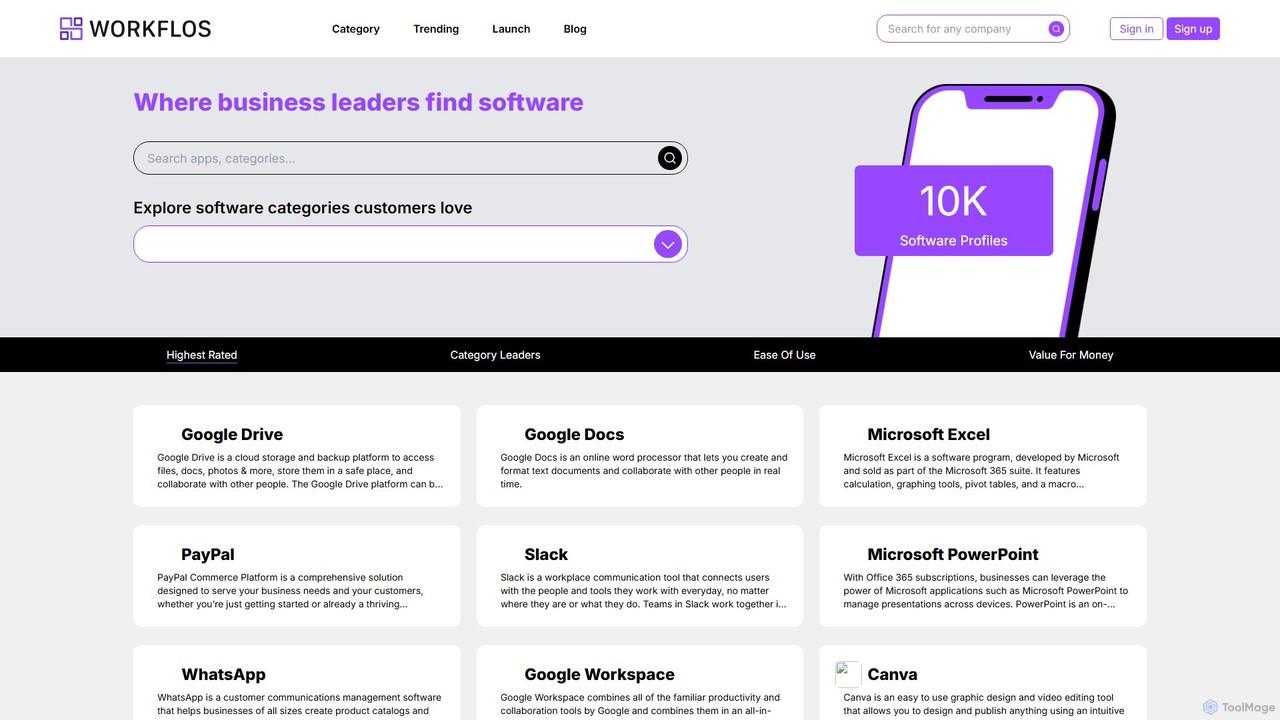
Workflos is a comprehensive software discovery platform designed for business leaders and teams. It features a vast directory of over 10,000 software profiles, allowing users to explore, compare, and select the best tools for their needs. By providing detailed information, user reviews, and side-by-side comparisons, Workflos simplifies the software selection process and helps businesses optimize their workflows and technology stack.

Software Discovery
Visits 5.5KFavorites 163Likes 165
Landy
Paid

Landy

Landy is an AI-powered real estate platform that connects homebuyers with low-commission, flat-fee agents for on-demand services. It allows users to book property tours and make offers by paying for individual services, saving thousands compared to traditional percentage-based realtor commissions.

Cost Saving
Visits 8.7KFavorites 135Likes 124

About Marketplace

AI Marketplaces are centralized platforms for discovering, buying, selling, and sharing AI models, prompts, agents, and other digital assets. These hubs connect AI developers and creators with users, providing access to a wide range of pre-built solutions. By offering ready-to-use components, these marketplaces significantly accelerate project development and enhance productivity, eliminating the need to build every AI function from scratch. They serve as a crucial ecosystem for innovation and monetization within the AI community.

Core Features

  • Asset Discovery Engine: Allows users to search, filter, and compare a vast library of AI models, prompts, and agents based on specific criteria.
  • Secure Transactions: Provides a trusted environment for buying, selling, or licensing AI assets with clear pricing and usage terms.
  • API Integration & Testing: Offers tools to test AI models via APIs and provides documentation for seamless integration into applications.
  • Creator Monetization Tools: Enables developers and creators to publish their AI assets, set pricing, and earn revenue from their work.
  • Community Reviews & Ratings: Features user-generated feedback to help evaluate the quality and reliability of assets on the platform.

Use Cases

AI Marketplaces are utilized by a diverse range of users. Developers leverage them to find specialized, pre-trained models to integrate into their applications, saving significant development time. Businesses and startups acquire custom AI agents for tasks like customer support or data analysis. Content creators and prompt engineers monetize their expertise by selling curated prompt packs for generative AI tools.

How to Choose

When selecting an AI Marketplace, consider the variety and quality of assets available; ensure they align with your project's needs. Evaluate the platform's pricing models, such as pay-per-use, subscription, or one-time purchase. Assess the quality of API documentation and the ease of integration. Finally, consider the community's size and activity, as a strong community often indicates higher quality assets and better support.

Marketplace use cases

1

Finding a Specialized API for App Development

A mobile app developer is building a social media analytics tool and needs a reliable sentiment analysis function. Instead of spending weeks developing and training their own model, they browse an AI Marketplace. They search for 'sentiment analysis API', compare top-rated options based on accuracy, latency, and cost per call. After testing a few endpoints in the platform's sandbox, they purchase a subscription to the best-performing API and integrate it into their app within hours, significantly accelerating their time-to-market.

2

Monetizing Custom Prompt Packages

A professional prompt engineer has developed a unique set of prompts for creating photorealistic architectural visualizations using a popular image generation model. To monetize this expertise, they package the prompts into a collection, complete with examples and usage guides. They then list this package for sale on an AI Marketplace. Marketers and architects looking to create high-quality visuals discover the package, read the positive reviews, and purchase it, providing the engineer with a steady stream of passive income.

3

Acquiring a Pre-trained Model for a Niche Task

A research team in bioinformatics needs a model capable of classifying protein structures, a highly specialized task. Building such a model from scratch would require vast datasets and computational resources. They turn to an AI Marketplace focused on scientific models. They find a pre-trained model that has been validated by other researchers in the field. By purchasing a license, they can immediately begin their research, integrating the model into their analysis pipeline and saving months of foundational development work.

4

Deploying a Customer Service AI Agent

A small e-commerce business wants to provide 24/7 customer support without hiring a large team. The owner visits an AI Marketplace and searches for 'e-commerce customer service agents'. They find an agent pre-trained on common retail queries like order tracking, returns, and product questions. After a simple setup process connecting the agent to their store's data and website chat, the AI is live. It handles over 70% of incoming customer inquiries automatically, freeing up the owner to focus on growing the business.

5

Comparing Open-Source Models for Research

An academic researcher is studying the performance of different large language models (LLMs) on translation tasks. An AI Marketplace that aggregates open-source models provides a perfect environment for this. The researcher can easily access and download various models like Llama, Mistral, and Falcon from a single location. The platform's standardized descriptions and community benchmarks help them quickly shortlist relevant models, saving significant time that would otherwise be spent scouring different repositories and forums.

6

Finding a No-Code AI Solution for Marketing

A marketing manager needs to generate personalized email subject lines for a new campaign but lacks coding skills. They explore an AI Marketplace's 'no-code' or 'agents' section. They find an AI agent specifically designed for 'Email Subject Line Generation'. By providing a brief description of the product and target audience, the agent generates hundreds of creative and A/B testable subject lines. This allows the manager to leverage advanced AI capabilities directly within their workflow without needing technical support.

Marketplace FAQ

What is an AI Marketplace?

An AI Marketplace is an online platform where developers, businesses, and creators can buy, sell, and share AI-related assets. These assets typically include pre-trained models, APIs, datasets, custom AI agents, and prompt packages. Unlike general software stores, AI Marketplaces are specifically tailored to the needs of AI development and application, providing tools for testing, integration, and monetization of AI components, thereby accelerating innovation and productivity.

How to choose the right AI Marketplace?

To choose the right AI Marketplace, consider these factors:

  • Asset Variety & Quality: Check if the platform offers a wide range of high-quality models, APIs, or agents relevant to your needs. Look for community reviews and ratings.
  • Pricing Model: Evaluate whether the pricing (e.g., pay-per-use, subscription, one-time fee) aligns with your budget and usage patterns.
  • Ease of Integration: For developers, assess the quality of the API documentation, SDKs, and sandbox environments for testing.
  • Community and Support: A vibrant community and responsive platform support can be crucial for troubleshooting and getting the most value from the assets.
What's the difference between an AI Marketplace and a general App Store?

The main difference lies in the type of product offered. A general App Store (like Apple's App Store or Google Play) primarily offers complete, standalone applications for end-users. An AI Marketplace, on the other hand, focuses on providing AI components and building blocks—such as models, APIs, and datasets—that developers and businesses use to build or enhance their own applications. AI Marketplaces are developer-centric, emphasizing integration and customization, while App Stores are consumer-centric, focusing on ready-to-use software.

What types of assets can be found on an AI Marketplace?

AI Marketplaces host a diverse range of digital assets tailored for AI development. Common types include:

  • Pre-trained Models: Models for tasks like image recognition, natural language processing, or sentiment analysis.
  • APIs: Endpoints that provide access to complex AI functionalities on a pay-per-use basis.
  • Datasets: Curated and labeled data for training or fine-tuning custom AI models.
  • AI Agents: Pre-configured bots or autonomous systems designed for specific tasks like customer support or data entry.
  • Prompt Packages: Collections of expertly crafted prompts for achieving specific results with generative AI tools.
Who should use an AI Marketplace?

AI Marketplaces are valuable for a wide range of users. Software Developers use them to quickly integrate advanced AI features into their applications without building models from scratch. Businesses and Startups can find cost-effective AI solutions for automation, data analysis, and customer service. Researchers can access diverse models and datasets for their studies. Finally, AI Creators and Prompt Engineers can use these platforms to monetize their skills and creations by selling them to a global audience.