Productivity Best in category 1 results Memory AI Tool

Popular AI tools in the Memory field of Productivity include Rewind, etc., helping you quickly improve efficiency.

Rewind

Rewind

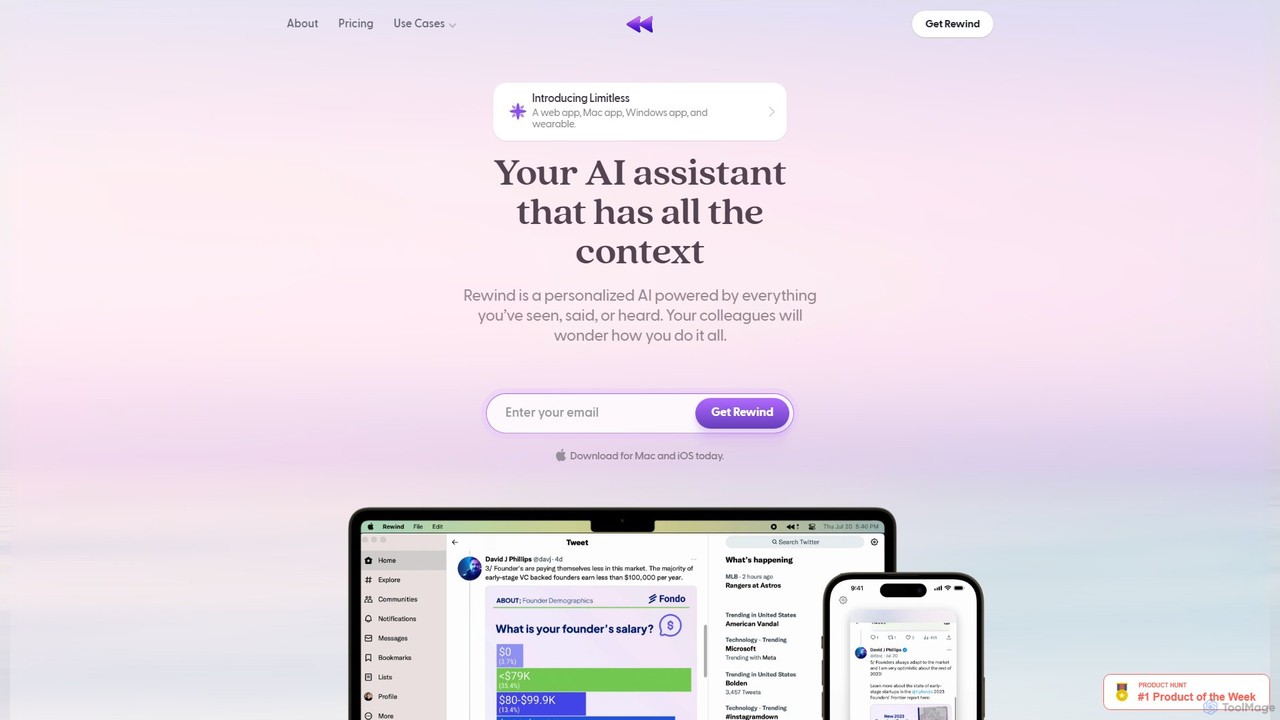
Rewind is a personalized AI assistant that acts as a search engine for your life. It securely captures …

10.8K

About Memory

AI Memory tools are a specialized category of AI-powered applications designed to augment human cognitive abilities by intelligently capturing, storing, organizing, and retrieving information. These tools leverage advanced natural language processing (NLP), semantic search, and sometimes knowledge graph technologies to create a persistent, context-aware digital memory. They significantly enhance personal and team productivity by offloading the burden of information recall, making knowledge instantly accessible and interconnected.

Core Features

  • Contextual Capture: Automatically records and indexes information from various sources (notes, meetings, web pages) with semantic understanding.
  • Intelligent Organization: Organizes data not just by tags or folders, but by understanding relationships, concepts, and user intent.
  • Semantic Retrieval: Allows users to find information using natural language queries, surfacing relevant data even if exact keywords aren't present.
  • Proactive Recall: Can proactively suggest relevant information based on current context, tasks, or ongoing conversations.
  • Knowledge Graph Integration: Builds interconnected networks of information, revealing relationships and insights across disparate data points.

Use Cases

Professionals across various fields utilize AI Memory tools to manage their vast information streams. Researchers use them to build comprehensive knowledge bases from articles and experiments, while project managers rely on them to track project details, decisions, and action items across numerous meetings. Content creators leverage these tools to store inspirations, research snippets, and past creative assets, enabling quick retrieval for new projects.

How to Choose

When selecting an AI Memory tool, consider its integration capabilities with your existing workflows (e.g., calendar, communication apps), the breadth of data types it can capture (text, audio, visual), its privacy and security features for sensitive information, and the sophistication of its retrieval mechanisms. Evaluate the learning curve and whether it offers proactive suggestions that genuinely add value to your daily tasks.

MemoryUse Cases

1

Building a Personal Research Knowledge Base

Researchers and students can use AI Memory tools to automatically capture, categorize, and link information from academic papers, web articles, and personal notes. By understanding the semantic relationships between concepts, the tool allows for natural language queries to retrieve specific facts, arguments, or related studies, significantly accelerating literature reviews and thesis writing.

2

Intelligent Meeting Summary and Action Item Tracking

Team leads and project managers leverage these tools to record and transcribe meetings, then intelligently summarize key discussions and identify actionable items. The AI can link these items to relevant documents or past conversations, ensuring that follow-ups are context-rich and easily accessible, reducing the effort required for manual note-taking and task assignment.

3

Enhancing Customer Support with Contextual Recall

Customer service agents can utilize AI Memory tools to instantly access a customer's complete interaction history, past issues, and relevant product information. This contextual recall capability allows agents to provide more personalized and efficient support, reducing resolution times and improving customer satisfaction by having all necessary information at their fingertips.

4

Creative Idea Management and Inspiration Retrieval

Content creators, designers, and marketers use AI Memory tools to store diverse inspirations, from visual mood boards and article snippets to brainstorming sessions. When starting a new project, they can query their digital memory using conceptual terms, and the tool will surface relevant past ideas, assets, or related concepts, fostering innovation and preventing creative blocks.

5

Personalized Learning and Skill Development Tracking

Individuals engaged in continuous learning or skill acquisition can employ AI Memory tools to track their progress, store learning resources, and recall specific concepts. The tool can intelligently connect new information with existing knowledge, create personalized review schedules, or even quiz users on topics, making the learning process more effective and tailored.

6

Augmenting Daily Productivity for Busy Professionals

Busy professionals can use AI Memory tools as a personal assistant to remember tasks, appointments, important details from conversations, and personal preferences. The tool can proactively remind them of upcoming deadlines, surface relevant information before a meeting, or help recall details about a contact, effectively extending their cognitive capacity and reducing mental load.

MemoryFrequently Asked Questions