Market01
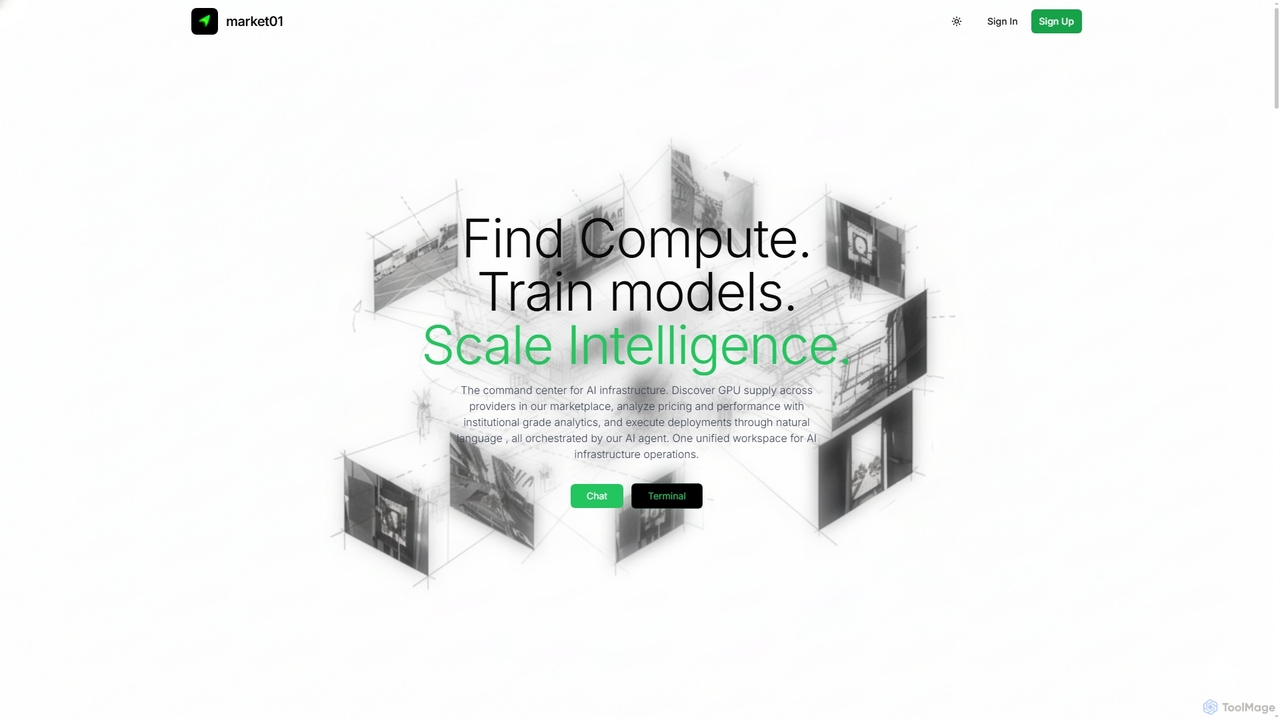
Market01 is an AI infrastructure command center that unifies GPU compute discovery, analysis, and deployment across multiple providers. …
Market01 is an AI infrastructure command center that unifies GPU compute discovery, analysis, and deployment across multiple providers. It leverages an AI agent and natural language interface, Telos Chat, to simplify operations for training models and scaling intelligence.
About Natural Language Interface
Natural Language Interface (NLI) tools are a class of AI-powered applications that enable users to interact with computers and software using everyday human language, whether through text or voice. These tools leverage advanced Natural Language Processing (NLP) and machine learning to understand user intent, extract relevant information, and execute commands without requiring complex syntax or coding. By abstracting away technical complexities, NLIs significantly enhance productivity and accessibility, making technology more intuitive and user-friendly for a wide range of tasks, from data querying to task automation.
Core Features
- Intent Recognition: Accurately identifies the user's underlying goal or purpose from their natural language input, enabling the system to respond appropriately.
- Entity Extraction: Pinpoints and categorizes key pieces of information, such as names, dates, locations, or product details, within a conversation for structured data processing.
- Dialogue Management: Maintains context across multiple turns of a conversation, allowing for more fluid, natural, and coherent interactions over extended periods.
- Multimodal Input: Supports various input methods, including typed text, voice commands, and sometimes even gestures, offering flexible and accessible user interaction.
- Response Generation: Formulates coherent, contextually relevant, and human-like responses, or executes specific actions based on the understood intent, providing immediate feedback or results.
Applicable Scenarios
Natural Language Interface tools are transforming how individuals and businesses interact with data and systems, significantly boosting productivity. They are widely adopted in customer service for intelligent chatbots that resolve queries efficiently, in business intelligence for natural language querying of complex databases, and in personal productivity for voice-controlled assistants managing schedules and smart devices. These interfaces empower non-technical users to perform complex operations, retrieve specific information, and automate intricate workflows simply by speaking or typing in plain language, democratizing access to powerful computing capabilities.
How to Choose
When selecting a Natural Language Interface tool, consider its accuracy in understanding diverse linguistic inputs and handling ambiguity, which is crucial for reliable performance. Evaluate its integration capabilities with your existing software ecosystems, CRM, ERP, and data sources to ensure seamless workflow. Assess the level of customization offered for specific domain knowledge, industry jargon, or unique business rules. Furthermore, review the supported languages, scalability to handle increasing user loads, and the security protocols to protect sensitive data, ensuring it meets both current and future operational demands.

Natural Language InterfaceUse Cases
Querying Business Data with Natural Language
Business analysts or sales managers can use NLI tools to instantly retrieve specific reports or insights from complex databases. Instead of writing SQL queries, they can simply ask questions like "Show me Q3 sales performance for the EMEA region last year" and receive immediate, relevant data visualizations or summaries, significantly accelerating decision-making processes.
Automating Customer Service Interactions
Customer support teams deploy NLI-powered chatbots to handle a high volume of routine inquiries, such as "What's my order status?" or "How do I reset my password?". These interfaces understand customer intent and provide accurate, personalized responses 24/7, freeing human agents to focus on more complex issues and improving overall customer satisfaction.
Controlling Smart Devices and Systems by Voice
Individuals in smart homes or office environments can leverage NLI to control various devices hands-free. By issuing voice commands like "Turn off the lights in the living room" or "Start the conference call in meeting room A," users can manage their environment efficiently, enhancing convenience and productivity without manual interaction with apps or switches.
Generating Content and Summaries from Raw Data
Content creators or researchers can utilize NLI tools to quickly draft reports, emails, or summaries based on provided data or documents. For example, inputting meeting transcripts and asking "Summarize key action items" can generate a concise overview, or "Draft an email to the team about these points" can produce a ready-to-send message, saving significant writing time.
Personalizing Learning and Educational Experiences
Students or lifelong learners can interact with NLI-driven educational platforms to get personalized explanations or practice. Asking "Explain quantum physics in simple terms" or "Give me practice problems on calculus" allows the system to adapt content and difficulty, providing tailored learning paths and immediate feedback, making complex subjects more accessible.
Streamlining Data Entry and Form Filling
Professionals in fields like healthcare or legal services can use NLI to expedite data entry. Instead of manually typing into structured forms, they can dictate information naturally, such as "Patient John Doe, born January 15, 1980, diagnosed with hypertension." The NLI tool then parses and populates the relevant fields, reducing errors and saving considerable administrative time.