
Productivity Best in category 1 results Payment Processing AI Tool

Popular AI tools in the Payment Processing field of Productivity include UniBee, etc., helping you quickly improve efficiency.

UniBee

UniBee

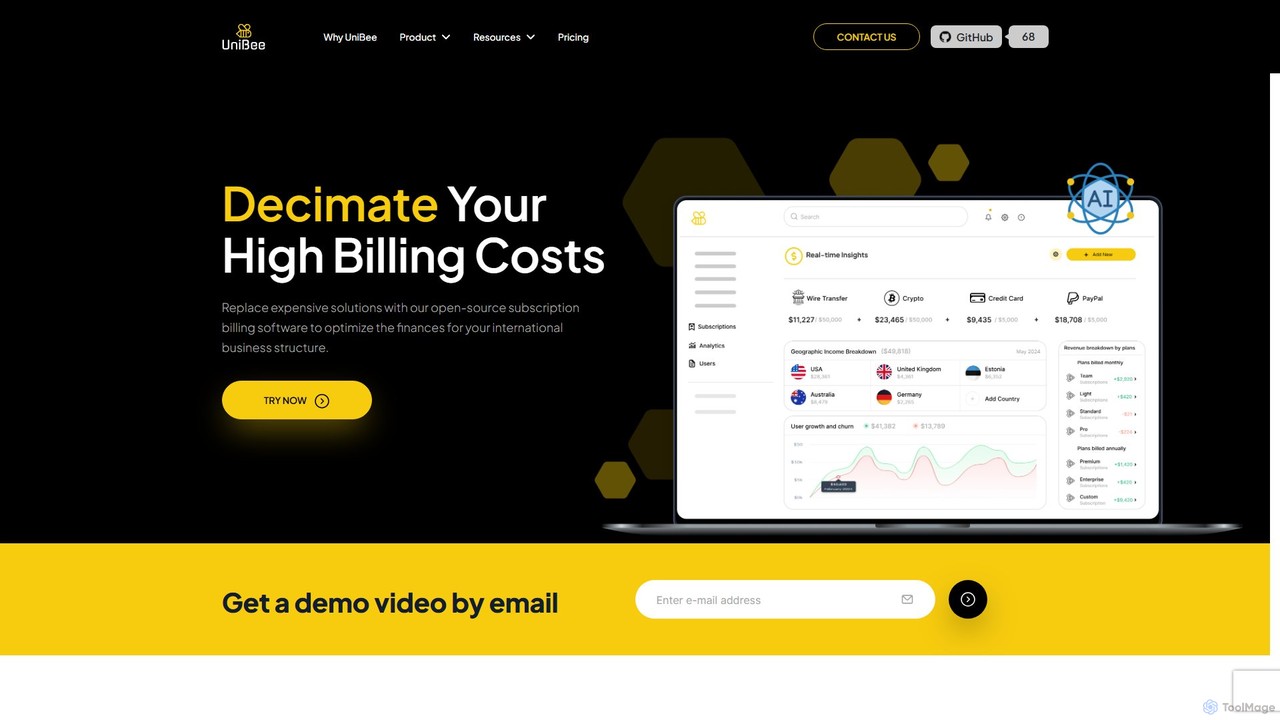
UniBee is an open-source subscription billing and payment management platform designed for SaaS businesses. It offers a flexible, …

25.2K

About Payment Processing

AI Payment Processing tools are a class of software that uses artificial intelligence to automate and optimize financial transactions. They leverage machine learning for advanced fraud detection, intelligent payment routing, and automated invoice reconciliation. By analyzing vast amounts of data in real-time, these tools enhance security, reduce manual errors, and improve cash flow, directly contributing to overall business productivity. Unlike traditional systems, they can predict payment failures and personalize dunning management for better customer retention.

Core Features

  • AI-Powered Fraud Detection: Analyzes transaction patterns in real-time to identify and block suspicious activities with high accuracy.
  • Intelligent Payment Routing: Automatically selects the most cost-effective or highest-success-rate payment gateway for each transaction.
  • Automated Invoicing & Reconciliation: Generates invoices, sends smart reminders, and matches payments to outstanding bills without manual intervention.
  • Predictive Dunning Management: Uses AI to forecast late payments or failures and customizes communication strategies to reduce churn.
  • NLP for Customer Support: Employs natural language processing to power chatbots that resolve common payment-related customer queries instantly.

Use Cases

These tools are essential for e-commerce platforms, SaaS companies, and subscription-based services that handle high volumes of recurring payments. They are also invaluable for freelance marketplaces managing mass payouts and B2B companies seeking to automate their accounts receivable processes and reduce late payments.

How to Choose

When selecting a tool, consider its integration capabilities with your existing CRM or e-commerce platform. Evaluate the sophistication of its fraud detection models, the range of supported payment methods and currencies, and the transparency of its fee structure. Finally, assess its scalability to ensure it can grow with your business's transaction volume.

Payment ProcessingUse Cases

1

Automating Fraud Prevention for E-commerce Stores

An e-commerce manager uses an AI payment tool to analyze thousands of daily transactions. The AI model assesses hundreds of data points in real-time, including user behavior, IP location, device fingerprint, and transaction history. It flags high-risk orders that deviate from normal patterns, allowing the team to manually review a small fraction of orders instead of all of them. This process significantly reduces chargebacks by over 30% and minimizes false positives, ensuring legitimate customers are not blocked.

2

Optimizing Subscription Billing for SaaS Companies

A SaaS business implements an AI system for its recurring billing. The tool's predictive dunning feature identifies customers whose credit cards are about to expire or have a high probability of failing. It then proactively sends customized reminders via email or SMS before the payment is due, suggesting they update their payment information. This intelligent approach significantly reduces involuntary churn caused by payment failures and improves customer lifetime value.

3

Streamlining Freelancer Payouts in a Marketplace

A global freelance platform uses an AI payment processor to manage mass payouts to thousands of freelancers in different countries. The system automatically handles currency conversions at optimal rates, selects the lowest-fee transfer method for each region (e.g., local bank transfer vs. wire), and ensures compliance with local tax regulations. This automates a complex and time-consuming process, ensuring freelancers are paid accurately and on time, which improves platform trust and retention.

4

Intelligent Invoice Processing for B2B Services

A digital marketing agency uses an AI tool to automate its accounts receivable. The system scans client contracts and project scopes to generate accurate invoices automatically. It then sends these invoices and schedules intelligent follow-ups based on payment terms. The AI can even use NLP to analyze client email replies regarding payments, categorizing them as 'payment sent,' 'requesting extension,' or 'dispute,' and routing them to the appropriate team member for action. This reduces manual administrative work by hours each week.

5

Reducing Transaction Fees with Smart Routing

A high-volume online business integrates an AI payment gateway that supports multiple processors (e.g., Stripe, Adyen, Braintree). For each incoming transaction, the system's algorithm dynamically analyzes factors like card type, issuing country, and the real-time success rates of each processor. It then routes the payment through the gateway with the highest probability of success and the lowest processing fee at that specific moment, saving the business thousands of dollars in fees and reducing declined transactions.

6

Enhancing Customer Support with Payment Chatbots

A utility company deploys an AI chatbot integrated with its payment system to handle common customer inquiries. Customers can ask questions like 'What's my current balance?', 'Can I get a payment extension?', or 'Confirm my last payment.' The bot securely authenticates the user, retrieves account information, processes payments within the chat interface, and can even negotiate simple payment plans based on pre-set rules. This provides 24/7 support and frees up human agents for more complex issues.

Payment ProcessingFrequently Asked Questions