202 QUALITY AI APPS
A comprehensive suite of 202 specialized AI tools designed for quality management, continuous improvement (KVP), and operational excellence …
A comprehensive suite of 202 specialized AI tools designed for quality management, continuous improvement (KVP), and operational excellence (OPEX). It empowers businesses to optimize work processes, minimize errors, enhance customer satisfaction, and adhere to global standards using AI-driven methodologies like Ishikawa diagrams, 5 Whys, and FMEA.
Pontus
Pontus is an AI-powered enterprise automation platform designed to transform manual business operations into efficient, end-to-end automated workflows. …
Pontus is an AI-powered enterprise automation platform designed to transform manual business operations into efficient, end-to-end automated workflows. It enables businesses to build and deploy custom automations for finance, legal, and data intelligence without costly system overhauls, driving tangible business outcomes and improving data reliability.
avataar
Avataar is an enterprise-grade Agentic AI platform designed to transform business operations. It deploys domain-specialized, autonomous AI agents …
Avataar is an enterprise-grade Agentic AI platform designed to transform business operations. It deploys domain-specialized, autonomous AI agents that execute complex workflows, driving significant cost efficiency, operational speed, and creating defensible intellectual property. The platform focuses on autonomous execution rather than just analysis, enabling a shift from manual processes to intelligent, self-improving systems.
Tonkean
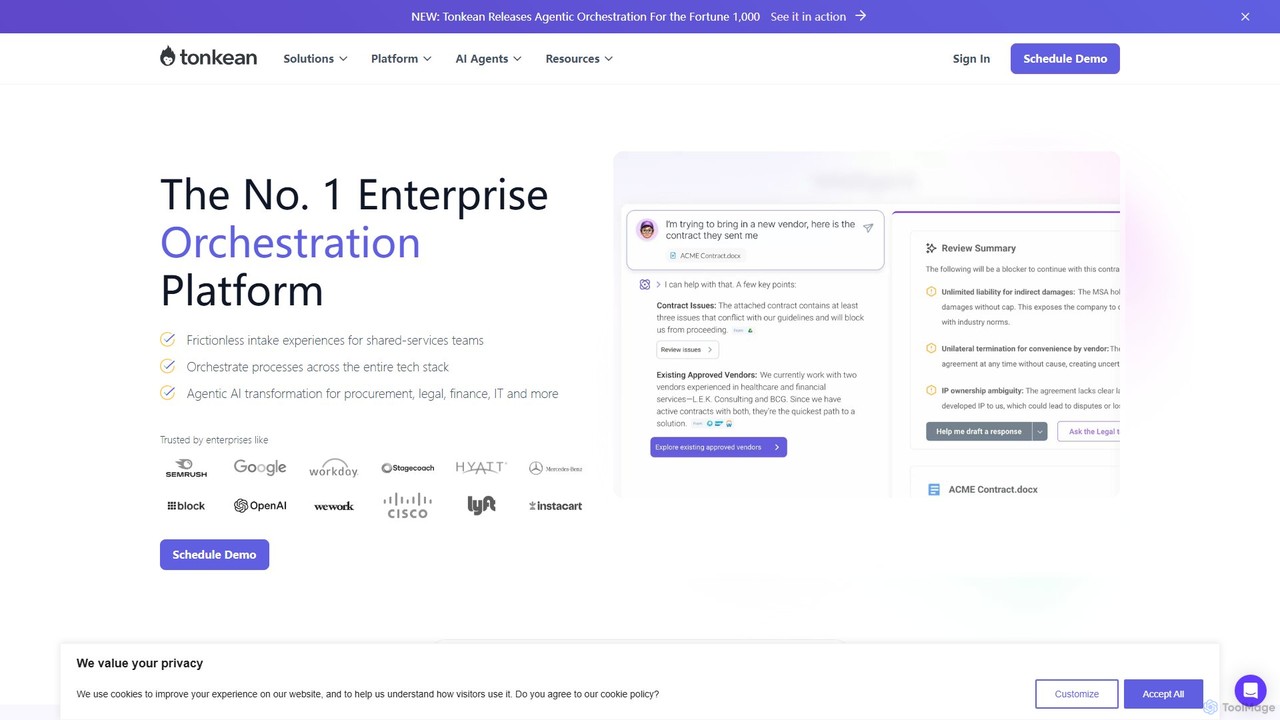
Tonkean is an AI-powered, no-code platform for enterprise process orchestration and intake management. It empowers operations teams to …
Tonkean is an AI-powered, no-code platform for enterprise process orchestration and intake management. It empowers operations teams to automate complex workflows, such as procurement and legal, by connecting existing systems and guiding employees through processes. Tonkean combines autonomous AI with rules-based logic to increase efficiency, ensure compliance, and accelerate business operations without writing a single line of code.
About Process Management
AI Process Management tools are a specialized category of productivity software that uses artificial intelligence to discover, analyze, and optimize business workflows. Leveraging technologies like process mining and machine learning, these tools automatically map out how tasks are actually performed, identifying bottlenecks and inefficiencies that are invisible to the naked eye. Their primary value lies in transforming complex operational data into actionable insights for continuous improvement and intelligent automation. This data-driven approach allows organizations to enhance efficiency, ensure compliance, and reduce operational costs with greater precision than traditional methods.
Core Features
- Process Mining & Discovery: Automatically analyzes event logs from systems like ERP or CRM to create visual maps of real-world processes.
- Predictive Analytics: Uses machine learning to forecast future process performance, predict delays, and simulate the impact of changes.
- Intelligent Automation (RPA+AI): Automates complex tasks by understanding unstructured data and making context-based decisions within a workflow.
- Conformance Checking: Compares actual process execution against a predefined ideal model to detect and flag deviations or compliance issues.
- Optimization Recommendations: Suggests specific, data-backed improvements to workflows, such as reallocating resources or automating steps.
Applicable Scenarios
These tools are essential for operations managers, business analysts, and IT leaders in data-intensive industries like finance, logistics, and manufacturing. For example, a bank can use them to analyze its loan approval process to reduce processing time, while a logistics company can optimize its entire order-to-cash cycle by identifying and resolving shipping delays.
Selection Criteria
When choosing an AI Process Management tool, consider its integration capabilities with your existing systems (e.g., SAP, Salesforce). Evaluate the accuracy of its process mining algorithms and the depth of its analytical features. Also, assess its scalability to handle large data volumes and the sophistication of its automation and recommendation engines.
Process ManagementUse Cases
Optimizing Order-to-Cash Cycle in Logistics
A logistics operations manager is tasked with reducing delivery times and improving cash flow. Using an AI Process Management tool, they connect it to their ERP and shipping systems. The tool's process mining feature automatically visualizes the entire order-to-cash workflow, revealing that 15% of orders are consistently delayed at the 'customs clearance' stage due to missing paperwork. The AI recommends automating document collection and verification. By implementing this, the company reduces the average cycle time by two days and improves on-time delivery rates by 12%, directly accelerating revenue collection.
Streamlining Patient Admission in Healthcare
A hospital administrator aims to reduce patient wait times in the emergency department. They deploy an AI Process Management tool to analyze data from the hospital's information system. The AI discovers that the process frequently stalls during 'insurance verification', with an average delay of 45 minutes. It also identifies that patient handoffs between nurses and doctors are inefficient. The tool's simulation feature allows the administrator to test a new workflow—where verification starts upon patient registration—predicting a 30% reduction in wait time. This data-driven insight enables the hospital to re-engineer its admission process, improving patient satisfaction and resource utilization.
Ensuring Compliance in Financial Auditing
A compliance officer at a financial institution needs to audit thousands of transactions daily to prevent fraud and ensure regulatory adherence. Manually checking is impossible. They use an AI Process Management tool with conformance checking capabilities. The tool compares every transaction's process flow against the institution's established compliance protocols. It automatically flags any deviation, such as an unauthorized approval or a skipped verification step, in real-time. This reduces audit time from weeks to hours and increases the detection rate of non-compliant activities by over 95%, significantly lowering regulatory risk.
Improving Software Development Lifecycle (SDLC)
A DevOps lead wants to accelerate the team's release cycle. By applying an AI Process Management tool to their CI/CD pipeline data (from Git, Jira, Jenkins), they get a clear view of the entire development process. The analysis reveals that the 'code review' stage is a major bottleneck, with pull requests waiting an average of 36 hours for approval. The AI also identifies a high rate of rework originating from a specific testing phase. Based on these insights, the lead implements a policy for faster reviews and allocates more resources to automated testing, resulting in a 20% faster release cycle and a 15% reduction in post-release bugs.
Automating Employee Onboarding in HR
An HR manager finds that the new employee onboarding process is inconsistent and slow, leading to poor initial experiences. They use an AI Process Management tool to design, automate, and monitor the onboarding workflow. The tool automatically assigns tasks to IT (provisioning hardware), Finance (payroll setup), and the hiring manager (scheduling intro meetings). It sends reminders for overdue tasks and uses AI to answer common new-hire questions via a chatbot. The process mining feature tracks completion rates, showing that IT provisioning is the main delay. This allows the HR manager to address the specific bottleneck, reducing total onboarding time by 40%.
Enhancing Customer Support Ticket Resolution
A customer service director wants to improve resolution times and customer satisfaction (CSAT) scores. They integrate an AI Process Management tool with their ticketing system (e.g., Zendesk). The AI analyzes thousands of ticket histories and discovers that 20% of tickets are incorrectly routed, causing an average delay of 8 hours per ticket. It also identifies that tickets related to 'billing issues' have the highest resolution time. The AI recommends an automated routing rule based on ticket content analysis and suggests creating a dedicated knowledge base for billing. After implementation, first-contact resolution increases by 25% and the average CSAT score improves by 10 points.