Productivity Best in category 1 results Process Mining AI Tool

Popular AI tools in the Process Mining field of Productivity include Tekst, etc., helping you quickly improve efficiency.

Tekst

Tekst

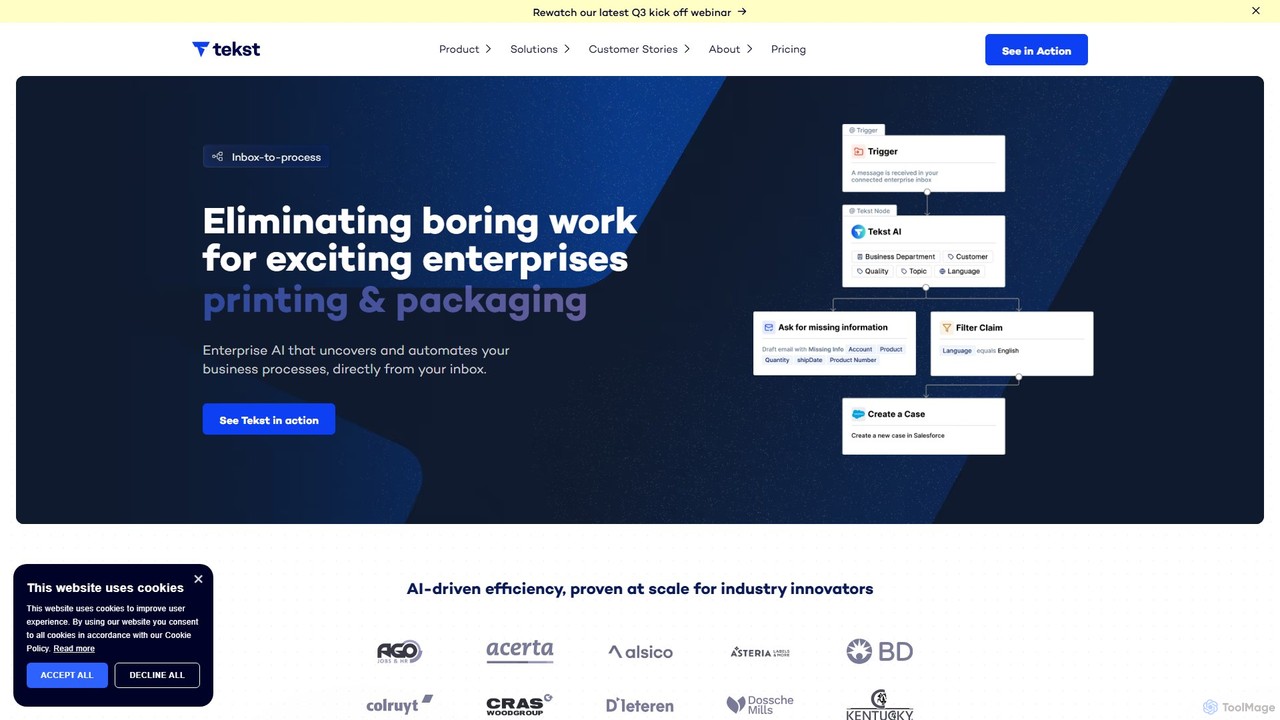
Tekst is an enterprise-grade AI platform that automates complex business workflows by analyzing and understanding unstructured communications. It …

12.0K

About Process Mining

Process Mining tools are AI-powered solutions that automatically discover, monitor, and improve real-world business processes by analyzing event logs. These tools leverage advanced algorithms to reconstruct process flows, identify bottlenecks, and detect deviations, providing an objective, data-driven view of operations. As a key component of productivity enhancement, Process Mining helps organizations understand how work truly gets done, enabling informed decisions for optimization and automation.

Core Features

  • Automated Process Discovery: Automatically maps actual process flows from event data, revealing hidden variations and steps.
  • Conformance Checking: Compares actual process execution against predefined models to identify deviations and compliance issues.
  • Performance Analysis: Visualizes key performance indicators (KPIs) like cycle times, resource utilization, and rework rates to pinpoint inefficiencies.
  • Root Cause Analysis: Uses AI to identify the underlying reasons for process bottlenecks, delays, or non-conformance.
  • Predictive Analytics: Forecasts future process outcomes and potential issues based on historical data patterns.

Use Cases

Process Mining is invaluable across various sectors for professionals seeking to enhance operational efficiency and transparency. It's widely adopted in finance for auditing transaction flows, in healthcare for optimizing patient journeys, and in manufacturing for streamlining production lines. Businesses use it to gain deep insights into their existing workflows, uncover hidden inefficiencies, and validate the impact of process changes.

How to Choose

When selecting a Process Mining tool, consider its data integration capabilities with your existing systems, the breadth of its analytical features (e.g., discovery, conformance, prediction), and its scalability to handle large datasets. Evaluate the user interface for ease of use, the level of AI-driven insights provided, and the vendor's support for implementation and training. Pricing models and compliance with industry-specific regulations are also crucial factors.

Process MiningUse Cases

1

Optimizing Customer Service Ticket Resolution

A customer service manager uses Process Mining to analyze event logs from their ticketing system. The tool reveals common pathways tickets take, identifies steps causing delays, and highlights agents or departments that are bottlenecks. This allows the manager to redesign workflows, provide targeted training, and implement automation for faster, more efficient customer support, reducing average resolution time by 20%.

2

Streamlining Order-to-Cash Cycles in E-commerce

An e-commerce operations team applies Process Mining to their order management, fulfillment, and invoicing data. They discover unexpected loops in the order processing, delays in warehouse picking, and discrepancies in billing. By visualizing the actual flow, they can pinpoint exact points of friction, leading to process redesigns that reduce the order-to-cash cycle time, improve cash flow, and enhance customer satisfaction.

3

Improving Patient Flow in Healthcare Facilities

Hospital administrators utilize Process Mining to map the journey of patients from admission to discharge, analyzing data from electronic health records. The analysis uncovers bottlenecks in diagnostic scheduling, prolonged wait times in specific departments, and variations in treatment pathways. This insight enables them to optimize resource allocation, streamline patient handovers, and improve overall patient experience and operational efficiency.

4

Enhancing Manufacturing Production Line Efficiency

A manufacturing plant manager employs Process Mining to analyze data from their production execution systems. The tool identifies deviations from the standard production process, unexpected rework loops, and machines that frequently cause delays. By understanding the actual flow and its inefficiencies, the manager can implement targeted improvements, reduce waste, and increase throughput on the production line.

5

Ensuring Compliance and Auditing Financial Transactions

A financial auditor uses Process Mining to verify that financial transactions adhere to internal policies and external regulations. By comparing the actual transaction process flows against predefined compliance models, the tool automatically flags any non-conforming activities or unauthorized steps. This significantly reduces manual auditing effort, enhances fraud detection, and ensures robust regulatory adherence.

6

Optimizing Supply Chain Logistics and Procurement

A supply chain analyst leverages Process Mining to examine event data from procurement, inventory management, and logistics systems. The analysis reveals inefficiencies such as delayed approvals, excessive inventory holding times, or suboptimal shipping routes. These insights allow for data-driven adjustments to procurement strategies, inventory policies, and logistics planning, leading to reduced costs and improved delivery times.

Process MiningFrequently Asked Questions