
ToolMage
Sign in

Best 1 Q&A AI tools for Productivity

Popular Q&A AI tools in Productivity include Lune, helping you work more efficiently.

Lune
Freemium

Lune

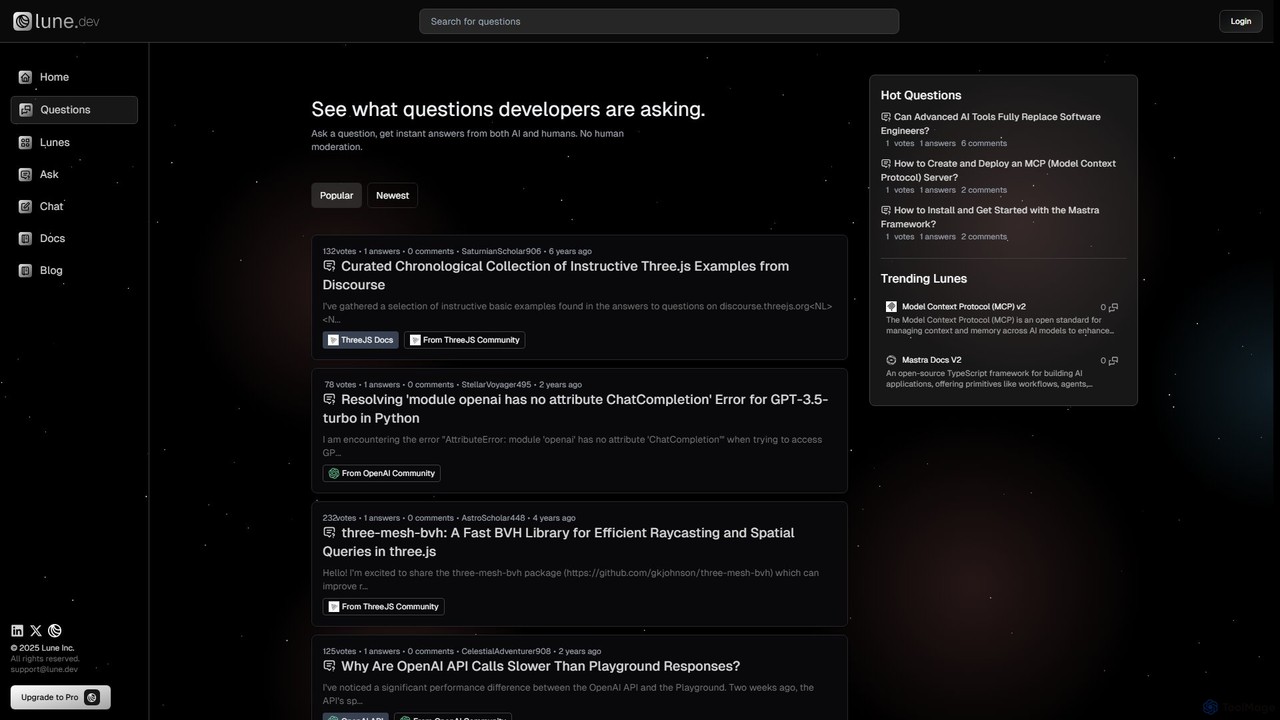
Lune is an AI-powered Q&A platform for developers, providing instant, accurate answers to technical questions. It leverages custom knowledge bases called "Lunes" and the Model Context Protocol (MCP) to ground AI responses in specific documentation, code repositories, and community discussions, ensuring high relevance and reliability.

Specialized Assistant
Visits 10.9KFavorites 173Likes 158

About Q&A

AI Q&A tools are intelligent systems designed to provide direct, accurate, and context-aware answers to user queries. Leveraging advanced Natural Language Processing (NLP) and often Retrieval Augmented Generation (RAG), these tools interpret complex questions and synthesize information from vast knowledge bases or real-time data. They significantly enhance information retrieval, automate support functions, and streamline access to critical knowledge, making information instantly accessible and personalized.

Core Features

  • Natural Language Understanding (NLU): Accurately interprets user intent and complex phrasing in questions.
  • Knowledge Base Integration: Connects to and synthesizes information from diverse data sources like documents, databases, and web content.
  • Contextual Awareness: Maintains conversational context to provide relevant follow-up answers and refine responses.
  • Response Generation: Formulates coherent, concise, and human-like answers based on retrieved information.
  • Multi-source Information Retrieval: Gathers and cross-references data from various internal and external sources for comprehensive answers.

Use Cases

These tools are invaluable across various sectors for automating information access. They are widely adopted in customer service for instant query resolution, in corporate environments for efficient internal knowledge management, and in educational settings to provide on-demand learning support. Their ability to quickly process and present relevant information makes them essential for improving productivity and decision-making.

How to Choose

When selecting an AI Q&A tool, prioritize accuracy and relevance of answers, which often depends on the quality of its underlying knowledge base and NLP capabilities. Consider its integration potential with existing systems, scalability to handle growing query volumes, and customization options for specific industry needs. Evaluate data security protocols and the ease of updating or expanding its knowledge sources to ensure long-term effectiveness.

Q&A use cases

1

Automate Customer Service Inquiries

Customer support teams utilize AI Q&A tools to instantly answer frequently asked questions (FAQs) and common customer queries. By integrating with helpdesk systems, these tools reduce response times, free up human agents for complex issues, and provide consistent, accurate information 24/7, significantly improving customer satisfaction and operational efficiency.

2

Enhance Internal Knowledge Management

Employees in large organizations use Q&A tools to quickly find specific information within vast internal documentation, policies, and training materials. Instead of sifting through countless documents, they can ask natural language questions and receive immediate, precise answers, boosting productivity and ensuring compliance with company guidelines.

3

Facilitate On-Demand Learning & Tutoring

Students and lifelong learners leverage AI Q&A platforms to get instant explanations for complex academic concepts, clarify doubts, or find specific facts from textbooks and educational resources. This provides personalized, accessible learning support outside traditional classroom hours, enhancing comprehension and study efficiency.

4

Streamline Research & Data Extraction

Researchers and analysts employ Q&A tools to rapidly extract specific data points, summaries, or insights from large volumes of scientific papers, reports, or market research documents. This accelerates the literature review process, helps identify key trends, and supports data-driven decision-making by providing quick access to critical information.

5

Generate Product FAQs & Documentation

Product managers and marketing teams use AI Q&A tools to automatically generate comprehensive FAQ sections for new products or services. By feeding product specifications and user manuals into the system, the tool can anticipate potential user questions and formulate clear, concise answers, improving user onboarding and reducing support tickets.

6

Assist Content Creation & Fact-Checking

Content creators, journalists, and writers utilize Q&A tools to quickly gather facts, statistics, and background information for articles, blog posts, or scripts. These tools act as an instant research assistant, helping to verify information, explore related topics, and ensure the accuracy and depth of their content, saving significant research time.

Q&A FAQ

What are AI Q&A tools?

AI Q&A tools are artificial intelligence systems designed to understand and answer user questions in natural language. They process queries, retrieve relevant information from integrated knowledge bases or data sources, and then generate coherent, context-aware responses. These tools aim to provide instant, accurate information, often automating tasks traditionally handled by human experts or manual searches.

How do AI Q&A tools work?

AI Q&A tools typically work by combining Natural Language Processing (NLP) for understanding questions and information retrieval techniques. When a user asks a question, the tool uses NLU to parse the intent and entities. It then searches its connected knowledge bases (documents, databases, web) for relevant passages. Finally, using Natural Language Generation (NLG) or RAG, it synthesizes these passages into a direct and understandable answer, often maintaining conversational context.

What are the benefits of using AI Q&A tools?

The primary benefits of AI Q&A tools include instant access to information, significant time savings for users and support staff, and improved consistency in answers. They enhance productivity by automating routine inquiries, reduce operational costs, and can operate 24/7. For users, they offer a personalized and efficient way to get precise answers without sifting through vast amounts of data.

How do AI Q&A tools differ from traditional search engines?

While both retrieve information, AI Q&A tools aim to provide direct, synthesized answers to specific questions, often from a curated knowledge base. Traditional search engines, conversely, return a list of web pages or documents that *might* contain the answer, requiring the user to sift through results. Q&A tools focus on understanding intent and generating a definitive response, rather than just indexing and linking.

What should I consider when choosing an AI Q&A tool?

When selecting an AI Q&A tool, consider its accuracy in understanding complex questions and providing relevant answers, its ability to integrate with your existing data sources and systems, and its scalability to handle future growth. Evaluate the ease of training and customization, supported languages, data security features, and the overall user experience. Also, assess the vendor's support and the tool's cost-effectiveness.