
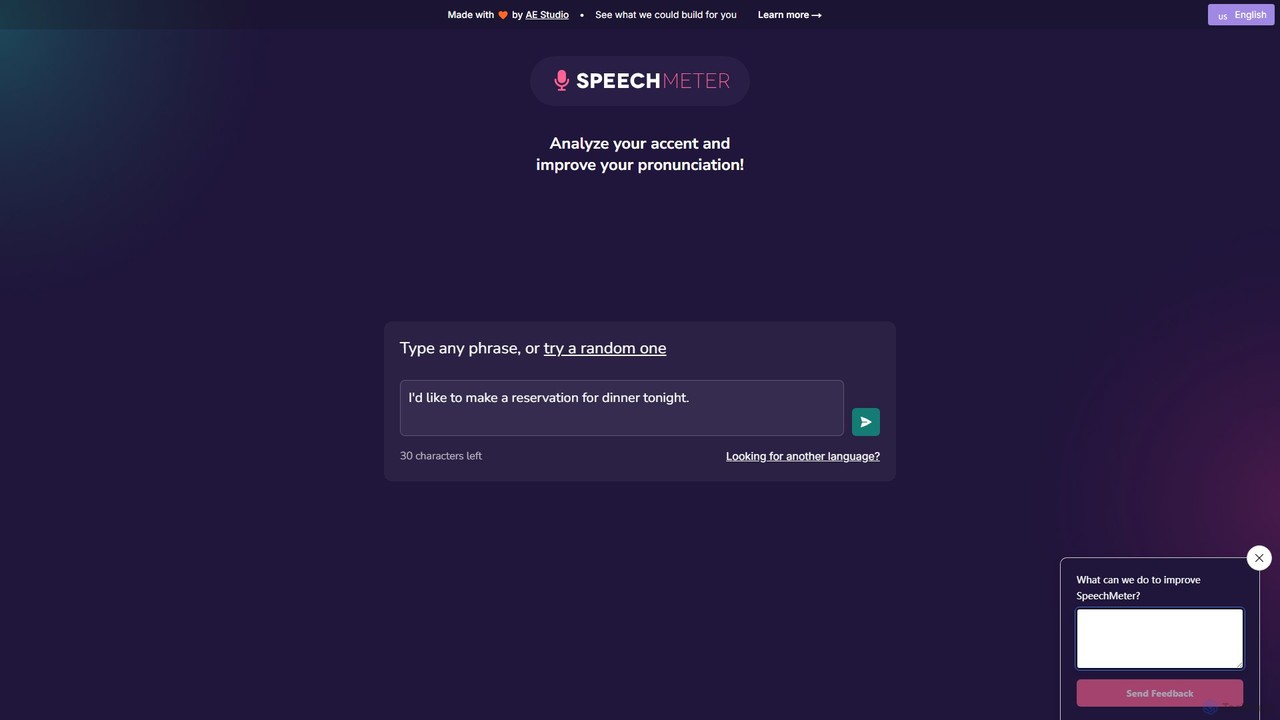
Speech Meter
Speech Meter is an AI-powered tool designed to help you analyze and improve your pronunciation and accent. By …
Speech Meter is an AI-powered tool designed to help you analyze and improve your pronunciation and accent. By recording your voice and comparing it to a standard model, it provides instant, objective feedback. Ideal for language learners, professionals, and anyone looking to enhance their speaking clarity, this free web-based tool offers a simple way to practice and build confidence in your spoken communication skills.
About Speech Improvement
Speech Improvement tools are AI-powered applications designed to analyze and provide feedback on your speaking skills. They use machine learning to assess various aspects of your delivery, such as pacing, filler words, tone of voice, and clarity. These tools act as a virtual coach, helping you become a more confident and persuasive communicator in presentations, meetings, and interviews. By refining this crucial soft skill, they directly enhance professional productivity and effectiveness.
Core Features
- Filler Word Detection: Identifies and tracks the use of crutch words like 'um', 'ah', 'like', and 'you know' to help you sound more polished.
- Pace and Pause Analysis: Measures your speaking speed in words per minute and analyzes the length and frequency of pauses for better rhythm.
- Tone and Intonation Feedback: Evaluates vocal variety, energy, and confidence conveyed through your tone to improve engagement.
- Clarity and Pronunciation Scoring: Assesses how clearly you articulate words and offers feedback on pronunciation for greater intelligibility.
- Content Analysis: Reviews word choice, identifies repetitive phrases, and suggests more impactful language.
Use Cases
These tools are widely used by professionals across various fields. Sales teams use them to refine pitches, managers to prepare for board meetings, and job seekers to practice for interviews. They are also valuable for students, public speakers, and non-native speakers looking to improve their fluency and pronunciation in a new language.
How to Choose
When selecting a Speech Improvement tool, consider the depth of analysis required—do you need basic filler word counting or advanced tonal analysis? Evaluate the feedback mechanism: is it real-time coaching or a post-session report? Also, check for integrations with presentation or video conferencing software and ensure it supports the specific languages or accents you need.
Speech ImprovementUse Cases
Preparing for a High-Stakes Presentation
A corporate manager needs to deliver a critical quarterly review to senior leadership. They use a speech improvement tool to record practice sessions. The AI analyzes their speech for filler words, pacing, and vocal tone, highlighting sections where the delivery lacked confidence or was too rushed. Based on this objective data, the manager refines their delivery, practices modulating their tone for key points, and eliminates nervous habits. The result is a more polished, confident, and persuasive presentation that effectively communicates their message and impresses the audience.
Acing a Job Interview
A recent graduate is preparing for their first major job interview. They use a speech improvement tool to practice answering common interview questions. The AI provides real-time feedback on their clarity, conciseness, and use of weak language versus power words. It also flags when they speak too quickly due to nervousness. After several practice runs, the candidate learns to structure their answers more effectively, speaks at a calm and steady pace, and replaces filler words with thoughtful pauses. This preparation boosts their confidence, helping them make a strong first impression on the hiring manager.
Refining Sales Pitches for Higher Conversion
A sales team wants to improve the effectiveness of their product demo script. Each representative records their pitch using a speech improvement tool. The AI analyzes not just filler words but also the energy and confidence in their tone throughout the pitch. It identifies parts of the script where the delivery sounds monotonous or unconvincing. The sales manager uses these aggregated insights to identify common weaknesses and conduct targeted training. As a result, the team develops a more dynamic and engaging pitch, leading to better client engagement and higher conversion rates.
Improving Pronunciation for Non-Native Speakers
An international professional working in an English-speaking environment wants to improve their pronunciation and reduce their accent for clearer communication. They use a speech improvement tool specifically designed for language learning. The user reads passages or repeats phrases, and the AI provides detailed, phoneme-level feedback, highlighting specific sounds that differ from a native speaker's model. It visualizes tongue and lip placement for difficult sounds. Consistent practice with this targeted feedback helps the user significantly improve their articulation, leading to clearer communication in meetings and greater confidence in professional interactions.
Enhancing Communication in Online Meetings
A project manager leading a remote team notices that virtual meetings are often dominated by a few voices. They introduce a speech improvement tool that integrates with their video conferencing platform. The tool provides real-time, private feedback to each participant on their speaking time, pace, and interruptions. It also offers post-meeting analytics for the team, showing speaking time distribution without revealing individual performance. This data-driven approach encourages more balanced participation, helps team members become more self-aware of their communication habits, and leads to more inclusive and productive online discussions.
Coaching for Public Speaking and Debates
A student preparing for a debate competition uses a speech improvement tool to rehearse their arguments. The tool's AI goes beyond simple delivery metrics and analyzes the persuasive structure of their speech. It provides feedback on the strength of their opening statement, the clarity of their key points, and the impact of their conclusion. It also times their speech to ensure it fits within the competition's limits. By using the tool as a practice partner, the student can identify logical fallacies in their arguments and weak points in their delivery, allowing them to build a more compelling and structurally sound case.