ToolMage
Sign in

Best 1 Speech Training AI tools for Productivity

Popular Speech Training AI tools in Productivity include AiRepeater, helping you work more efficiently.

AiRepeater
Freemium

AiRepeater

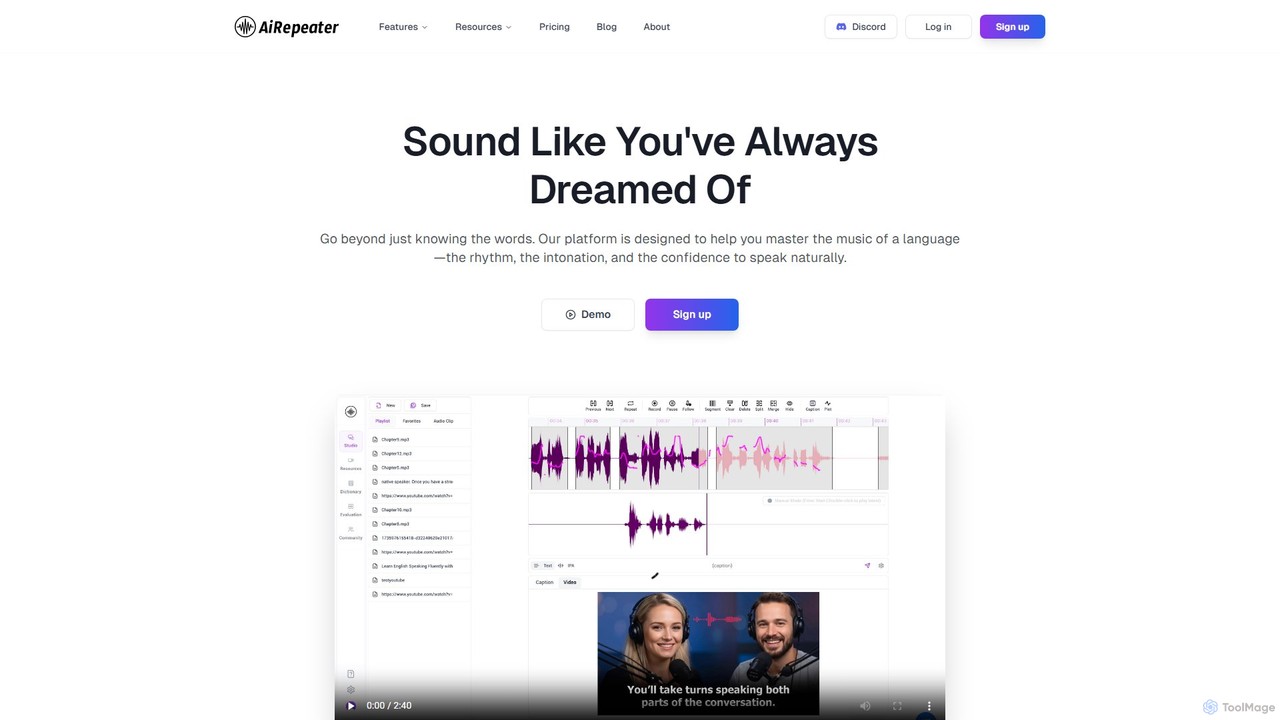
AiRepeater is an AI-powered language learning platform designed to perfect your pronunciation, accent, and fluency. It uses shadowing, repetition, and advanced speech analysis to help you master the rhythm and intonation of a new language. Import any audio/video content and transform it into a personalized practice session with instant, detailed feedback.

Pronunciation
Visits 5KFavorites 143Likes 126

About Speech Training

Speech Training tools are AI-powered applications designed to help users enhance their verbal communication skills. These tools leverage advanced speech recognition and AI algorithms to analyze spoken language, providing real-time feedback on pronunciation, intonation, fluency, and pacing. They serve as virtual coaches, enabling individuals to practice and refine their speaking abilities for various personal and professional contexts.

Core Features

  • Pronunciation Analysis: Identifies and corrects specific phonetic errors, helping users articulate words more clearly.
  • Fluency & Pacing Feedback: Monitors speech speed, detects filler words, and suggests optimal rhythm for smoother delivery.
  • Intonation & Pitch Correction: Guides users on vocal tone, inflection, and pitch variation to convey meaning and emotion effectively.
  • Speech Recognition & Transcription: Converts spoken words into text, allowing users to review their exact utterances and identify areas for improvement.
  • Practice Scenarios: Offers simulated environments for practicing public speeches, job interviews, or conversational skills with AI prompts.

Applicable Scenarios

Professionals preparing for high-stakes presentations, language learners aiming for native-like accents, and individuals seeking to overcome speech anxiety all benefit from these tools. They are invaluable for anyone looking to systematically improve their vocal delivery and confidence in speaking.

How to Choose

When selecting a Speech Training AI tool, consider the granularity of feedback it provides (e.g., word-level vs. phoneme-level), the variety of practice modes available (e.g., public speaking, interview prep, casual conversation), and its language support for specific accents or dialects. Also, evaluate its user interface for ease of use and accessibility across different devices.

Featured tool rankings

Speech Training use cases

1

Public Speaking Confidence Building

Individuals preparing for high-stakes presentations, conferences, or public addresses can leverage AI speech training tools to simulate real-world speaking scenarios. Users practice their speeches, receiving instant, objective feedback on their pacing, volume, intonation, and detection of filler words like "um" or "ah." This iterative practice helps refine delivery, reduce anxiety, and build significant confidence before the actual event, ensuring a more impactful and professional presentation.

2

Language Pronunciation Improvement

Non-native speakers aiming to achieve greater clarity and reduce their accent in a new language find these tools invaluable. By speaking phrases or sentences into the AI trainer, users receive precise feedback on individual phonemes, word stress, and sentence rhythm. This targeted correction helps them identify and rectify specific pronunciation errors that might be difficult to detect on their own, leading to more natural and effective communication in their target language.

3

Job Interview Rehearsal

Job seekers can significantly enhance their interview performance by practicing with AI speech training tools. These platforms offer simulated interview environments where users can rehearse answers to common questions. The AI analyzes their verbal responses for clarity, confidence, articulation, and even detects hesitation or rambling. This objective feedback allows candidates to refine their delivery, ensuring they present themselves professionally and articulately, making a stronger and more memorable impression on potential employers.

4

Sales Pitch Optimization

Sales professionals can utilize AI speech training to perfect their sales pitches and improve client engagement. By practicing their pitch with the AI, they receive feedback on elements like persuasive tone, clarity of message, and the effectiveness of their vocal delivery. The tool can help identify areas where the pitch might sound monotonous or unclear, enabling sales teams to refine their communication style for maximum impact, ultimately leading to higher conversion rates and stronger client relationships.

5

Voice Acting & Narration Skill Development

Aspiring voice artists, podcasters, or narrators can use these AI tools to develop and refine their vocal performance skills. The AI provides detailed analysis on intonation, emotional expression, vocal range, and consistency, crucial for delivering diverse character voices or compelling narratives. Users can practice different vocal styles and receive objective feedback, helping them to master vocal control and enhance their ability to convey specific emotions and nuances through their speech.

6

Speech Therapy Support & Articulation Practice

Individuals undergoing speech therapy or seeking to improve articulation can use AI speech training as a valuable supplementary resource. These tools offer structured exercises for practicing specific sounds, words, or sentence structures. The AI provides objective, real-time feedback on articulation accuracy, helping users to consistently practice and reinforce correct speech patterns. This support complements traditional therapy, allowing for more frequent and targeted practice outside of clinical sessions, aiding in faster progress.

Speech Training FAQ

What are AI Speech Training tools?

AI Speech Training tools are software applications that use artificial intelligence to help individuals improve their verbal communication skills. They analyze aspects like pronunciation, fluency, intonation, and pacing, providing users with objective, real-time feedback. These tools are designed to act as virtual coaches, assisting in refining speaking abilities for various personal, academic, and professional contexts.

How do AI Speech Training tools work?

These tools typically work by recording a user's speech and then processing it using advanced AI algorithms, including automatic speech recognition (ASR) and natural language processing (NLP). The AI compares the user's speech patterns against ideal models, identifying deviations in pronunciation, rhythm, and tone. It then generates instant, actionable feedback, often visually or audibly, to guide the user towards improvement.

Who can benefit most from Speech Training AI?

A wide range of individuals can benefit from Speech Training AI. This includes public speakers aiming to enhance their delivery, language learners seeking to perfect their accent and clarity, professionals preparing for important presentations or interviews, and even individuals looking to improve general conversational fluency. It's also a valuable supplementary resource for those working on articulation or recovering from speech impediments.

What features should I look for in a Speech Training AI tool?

When choosing a tool, prioritize features like detailed pronunciation analysis (e.g., phoneme-level feedback), comprehensive fluency metrics (pacing, pauses, filler words), and intonation guidance. Look for a variety of practice modes, such as public speaking simulations, interview prep, or conversational exercises. Multi-language support, customizable feedback settings, and a user-friendly interface are also crucial for an effective learning experience.

How does AI Speech Training differ from traditional speech coaching?

AI Speech Training offers instant, objective, and scalable feedback, allowing for frequent, self-paced practice anytime, anywhere. It excels at identifying technical aspects like pronunciation accuracy and pacing. Traditional human speech coaching, conversely, provides personalized, nuanced feedback, addresses emotional aspects of speaking, and can adapt to complex individual needs and non-verbal cues, offering a deeper, more holistic development experience. They can be complementary.