ToolMage
Sign in

Best 26 Startup Tools for Productivity

Popular Startup Tools in Productivity include Nack.ai, Typogram, Namify, Skala, ShipFast AI, femaleswitch, Buildpad, NameHassle, Woz, and Brandix, helping you work more efficiently.

Moonidea
Freemium

Moonidea

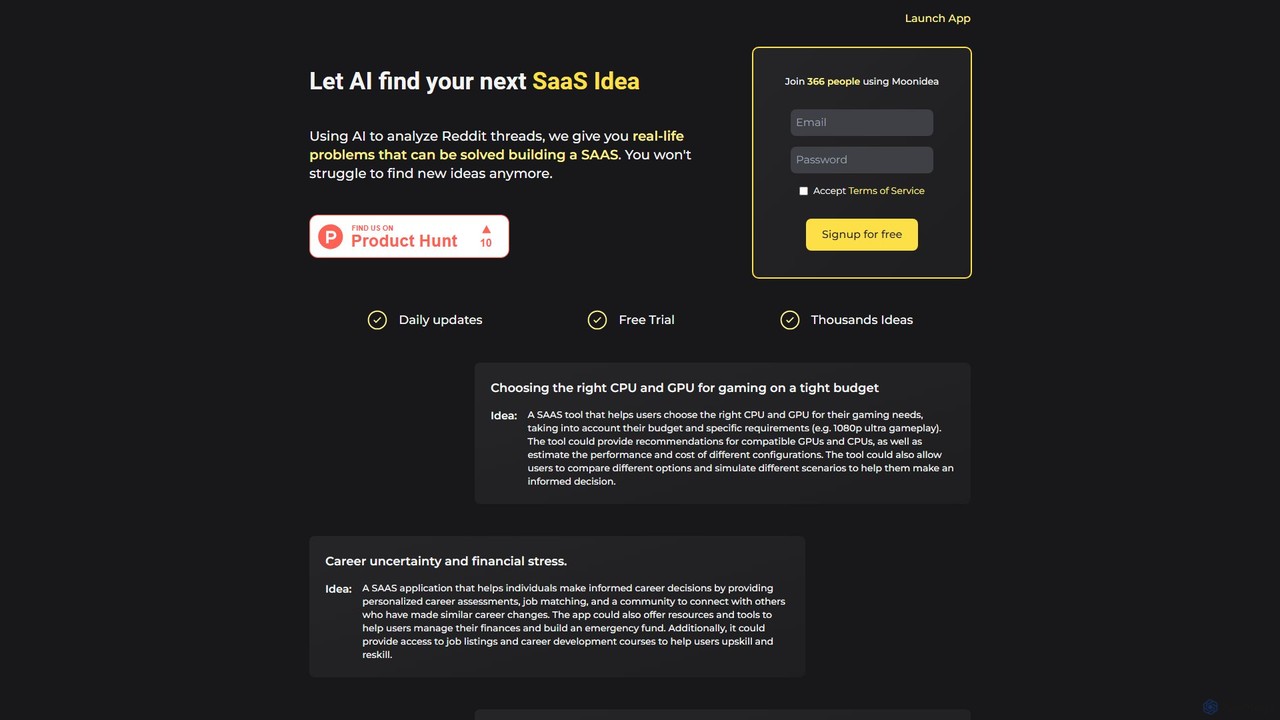
Moonidea is an AI-powered platform that generates validated SaaS business ideas by analyzing real-world problems discussed in Reddit threads. It helps entrepreneurs and developers discover their next venture by identifying and filtering user pain points that can be solved with a software solution.

Idea Generation
Visits 5.7KFavorites 131Likes 97
FikraHub
Paid

FikraHub

FikraHub is an AI-powered innovation and entrepreneurship ecosystem designed to transform ideas into impactful ventures. It provides a suite of tools for idea generation, business planning, and validation, catering to students, entrepreneurs, and large organizations. The platform fosters collaboration, offers expert mentorship, and supports the entire journey from concept to market-ready solution.

Idea Generation
Visits 5.9KFavorites 154Likes 171

About Startup Tools

Startup Tools are AI-powered platforms designed to streamline the complex journey of launching and scaling a new venture. These tools leverage artificial intelligence to automate critical processes, from market research and product development to marketing and fundraising. They empower entrepreneurs and small teams to operate efficiently, make data-driven decisions, and accelerate growth with limited resources.

Core Features

  • Market Intelligence & Validation: AI-driven analysis of market trends, competitor landscapes, and customer feedback to validate business ideas.
  • MVP Development & Prototyping: Low-code/no-code AI tools for rapidly building and testing minimum viable products and interactive prototypes.
  • Automated Marketing & Growth Hacking: AI-powered content generation, social media scheduling, email campaign optimization, and lead generation to acquire early users.
  • Fundraising & Investor Relations: Tools for creating compelling pitch decks, managing cap tables, and tracking investor communications.
  • Lean Operations & Team Collaboration: AI assistants for project management, task automation, and communication within small, agile teams.

Applicable Scenarios

Early-stage startups use these tools to validate their business models and identify target markets before significant investment. Founders leverage AI for rapid MVP development and iterative product testing. Growth teams utilize automated marketing features to acquire and retain initial customers efficiently.

How to Choose

When selecting startup tools, prioritize scalability to accommodate future growth, integration capabilities with existing platforms, and cost-effectiveness suitable for lean budgets. Evaluate the specific features for your current stage (e.g., idea validation, fundraising, or user acquisition) and ensure ease of use for non-technical founders.

Featured tool rankings

Startup Tools use cases

1

AI-Powered Market Research for Idea Validation

An aspiring entrepreneur uses AI startup tools to analyze market trends, conduct sentiment analysis on social media, and identify unmet customer needs. By inputting their business concept, the tool generates comprehensive reports on potential market size, competitor analysis, and target audience demographics, significantly reducing the risk of launching an unviable product and saving months of manual research.

2

Accelerating Minimum Viable Product (MVP) Creation

A tech startup team utilizes no-code/low-code AI platforms to quickly build and deploy a functional MVP without extensive coding. They can drag-and-drop components, integrate AI features like chatbots or recommendation engines, and gather user feedback in real-time. This allows for rapid iteration and validation of core product features within weeks, rather than months, accelerating time-to-market.

3

AI-Driven Lead Generation and Early User Acquisition

A new SaaS startup employs AI marketing tools to identify potential early adopters, personalize outreach emails, and automate social media posting. The AI analyzes user behavior and engagement patterns to optimize campaign timing and content, resulting in a higher conversion rate for sign-ups and trials. This enables the startup to build its initial user base efficiently without a large marketing team.

4

Crafting Compelling Pitch Decks with AI Assistance

A founder preparing for a seed funding round uses AI-powered presentation tools to generate a professional and data-rich pitch deck. The tool can suggest relevant market data, refine messaging for clarity and impact, and even design visually appealing slides based on input. This saves significant time and ensures the pitch effectively communicates the startup's vision and potential to investors.

5

AI-Enhanced Financial Tracking and Expense Management

A small startup team leverages AI accounting tools to automate expense categorization, reconcile bank statements, and generate financial reports. The AI learns from past transactions, reducing manual data entry errors and providing real-time insights into cash flow and burn rate. This allows founders to maintain accurate financial records and make informed decisions about spending without needing a dedicated finance department.

6

AI-Assisted Project Management for Agile Teams

A distributed startup team uses AI-integrated project management software to automate task assignments, track progress, and identify potential bottlenecks. The AI can analyze team workload, suggest optimal task distributions, and provide predictive insights into project timelines. This enhances team productivity, ensures projects stay on track, and facilitates seamless communication across different time zones.

Startup Tools FAQ

What are Startup Tools?

Startup Tools are specialized AI-powered applications designed to support new businesses through their various growth stages. They leverage artificial intelligence to automate and optimize tasks ranging from market research and product development to marketing, sales, and financial management. These tools are crucial for early-stage companies to maximize efficiency, minimize costs, and scale rapidly with limited resources, helping founders make data-driven decisions and navigate the complexities of entrepreneurship.

How do Startup Tools differ from general Productivity Tools?

While both aim to enhance efficiency, Startup Tools are specifically tailored to the unique challenges and rapid growth cycles of new ventures. General productivity tools offer broad functionalities for various users, whereas startup tools often integrate features for market validation, MVP creation, growth hacking, fundraising, and lean operational management. They prioritize scalability, cost-effectiveness for small teams, and quick iteration, addressing the specific needs of founders and early-stage teams in a way general tools do not.

What are the key benefits of using AI in Startup Tools?

AI integration in Startup Tools offers several key benefits. It enables automation of repetitive tasks, freeing up valuable time for founders to focus on strategic initiatives. AI provides data-driven insights for market analysis, customer behavior prediction, and personalized marketing, leading to more effective decision-making. Furthermore, AI-powered tools can accelerate product development through intelligent prototyping and enhance operational efficiency by optimizing workflows, all contributing to faster growth and better resource allocation for startups.

What types of startups can benefit most from AI Startup Tools?

AI Startup Tools are highly beneficial for a wide range of new ventures, particularly those in tech, SaaS, e-commerce, and any industry requiring rapid innovation and data-driven growth. They are ideal for lean startups with limited budgets and small teams looking to maximize their impact. Whether you're validating an initial idea, building an MVP, seeking seed funding, or scaling your early user base, these tools provide essential support to navigate the competitive startup landscape efficiently.

How to choose the right AI Startup Tools for my business?

To select the right AI Startup Tools, first assess your current stage and specific needs (e.g., idea validation, fundraising, marketing, operations). Look for tools that offer scalability to grow with your business, seamless integration with your existing tech stack, and a pricing model that fits your budget. Prioritize user-friendliness, strong customer support, and features that directly address your most pressing challenges, ensuring they provide tangible value and accelerate your startup's progress.