ToolMage
Sign in

Best 1 Summarizing AI tools for Productivity

Popular Summarizing AI tools in Productivity include Summarizer, helping you work more efficiently.

Summarizer
Freemium

Summarizer

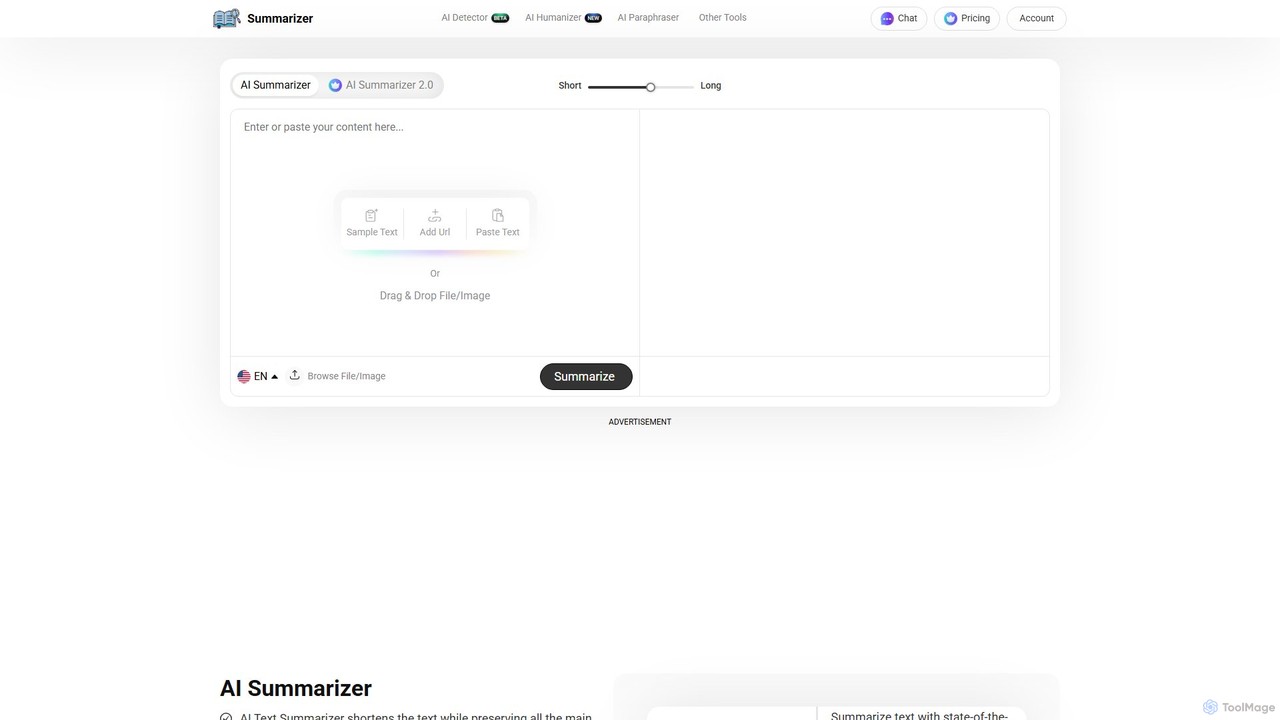
Summarizer is an AI-powered tool that condenses long texts, articles, and documents into concise, easy-to-digest summaries. It supports multiple languages, allows users to adjust summary length, and can process content directly from URLs. Ideal for students, researchers, and professionals looking to save time and increase productivity.

Research
Visits 495.2KFavorites 168Likes 178

About Summarizing

AI Summarizing tools are applications that use natural language processing (NLP) to condense long texts into short, coherent summaries. They analyze documents, articles, or conversations to identify key points and main ideas, presenting them in a concise format. This technology significantly accelerates information processing, allowing users to grasp the essence of extensive content without reading it in its entirety. As a key component of the Productivity suite, these tools directly enhance efficiency by saving valuable reading time and improving comprehension.

Core Features

  • Extractive & Abstractive Methods: Offers options to either pull key sentences directly from the source or generate new, human-like summary sentences.
  • Customizable Summary Length: Allows users to specify the desired length of the summary, from a single paragraph to a list of bullet points.
  • Multi-Format Support: Processes various input types, including text documents, web page URLs, PDFs, and sometimes audio or video transcripts.
  • Key Phrase Identification: Highlights important keywords and concepts within the original text to provide context for the summary.
  • Language Versatility: Supports summarization across multiple languages, breaking down language barriers in research and communication.

Use Cases

These tools are invaluable for students, researchers, journalists, and business analysts who regularly deal with large volumes of information. They are used to quickly digest academic papers, market research reports, legal documents, and news articles. In a corporate setting, they help summarize meeting minutes, customer feedback, and internal communications, enabling faster decision-making.

How to Choose

When selecting a summarizing tool, consider the accuracy and coherence of the generated summaries. Evaluate the range of supported input formats (PDF, URL, text) and languages. For professional use, check for integration capabilities with browsers or other productivity apps like Notion or Slack. Finally, review the tool's data privacy policy, especially if you plan to summarize sensitive or confidential information.

Summarizing use cases

1

Accelerate Academic Research

Researchers and students often face dozens of dense academic papers. An AI summarizing tool can process a 30-page PDF and generate a concise abstract or a list of key findings in seconds. This allows them to quickly assess a paper's relevance to their work before committing to a full read. By summarizing multiple sources, they can rapidly build a literature review, identify research gaps, and synthesize information, cutting down research time significantly.

2

Streamline Business Intelligence Reporting

Business analysts and executives need to stay informed about market trends, competitor activities, and industry news. Instead of manually reading lengthy reports, they can use an AI summarizer to get daily briefings. The tool can process financial reports, market analyses, and news articles, delivering key insights and data points directly. This enables quicker, more informed strategic decisions without the information overload.

3

Generate Concise Meeting Minutes

After a long meeting, creating clear and actionable minutes can be tedious. By feeding a meeting transcript (from a tool like Otter.ai or Zoom) into a summarizer, project managers can instantly generate a summary of the key discussion points, decisions made, and action items assigned. This ensures all participants are aligned and saves administrative time, improving overall team productivity.

4

Enhance Content Curation and Creation

Content creators and social media managers need to consume vast amounts of information to find relevant topics. An AI summarizer helps them quickly scan news articles, blog posts, and research reports to identify interesting angles for their own content. They can use the summaries to draft social media posts, create newsletters, or outline new articles, ensuring their content is timely and well-informed.

5

Expedite Legal Document Review

Legal professionals frequently work with lengthy contracts, case law, and depositions. While not a substitute for expert legal analysis, an AI summarizer provides a first-pass overview to quickly grasp the core arguments, clauses, and facts of a document. This helps prioritize which documents require in-depth review, saving valuable billable hours and accelerating case preparation.

6

Optimize Personal Knowledge Management

Individuals dedicated to personal growth and learning often save articles, podcasts, and book notes. An AI summarizer can integrate with note-taking apps like Notion or Evernote to automatically create summaries of saved web pages or imported documents. This transforms a collection of links into a searchable, digestible knowledge base, making it easier to revisit and recall key information.

Summarizing FAQ

What are AI Summarizing tools?

AI Summarizing tools are applications that use artificial intelligence, specifically natural language processing (NLP), to automatically condense long-form text into shorter versions. They identify the most critical information and present it as a concise paragraph or bullet points. Unlike simple text highlighters, these tools can understand context and relationships between concepts to create coherent and accurate summaries, saving users significant time in reading and research.

How to choose the right AI Summarizing tool?

To choose the right tool, consider four key factors. First, evaluate the summary quality: is it accurate, coherent, and does it capture the main points? Second, check its versatility: does it support the file formats (PDF, DOCX, URL) and languages you need? Third, assess its integration capabilities: does it offer browser extensions or connect with apps you already use? Finally, review its privacy policy to ensure your data is handled securely, especially for confidential documents.

What is the difference between extractive and abstractive summarization?

Extractive summarization works by identifying and pulling the most important sentences or phrases directly from the original text and stitching them together. It's like using a highlighter. Abstractive summarization, a more advanced method, involves the AI understanding the source text and then generating new, unique sentences to express the core ideas in its own words, much like a human would. Abstractive summaries are often more fluent and concise, but extractive methods can be more factually precise to the source.

Can AI Summarizing tools handle content other than text?

Many advanced AI summarizing tools can process more than just plain text. They often handle various inputs by first converting them to text. For example, you can provide a link to a YouTube video, and the tool will first transcribe the audio into text before summarizing it. Similarly, some tools can process audio files like podcasts or meeting recordings. This capability makes them powerful for extracting key insights from multimedia content.

Who benefits most from using AI Summarizing tools?

A wide range of users benefit from these tools. Students and academics use them to speed up literature reviews. Business professionals, including analysts and managers, use them to quickly digest reports and stay informed. Journalists and content creators leverage them for research and content curation. Legal professionals use them for initial document review. Essentially, anyone who needs to process large amounts of textual information efficiently can find significant value in using an AI summarizer.