ToolMage
Sign in

Best 1 Text Transformation AI tools for Productivity

Popular Text Transformation AI tools in Productivity include Avoid, helping you work more efficiently.

Avoid
Freemium

Avoid

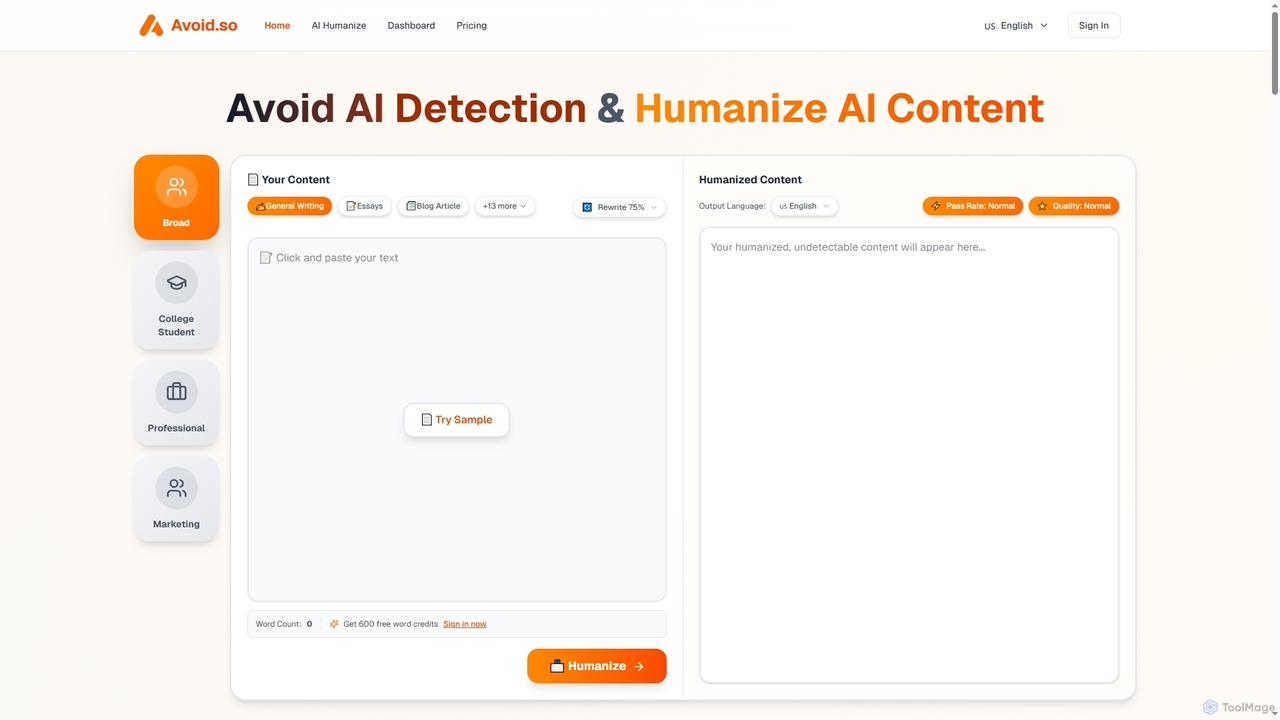
Avoid is an advanced AI humanizer tool that transforms AI-generated content into authentic, human-like writing, bypassing major AI detection systems with a 99.8% success rate. It helps users maintain originality and academic integrity across over 50 languages.

Academic Integrity
Visits 6.9KFavorites 140Likes 141

About Text Transformation

Text Transformation tools are AI-powered applications designed to modify, refine, and optimize existing text content. Leveraging advanced natural language processing (NLP) and machine learning, these tools can rephrase, summarize, expand, or adjust the tone and style of written material. They empower users to enhance clarity, improve readability, and adapt content for various purposes, significantly boosting productivity in writing and communication tasks.

Core Features

  • Content Summarization: Condenses lengthy documents, articles, or reports into concise summaries, highlighting key information.
  • Paraphrasing & Rewriting: Rephrases sentences or paragraphs to improve originality, clarity, or to avoid plagiarism, while maintaining the original meaning.
  • Tone & Style Adjustment: Modifies text to match a desired tone (e.g., formal, casual, persuasive) or writing style, suitable for different audiences.
  • Text Simplification: Rewrites complex or technical jargon into simpler, more accessible language for broader understanding.
  • Content Expansion: Develops brief notes, bullet points, or outlines into more detailed and comprehensive paragraphs or sections.

Applicable Scenarios

These tools are invaluable for content creators, marketers, students, and business professionals. They are used in academic writing to rephrase sources, in marketing to adapt campaigns for different channels, and in corporate communications to ensure consistent messaging. From refining blog posts to simplifying technical manuals, Text Transformation tools streamline the editing process.

How to Choose

When selecting a Text Transformation tool, consider its accuracy in preserving meaning, the range of transformation options (summarization, paraphrasing, tone adjustment), and the quality of its output. Evaluate its integration capabilities with existing workflows, supported languages, and user interface. Look for tools that offer customization options and robust performance for your specific text processing needs.

Text Transformation use cases

1

Summarizing Research Papers for Quick Review

Academic researchers and students can input lengthy scientific articles or reports to generate concise summaries. This allows them to quickly grasp the main arguments and findings without reading the entire document, saving significant time during literature reviews and study preparation.

2

Rewriting Marketing Copy for Different Platforms

Marketing professionals can transform existing ad copy, product descriptions, or campaign messages to suit various platforms like X (formerly Twitter) (short and punchy), LinkedIn (professional), or Instagram (engaging and visual-focused captions). This ensures consistent brand messaging while optimizing for platform-specific engagement.

3

Simplifying Legal or Technical Documents for Lay Audiences

Legal professionals or technical writers can use these tools to convert complex legal contracts, terms of service, or technical manuals into plain language. This makes critical information accessible and understandable for clients, customers, or non-specialist employees, improving transparency and comprehension.

4

Adjusting Tone of Customer Service Responses

Customer support teams can refine pre-written responses or draft new ones to ensure a consistent, empathetic, or formal tone, depending on the customer's query and company guidelines. This helps maintain brand voice and improves customer satisfaction by delivering appropriate and professional communication.

5

Expanding Bullet Points into Detailed Reports

Business analysts or project managers can take meeting notes, strategic outlines, or presentation bullet points and automatically expand them into comprehensive paragraphs or sections. This accelerates the creation of detailed reports, proposals, or internal documentation, turning brief ideas into fully fleshed-out content.

6

Repurposing Blog Content into Social Media Posts

Content creators can transform long-form blog articles into multiple short, engaging social media updates. The tools can extract key sentences, rephrase them, or generate catchy headlines suitable for platforms like Facebook, X (formerly Twitter), or Instagram, maximizing content reach and engagement.

Text Transformation FAQ

What are AI Text Transformation tools?

AI Text Transformation tools are applications that use artificial intelligence, specifically natural language processing (NLP), to modify and refine existing written content. They can perform tasks such as summarizing, paraphrasing, expanding, simplifying, or adjusting the tone and style of text, helping users to enhance clarity, readability, and overall content quality.

How do AI Text Transformation tools work?

These tools typically work by employing advanced machine learning models, often based on deep learning architectures like transformers. They analyze the input text to understand its meaning, context, and structure. Then, based on the desired transformation (e.g., summarization, paraphrasing), the AI generates a new version of the text that adheres to the specified parameters while preserving the core message.

What's the difference between Text Transformation and Text Generation?

Text Transformation focuses on *modifying* existing text, taking an input document and altering its form, style, or length while retaining its original meaning. Examples include summarizing or rephrasing. Text Generation, on the other hand, involves *creating* entirely new text from scratch based on a prompt or specific parameters, such as writing an article from a few keywords or generating creative stories.

Who can benefit from using Text Transformation tools?

A wide range of users can benefit, including content creators, marketers, students, academics, business professionals, and customer service teams. Anyone who regularly works with written content and needs to refine, adapt, or condense text for different audiences or purposes will find these tools valuable for improving efficiency and output quality.

How do I choose the best Text Transformation tool for my needs?

To choose the best tool, consider the specific transformations you need (e.g., summarization, tone adjustment, simplification). Evaluate the tool's accuracy, the naturalness of its output, and its ability to maintain the original meaning. Also, look at its user interface, integration options with other software, pricing, and the range of languages it supports to ensure it aligns with your workflow and budget.