Project Aria
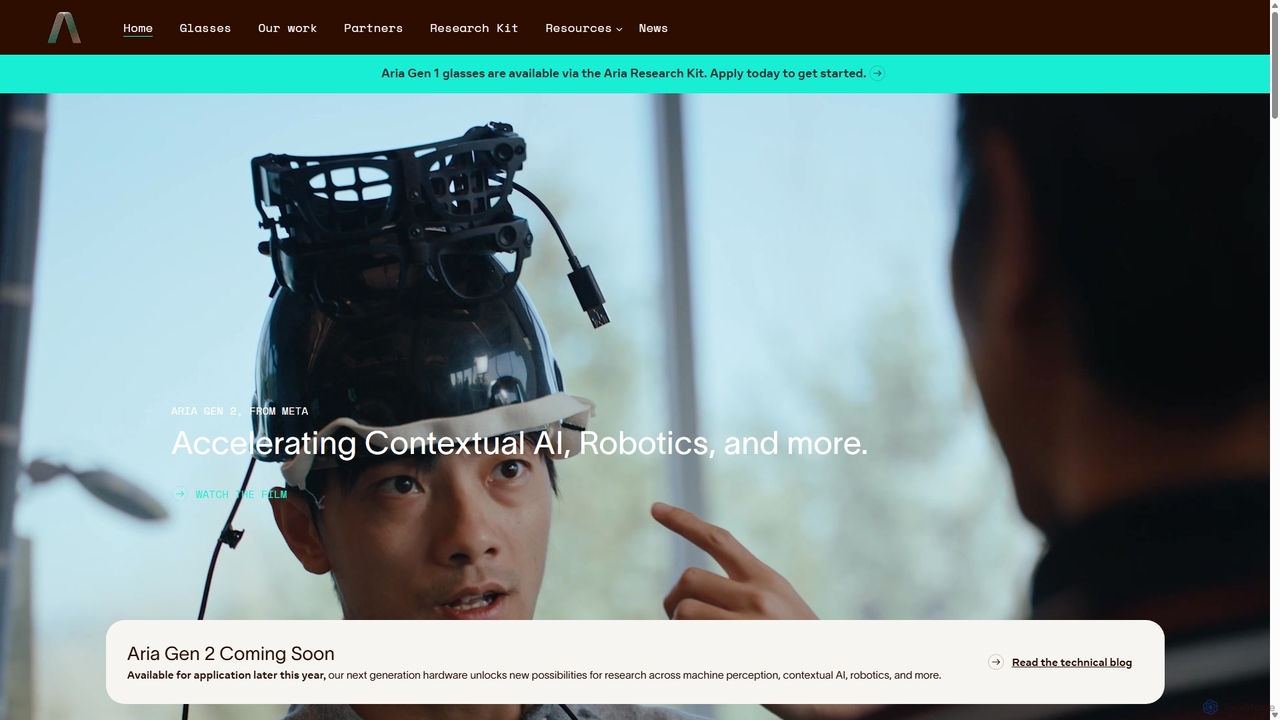
Project Aria is a research initiative by Meta designed to accelerate the development of contextual AI, augmented reality …
Project Aria is a research initiative by Meta designed to accelerate the development of contextual AI, augmented reality (AR), and robotics. It utilizes advanced research glasses, like the Aria Gen 2, to capture first-person perspective data, providing researchers with a comprehensive platform including hardware, open-source datasets, and development tools to build the future of machine perception.
VCAI
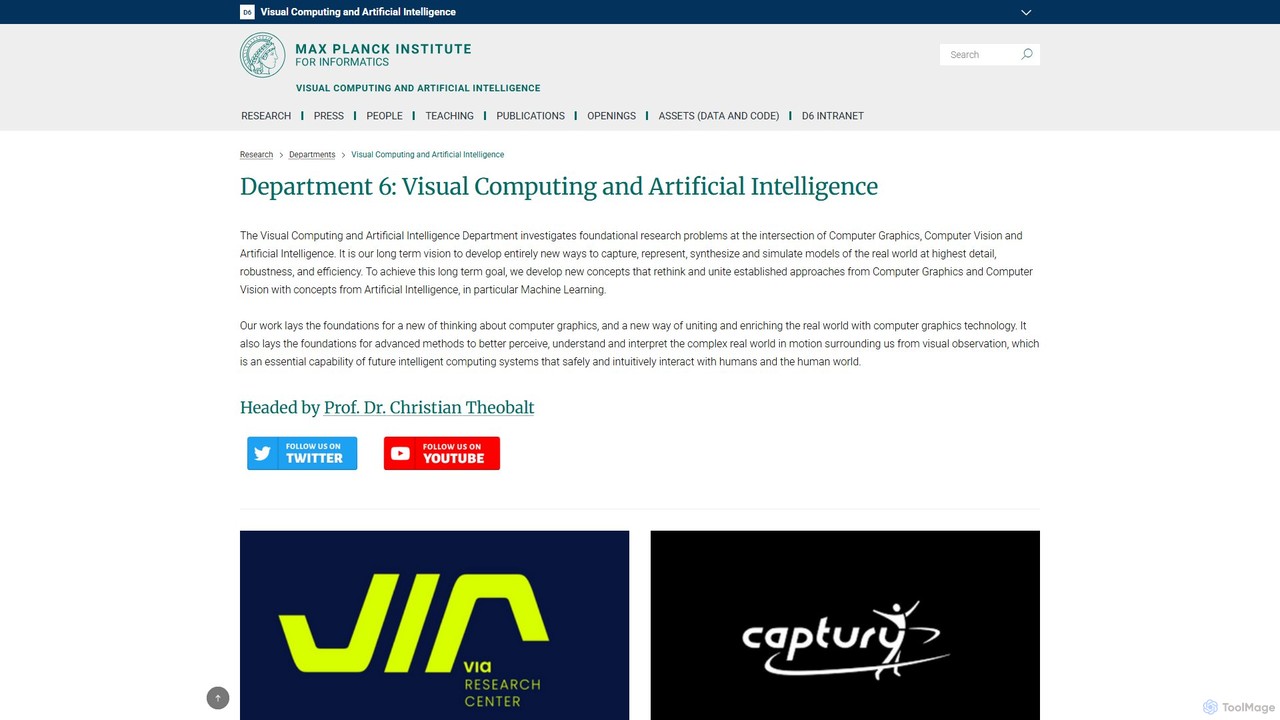
VCAI is the Visual Computing and Artificial Intelligence department at the Max Planck Institute for Informatics. Led by …
VCAI is the Visual Computing and Artificial Intelligence department at the Max Planck Institute for Informatics. Led by Prof. Christian Theobalt, it conducts foundational research at the intersection of computer vision, graphics, and AI. The lab is renowned for pioneering work in 3D reconstruction, neural rendering (like 3D Gaussian Splatting), digital humans, and motion capture. Its research drives innovation in VR/AR, film, and robotics, with many projects released as open-source code and leading to commercial spin-offs.
About Computer Vision
Computer Vision is a field of artificial intelligence that enables computers and systems to derive meaningful information from digital images, videos, and other visual inputs. It involves training machine learning models, often using deep learning, to interpret and understand the visual world. These tools are crucial for automating tasks that traditionally required human visual perception, driving innovation across various industries as a key area within AI research.
Core Features
- Object Detection: Identifies and locates specific objects within an image or video frame, drawing bounding boxes around them.
- Image Segmentation: Divides an image into multiple segments or regions, often pixel by pixel, to isolate objects or areas of interest.
- Facial Recognition: Identifies or verifies a person from a digital image or a video frame by comparing facial features.
- Optical Character Recognition (OCR): Extracts text from images, converting scanned documents or photos into editable and searchable data.
- Pose Estimation: Determines the position and orientation of a body or object in an image or video, often tracking key points.
Applicable Scenarios
Computer Vision tools are widely applied in sectors requiring automated visual analysis. For instance, in manufacturing, they perform automated quality control by detecting defects on production lines. In healthcare, they assist radiologists in analyzing medical images for anomalies. For autonomous vehicles, these systems are indispensable for real-time environment perception, enabling navigation and obstacle avoidance.
How to Choose
When selecting a Computer Vision tool, consider its accuracy and robustness in diverse conditions, especially regarding lighting and occlusion. Evaluate its real-time processing capabilities for applications like surveillance or autonomous systems. Assess the ease of integration with existing hardware and software, and check for model customizability options to adapt to specific datasets. Finally, review data privacy and security features, particularly for sensitive applications.
Computer VisionUse Cases
Automated Quality Inspection in Manufacturing
Manufacturing engineers deploy Computer Vision systems on production lines to automatically detect defects, anomalies, or incorrect assembly of products. By analyzing images or video feeds in real-time, the AI identifies flaws that human inspectors might miss, ensuring consistent product quality and significantly reducing waste. This leads to faster inspection cycles and higher throughput without compromising standards.
Enhancing Autonomous Vehicle Perception
Developers of autonomous vehicles utilize Computer Vision for real-time environmental understanding. These tools process camera feeds to identify other vehicles, pedestrians, traffic signs, lane markings, and potential obstacles. This critical visual data enables the vehicle's AI to make informed decisions for navigation, collision avoidance, and safe operation, forming the foundation of self-driving capabilities.
Assisting Medical Diagnosis with Image Analysis
Medical professionals, such as radiologists and pathologists, leverage Computer Vision tools to analyze complex medical images like X-rays, MRIs, CT scans, and microscopic slides. The AI can highlight subtle anomalies, tumors, or disease indicators that might be difficult for the human eye to detect, providing a second opinion and accelerating the diagnostic process. This enhances accuracy and supports early intervention.
Retail Analytics for Customer Behavior Insights
Retail store managers and marketing analysts use Computer Vision to gain insights into customer behavior and store operations. By analyzing video footage, these systems can track foot traffic patterns, monitor queue lengths, identify popular product displays, and even detect out-of-stock items. This data helps optimize store layouts, staffing levels, and merchandising strategies to improve the shopping experience and sales.
Security and Surveillance Anomaly Detection
Security personnel and facility managers employ Computer Vision for advanced surveillance and anomaly detection. These tools can automatically identify unusual activities, unauthorized access, or suspicious objects in real-time video feeds. Features like facial recognition for access control, crowd monitoring, and perimeter breach detection enhance security measures, allowing for quicker response to potential threats and reducing the need for constant human oversight.
Agricultural Crop Health Monitoring
Farmers and agricultural researchers utilize Computer Vision integrated with drones or ground-based sensors to monitor crop health across large fields. The AI analyzes images to detect early signs of plant diseases, pest infestations, or nutrient deficiencies. This enables precision agriculture practices, allowing targeted application of pesticides or fertilizers, optimizing resource use, and improving crop yields while minimizing environmental impact.